More stocks are rising even as KOSPI stalls, shifting the market's weight from large caps to individual names
- Input
- 2026-08-31 15:51:09
- Updated
- 2026-08-31 15:51:09
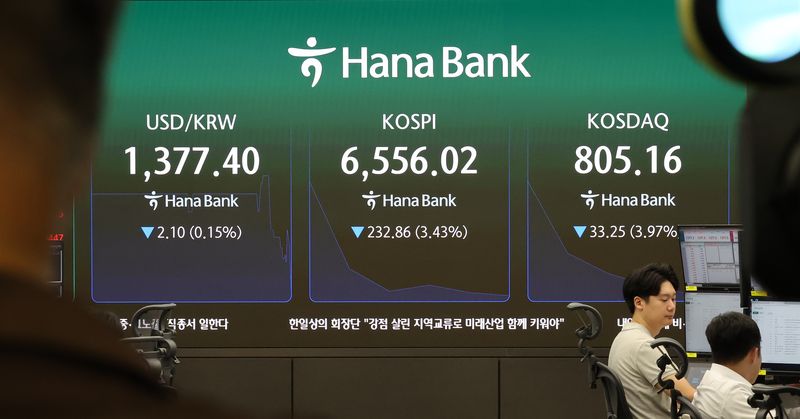
[Financial News] As KOSPI hesitated near the 7,000 level, the market's center of gravity has shifted from large-cap stocks to individual names. Even on days when heavyweight stocks such as Samsung Electronics and SK hynix dragged the index lower, more stocks advanced than declined, underscoring a clear rotation across sectors.
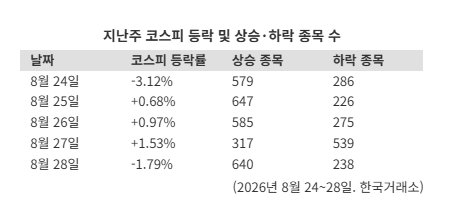
According to the Korea Exchange on the 31st, KOSPI closed at 6,788.88 on the 28th, down 1.79% from the previous session. But on the Korea Exchange Main Board, 640 stocks rose, 2.7 times the 238 that fell. Excluding unchanged stocks, more than seven out of 10 names that moved in price finished higher.
This trend stood out throughout last week. On four of the five trading days, the number of rising stocks exceeded the number of falling ones. Even on the 24th and the 28th, when KOSPI declined, more stocks gained than lost. On the 24th, KOSPI plunged 3.12%, yet 579 stocks rose on the Korea Exchange Main Board, more than double the 286 that fell.
Brokerages say buying is spreading into other sectors as a pause in large-cap semiconductor stocks, which carry heavy index weight, weighs on the market. With KOSPI entering a short-term trading range between 6,000 and 7,000, the correction in the two semiconductor giants and first-half market leaders is limiting further upside for the index.
Kim Jong-min, senior analyst at Samsung Securities, said, "There is no short-term momentum to drive a sharp move higher in the index." He added, "The index is likely to remain trapped in a certain range, while the battle for returns between sectors and individual stocks intensifies."
Differentiation by sector is also visible in fund flows. According to Shinyoung Securities, institutions were net sellers of semiconductors worth 3.7181 trillion won last week, while they bought IT appliances, machinery, construction and building materials, banks, and cosmetics and apparel. Foreign investors also sold 6.7183 trillion won worth of semiconductors, but were net buyers in IT hardware, retail, machinery, transportation, and shipbuilding.
Improving earnings outlooks for non-semiconductor sectors are also supporting the stock-specific rally. According to Hana Securities, sectors with upgraded operating profit forecasts for the third and fourth quarters include refining, shipping, shipbuilding, home appliances, electrical equipment, and machinery. Earnings estimates were also raised for major companies such as Samsung Electro-Mechanics, Samsung SDI, LG Electronics, HMM, SK Innovation, and HD Hyundai.
Noh Dong-gil, a researcher at Shinhan Investment & Securities, said, "We need to see a rising earnings revision ratio for non-semiconductor sectors." He added, "If the ratio improves not only in insurance and energy, but also in essential consumer goods and merchants and capital goods, the market could shift into a broader bull run." He also warned, "If the earnings of recently rallying machinery and IT hardware stocks fail to follow through, we should be cautious about the possibility that this is only a valuation rotation."
However, in September, external variables such as interest rates are expected to determine whether the stock-specific rally can continue. As earnings season winds down, market attention may shift to U.S. employment and inflation data, as well as the monetary policy of the Federal Reserve System (the Fed).
Lee Sang-yeon, a researcher at Shinyoung Securities, said, "It is necessary to distinguish not only the direction of long-term interest rates, but also whether the rise in rates stems from expectations for the policy rate or from term premiums and fiscal concerns."
[email protected] Choi Du-seon Reporter