Six Emerging Economies Use EVs to Break Through Carmaker Entry Barriers..."Racing to Build Their Own Brands"
- Input
- 2026-08-31 14:26:28
- Updated
- 2026-08-31 14:26:28
■ Batteries and electronics, not engines and transmissions, are becoming the key battleground
KATECH estimated that while internal combustion engine vehicles contain as many as 30,000 parts, EVs use only about 12,000. It said changes in cost structures and the rise of modularization have opened the door for latecomers. The report also pointed to growing concerns over energy security amid recent geopolitical instability as another reason countries are rushing to expand EV adoption.
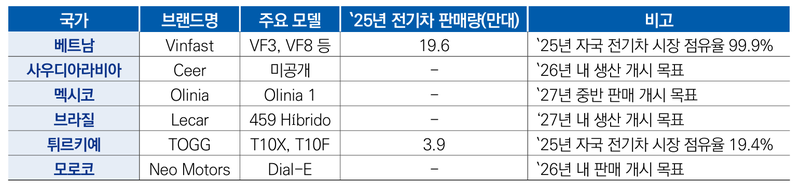
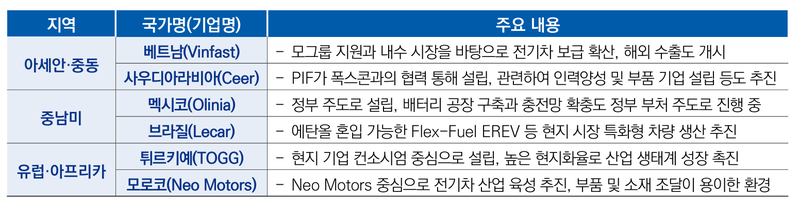
The report highlighted six countries as representative cases from ASEAN, the Middle East, Latin America, Europe and Africa. Vietnam's VinFast, backed by its parent company Vingroup and policies such as registration tax exemptions, saw sales rise to 175,000 units last year, nearly double from a year earlier, and now accounts for 99.9% of the domestic EV market. Saudi Arabia plans to begin production in the fourth quarter of this year through Ceer, a brand established by PIF in partnership with Foxconn, while also building an ecosystem that includes workforce training institutions and joint ventures for parts.
Mexico has launched Olinia under government leadership and is developing low-cost vehicles priced between 7.35 million won and 12.25 million won. Brazil's startup Lecar is preparing to produce extended-range EVs that can run on ethanol blends. Türkiye's Togg, founded by a local corporate consortium, raised its localization rate from 51% in 2023 to 75% last year and became the country's top-selling EV brand. In Morocco, Neo Motors' compact EV, the Dial-E, became the first African model to receive European approval.
These countries are also investing heavily in building out the broader industrial ecosystem, not just assembling cars. VinFast has secured 85% of Vietnam's EV charging market through an affiliated charging company, strengthening its market dominance by directing charging convenience mainly to its own vehicles. In Saudi Arabia, the SWF has established parts joint ventures and specialized investment firms one after another to support supply chain development from raw materials to finished vehicles. Türkiye's Togg has begun local mass production of battery packs and modules through a joint venture with a Chinese battery maker, while Morocco is also improving its access to battery materials by leveraging one of the world's largest phosphate reserves.
■ "Price competition and trade barriers will both intensify"
As of last year, the number of EVs per public charger stood at 12.0 in Türkiye, 23.5 in Brazil and 40.6 in Mexico, showing that charging infrastructure expansion is urgently needed. In response, the Mexican government plans to actively support production and logistics cost reductions by developing a common platform and building regional assembly hubs. Other emerging economies are also moving to build battery plants and expand charging networks in parallel at the government level.
At the same time, the report warned that if mass production of low-cost EVs in emerging economies takes off, price competition will intensify and trade barriers such as tariffs to protect domestic industries could also rise. Türkiye, in fact, has imposed an additional 30% tariff on vehicles from countries outside the European Union and FTA partners since September last year, bringing the total tariff rate to 40%.
Jung Jun-ha, a senior researcher at KATECH's Technology Policy Office who authored the report, said, "At the early stage of emerging economies entering new supply chains, domestic companies need to secure cooperative relationships in advance through joint development and joint ventures with local firms." He added that the rise of local EV brands in emerging economies represents not only a shift in competition but also the creation of new markets for customers and technology cooperation, meaning that securing partnerships at the early stage of supply chain formation will determine future market leadership.
[email protected] Kim Dong-chan Reporter