"The stock market is in this state, so borrowing to invest is out of the question"... Credit loans fall for the first time in four months
- Input
- 2026-09-01 05:00:00
- Updated
- 2026-09-01 05:00:00
[Financial News] As sharp swings in the stock market have cooled demand for debt-fueled investing, bank credit loans have turned downward. With interest rates rising and household loan growth still under tight control, credit loans are expected to remain flat or decline for the time being.
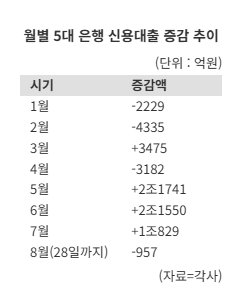
According to the financial sector on the 1st, the outstanding balance of credit loans at the five major commercial banks (KB Kookmin Bank, Shinhan Financial Group, Hana, Woori Bank and NH NongHyup) stood at 109.6575 trillion won as of the 28th, down 95.7 billion won from the end of the previous month.
Credit loans rose by 2.1741 trillion won in May, 2.155 trillion won in June and 1.0829 trillion won in July, posting increases of more than 1 trillion won for three straight months. The shift to a decline this month comes four months after a 318.2 billion won drop in April.
The slowdown in credit loan growth is seen as a result of weaker borrowing demand for stock investments amid continued uncertainty in the market.
The KOSPI, after hitting an all-time closing high of 9,114.55 on June 22, entered a full-fledged correction. It fell as low as 5,262.77 intraday on the 29th of last month. This month, it has repeatedly swung between the 6,000 and 7,000 levels. On the 18th, it rose to 7,216.62 intraday, but the next day it plunged 5.80 percent to 6,471.17 before rebounding 5.89 percent on the 20th. As the market direction has become unclear, demand for short-term borrowing to invest has also weakened, analysts said.
The Bank of Korea's two consecutive benchmark rate hikes are also adding to the burden on credit loan borrowers. As of last month, the upper end of credit loan rates at the five major banks had climbed into the high 5 percent range. The yield on one-year AAA-rated bank bonds, which serves as a benchmark for credit loan rates, also rose from around 3.4 percent in early June to 3.763 percent on the 28th.
A banking industry official said, "Stock market uncertainty, the burden of higher interest rates and the policy of managing household loan growth all led to a decline in credit loan balances." The official added, "Because credit loans respond quickly to market conditions and are highly sensitive to rate changes, it will be difficult to return to the sharp growth seen before for the time being."
Given these conditions, credit loans are likely to remain flat or continue to decline for now.
Although the financial authorities raised the target for managing household loan growth in the financial sector to 3 percent, banks are still managing lending within their set overall limits. The five major commercial banks are expected to have only about 300 billion won in additional household lending capacity in the second half of the year. From the banks' perspective, they have little room to be flexible with household loans other than group loans. As a result, some say real demand borrowers who are not eligible for group loans and need urgent funds for final payments or jeonse deposit refunds may fail to secure the money they need.
A banking industry official said, "Even if you consider the existing approved mortgage loans and the increased execution of group loans, banks do not have much room left in their household lending quotas."
[email protected] Ye Byeong-jeong Reporter