LG Uplus to Detect Risks at District Energy Facilities in Advance with AI and IoT
- Input
- 2026-08-31 14:22:03
- Updated
- 2026-08-31 14:22:03
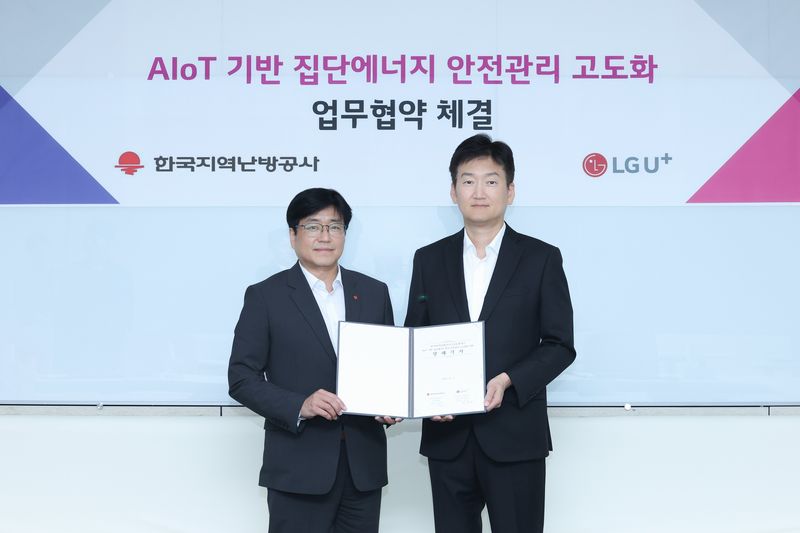
LG Uplus and KDHC announced on the 31st that they had signed a Memorandum of Understanding (MOU) at LG Uplus' Yongsan Building in Yongsan District, Seoul, to advance safety management in the district energy sector based on AIoT. The signing ceremony was attended by key officials from both companies, including Kwon Yong-hyun, head of LG Uplus' Enterprise Business Division, and Jung Nam-seong, head of KDHC's Construction Division.
District energy refers to an energy system that supplies heat and electricity produced at large-scale energy production facilities to apartment complexes, office buildings, commercial facilities and other sites. Because key equipment such as heat source facilities and heat pipelines operates in high-temperature environments above 100 degrees Celsius, and because heat pipelines are buried underground, subsidence or pipe corrosion can lead to major accidents.
The two companies plan to build a predictive maintenance system that combines LG Uplus' AI-based control platform and IoT technology with KDHC's operational experience in district energy facilities. The system will detect on-site risks in real time and predict and respond to potential accidents in advance.
Specifically, they will verify technologies for early sinkhole detection, stray current detection in heat pipelines, and strengthened physical security and monitoring for hazardous facilities such as power distribution rooms.
For sinkhole detection, the companies will use tilt-sensing technology in an underground geothermal remote sensing terminal they developed together. Sensors will measure changes in ground tilt and vibration in real time, and AI will analyze the data to identify sinkhole risks at an early stage.
Stray current, which can cause corrosion in heat pipelines, will be identified by analyzing current density and frequency in the pipes in real time to pinpoint risk areas. In power distribution rooms, AI-based physical security technology will be applied to manage access and entry to key equipment, with 24-hour monitoring planned.
Kwon said, "We will closely examine safety blind spots at district energy facilities and continue to advance our AIoT solutions to help strengthen the safety of energy infrastructure," adding, "We will also keep introducing customized solutions that combine AI and IoT so we can address pain points at various infrastructure sites."
[email protected] Yoon Hong-jip Reporter