MOF Sets Rules for Bringing Lithium Batteries on Passenger Ships, to Take Effect Next Year
- Input
- 2026-08-31 14:01:55
- Updated
- 2026-08-31 14:01:55
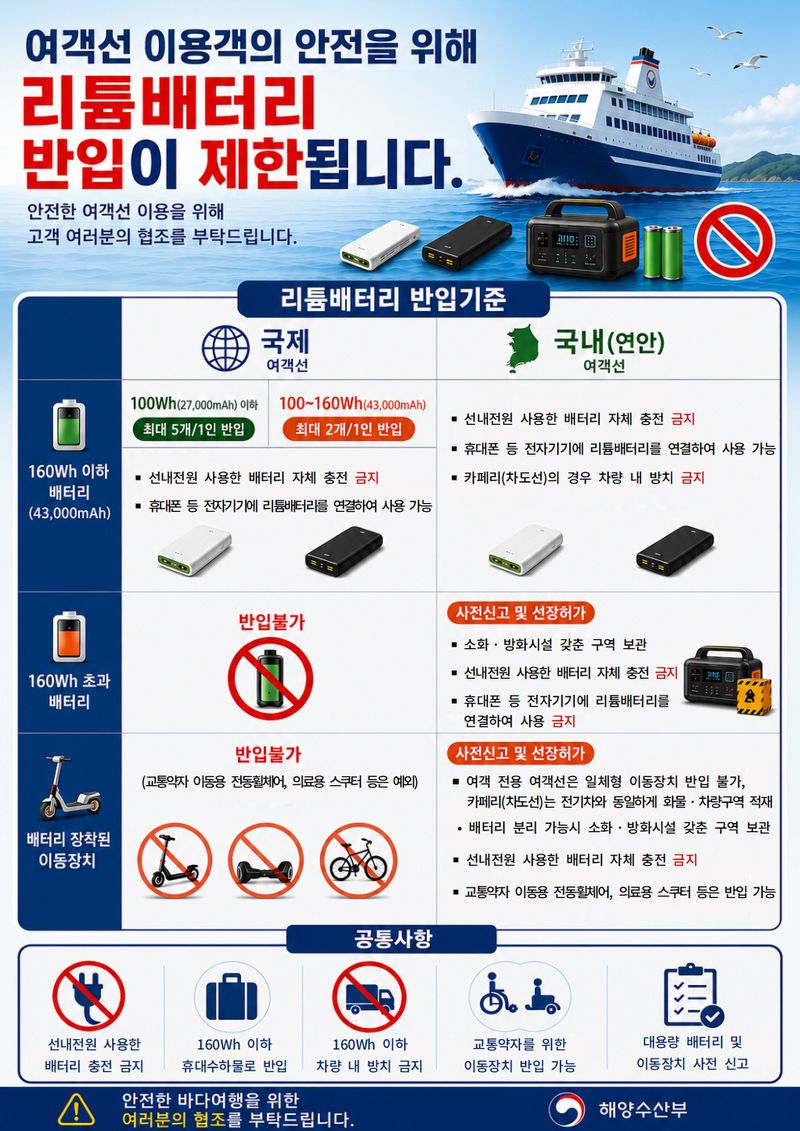
[Financial News] The Ministry of Oceans and Fisheries (MOF) has established new rules for bringing lithium batteries on passenger ships to prevent fire accidents, and will fully implement them next year after a public awareness and guidance period.
MOF said on the 31st that it will run a public awareness and guidance period from Sept. 1 through the end of December, then begin full enforcement next year of strengthened safety measures for carrying lithium batteries on passenger ships.
Because passenger ships operate at sea, a lithium battery thermal runaway can quickly lead to a fire and cause major casualties. However, no domestic or international standards had been in place for bringing lithium batteries used in portable chargers, large batteries such as power banks, or personal mobility devices such as electric bicycles onto passenger ships. In response, the Ministry of Oceans and Fisheries drew up detailed entry rules that reflect the operating conditions of international passenger ships and coastal passenger ships.
Under the new rules, large batteries and personal mobility devices exceeding 160Wh are completely banned on international passenger ships. On coastal passenger ships, batteries and mobility devices above the same threshold may be brought on board only with the captain's prior approval, and they must be stored in a separate area equipped with fire suppression facilities.
Small batteries of 160Wh or less may be carried on board if separate safety guidelines are followed. However, charging batteries using the ship's power supply is prohibited under any circumstances to prevent fires caused by overcharging. Mobility equipment for passengers with reduced mobility, such as electric wheelchairs and medical scooters, will be allowed on board regardless of these restrictions.
To minimize initial confusion when the new rules take effect, the Ministry of Oceans and Fisheries plans to work with the Korea Maritime Transportation Safety Authority (KOMSA), the Korean Shipping Association (KSA), and passenger ship operators to inform travelers of the changes through onboard videos, notices at terminals, and text alerts.
Jeong Do-hyeon, director of maritime safety at the Ministry of Oceans and Fisheries, said, "Lithium battery fires on passenger ships can lead to major casualties, so strict entry controls and thorough safety management are necessary." He added, "We hope passengers will understand that there may be some inconvenience and cooperate so these measures can take root smoothly in the field and help ensure safe maritime transportation."
[email protected] Reporter Lee Yu-beom Reporter