Jeju's peak power demand stays above 1,000 MW for 12th straight day as late-summer demand remains high after August record
- Input
- 2026-08-31 14:01:16
- Updated
- 2026-08-31 14:01:16
[Financial News, Jeju = Reporter Jung Yong-bok] Jeju Province's peak power demand has remained above 1,000 MW for 12 consecutive days, showing that high electricity demand is continuing into late summer. After setting a new record in early August, demand has shown little sign of easing even in the latter part of the month.
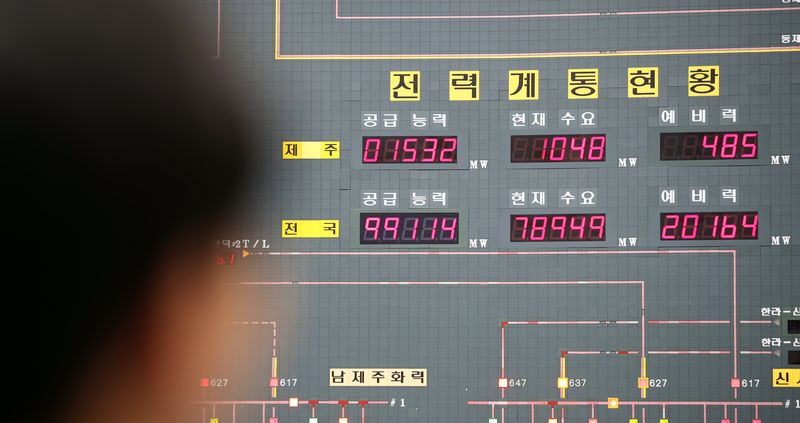
According to the Korea Power Exchange on the 31st, Jeju's peak power demand on the 30th reached 1,041.82 MW at 8 p.m. That was 38.59 MW, or 3.85%, higher than 1,003.23 MW on the same day last year.
Supply capacity stood at 1,620.95 MW, while reserve capacity was 579.13 MW, giving a reserve margin of 55.59%. With reserves equal to 55.59% of peak demand, the power supply remained stable.
A similar trend was seen on the 29th. Jeju's peak power demand reached 1,041.55 MW at 8 p.m., up 0.76% from 1,033.72 MW on the same day last year. Reserve capacity was 557.69 MW, and the reserve margin was 53.54%.
National power demand moved in the opposite direction on the same dates. On the 29th, peak demand nationwide came to 77,582 MW, down 4.4% from 81,144 MW a year earlier. On the 30th, it fell to 75,575 MW, 3.3% below 78,152 MW on the same day last year.
The sustained high demand in Jeju is clear. After Jeju's peak power demand fell to 997.72 MW on the 18th, it climbed back above 1,000 MW on the 19th at 1,047.64 MW. It then stayed in the 1,000 MW range for 12 straight days through the 30th.
This summer also brought a new all-time peak demand record. At 7 p.m. on Aug. 4, Jeju's peak power demand surged to 1,186.3 MW. That was 7.7 MW higher than the previous record of 1,178.6 MW set on Aug. 5, 2024, marking the highest combined summer and winter peak on record.
The Korea Power Exchange said the record was driven mainly by a surge in cooling demand as the daytime high in Jeju City reached 32.4 degrees Celsius. It also explained that the contribution from solar power and other renewable sources declines after sunset, which added to the increase in demand.
Because Jeju's summer peak demand moves closely with temperatures, the 1,000 MW-level demand seen in late August this year should be viewed first in light of the heat wave and tropical nights.
Demand on the 31st was also expected to remain above 1,000 MW. The Korea Power Exchange projected Jeju's peak power demand at around 1,033 MW for the day. If actual demand matches the forecast, it would mark 13 straight days above 1,000 MW.
The issue is not a shortage of electricity. Even after setting a new all-time peak, the key question is how long demand in the 1,000 MW range will continue into late summer and what is driving it higher.
An official at the Korea Power Exchange Jeju headquarters said, "We believe the prolonged high temperatures through late August have pushed up Jeju's electricity demand through increased cooling use." The official added, "Current reserve capacity is sufficient, so there is no problem with the power supply and demand balance, but we are continuing to monitor temperature and demand trends."
[email protected] Jung Yong-bok Reporter