"I Can't Repay the Interest"... CCRS Debt Restructuring Cases Reach 97,000 in the First Half
- Input
- 2026-08-31 14:39:57
- Updated
- 2026-08-31 14:39:57
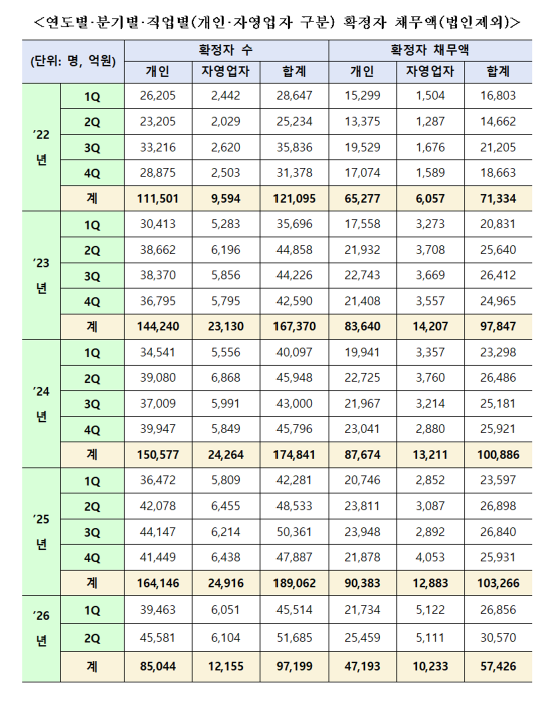
According to data submitted by the Credit Counseling and Recovery Service (CCRS) to the office of People Power Party lawmaker Park Sung-hoon of the National Policy Committee on the 31st, 97,199 people had their debt restructuring finalized in the first half of this year, including fast-track debt adjustment, pre-debt adjustment and individual workout programs. The number rose from 121,095 in 2022 to 167,370 in 2023, then to 174,841 in 2024 and 189,062 last year. That marks a sharp increase of 56.1% in just three years.
The number of finalized debt restructuring cases in the first half of this year has already surpassed half of last year's annual total. Of the 97,199 cases, most were individual debt adjustments, totaling 85,044. Debt restructuring for self-employed borrowers accounted for 12,155 cases. Their combined debt amounted to 5.7426 trillion won.
CCRS debt restructuring programs are broadly divided into fast-track debt adjustment, pre-debt adjustment and individual workout. Borrowers who are less than 30 days delinquent go through the fast-track process. Those with longer delinquency periods use pre-debt adjustment for 31 to 89 days, or individual workout for 90 days or more.
The increase in fast-track debt adjustment for borrowers in the early stages of delinquency was also evident. Finalized cases rose from 16,766 in 2022 to 53,551 last year, more than tripling in three years. Another 27,003 people finalized fast-track debt adjustment in the first half of this year.
The rise was especially pronounced among older borrowers. Among those aged 70 and above, cases jumped from 239 in 2022 to 1,684 last year, more than sevenfold. The number for people in their 60s also increased roughly fivefold, from 1,015 to 5,339 over the same period. In the first half of this year, borrowers in their 70s and older accounted for 1,008 cases, while those in their 60s accounted for 2,800, or 14.1% of the total.
Finalized individual workout cases for long-term delinquent borrowers also rose, from 80,952 in 2022 to 99,912 last year. In the first half of this year alone, the figure reached 55,213. In particular, the second quarter saw 30,054 cases, the highest quarterly total in five years.
Applications for small emergency loans by vulnerable borrowers who continue to repay their debts faithfully after restructuring are also on the rise. CCRS recorded 26,703 applications for its small-loan program for diligent repayers in the first half of this year, with total requested funding of 78.835 billion won.
The second quarter alone saw 14,893 applications, the highest quarterly figure since 2022.
Lawmaker Park Sung-hoon said, "The fact that finalized debt restructuring cases surged 56% in just three years, and that fast-track debt adjustment for people in their 70s and older increased sevenfold, is a warning sign that the number of people unable to cope with debt is spreading across all generations." He added, "Rather than limiting policy to post-facto measures such as restructuring debt and extending new loans, we need to strengthen proactive debt management and recovery support so that vulnerable borrowers can escape the vicious cycle of delinquency and repeated borrowing."
[email protected] Park Moon-soo Reporter