Chey Tae-won: "If Korea and Japan are combined, it becomes a $6 trillion market... Let's build a bigger industrial ecosystem"
- Input
- 2026-08-31 15:28:56
- Updated
- 2026-08-31 15:28:56
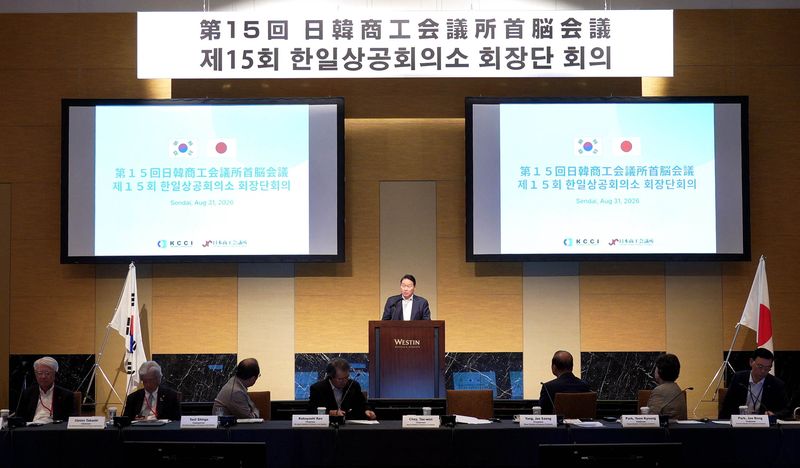
In his opening remarks at the 15th Korea-Japan Chamber Leaders Meeting held at the Westin Hotel Sendai in Japan on the 31st, Chey said, "Let's start with areas where the two countries can create synergy, such as artificial intelligence (AI), advanced industries, supply chains, energy and startups."
KCCI, together with the Japan Chamber of Commerce and Industry (JCCI), hosted the 15th Korea-Japan Chamber Leaders Meeting under the theme, "The Future of Korea and Japan from the Regions." The exchange between the two chambers' leaders began with the first meeting in 1985 and has continued for more than 40 years. This year's meeting was attended by 16 business leaders from Korea, including Chey, and 12 Japanese business leaders, including JCCI Chairman Ken Kobayashi.
Chey said, "Last year marked the 60th anniversary of the normalization of diplomatic ties between Korea and Japan, and this year will be the first year of a new 60-year chapter." He added, "This year, the leaders of both countries have continued shuttle diplomacy, traveling between Nara in Japan and Andong in Korea." He went on to say that cooperation is becoming more concrete not only in the economy and society, but also in critical mineral supply chains and energy security. "As summit diplomacy broadens the foundation for bilateral cooperation, I believe it is now time to make that potential more concrete in the economic field," he added.
Chey also cited the rapidly changing global economic environment, including supply chain restructuring, the spread of protectionism and intensifying competition in advanced technologies such as AI, as reasons to strengthen Korea-Japan cooperation. "It is no longer a world where good technology and good products alone can be sold anywhere," he said. "We are now in an era where market size, supply chains, energy and resources all determine corporate competitiveness."
Chey also reiterated the need for the Korea-Japan economic alliance he has long proposed. "Unlike in the past, I believe Korea and Japan are now more complementary than competitive," he said. "We should not view future cooperation between the two countries simply as a relationship of buying and selling more from each other." He explained, "What I mean by the Korea-Japan economic alliance is not seeing our respective markets and industries separately, but building a larger market and industrial ecosystem together."
He also emphasized that the combined economies of the two countries exceed $6 trillion in terms of gross domestic product (GDP). Chey suggested that if the global market is becoming increasingly bloc-based while our domestic markets are shrinking, becoming partners that expand each other's markets could be a practical choice for both countries.
As concrete areas for cooperation, he pointed to AI, advanced industries, supply chains, energy and startups. He also mentioned pilot projects allowing travel between the two countries without passports, greater investment between startups in both countries, and AI data sharing as possible areas of collaboration. Chey said, "If we gradually turn each possibility for cooperation into something concrete, it will naturally become a success story, and trust among business communities in Korea and Japan can grow even stronger."
Meanwhile, the two chambers adopted a joint statement on the day and agreed to strengthen cooperation in supply chains, energy security and future industries, while further expanding regional and people-to-people exchanges. They also pledged active support for efforts to strengthen energy security, including expanding stockpiles, improving the stability of energy supply chains, and facilitating mutual swaps of crude oil, petroleum products and LNG. In addition, they agreed to expand cooperation in future industries such as AI, semiconductors and clean energy, and to promote innovative cooperation in environmental and green sectors around the 2027 Yokohama International Horticultural Expo.
[email protected] Lim Su-bin Reporter