Jeju Development Corp. and Korea ESG Data hold human rights management forum, focusing on due diligence... Government pledges active support for a fresh leap forward
- Input
- 2026-08-31 11:40:44
- Updated
- 2026-08-31 11:40:44
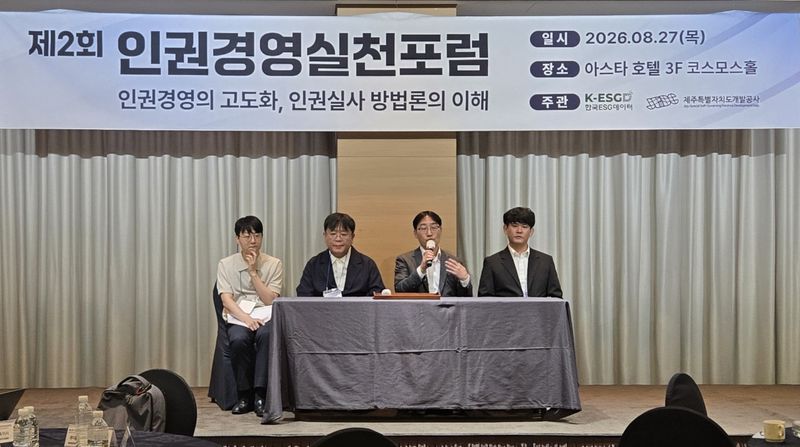
[Financial News, Jeju Province = Reporter Jeong Yong-bok] Human rights management at public institutions and companies is shifting from declarations and training to "human rights due diligence," a process that identifies and prevents human rights risks in advance and provides remedies when problems arise. More than 100 public- and private-sector practitioners from across the country gathered in Jeju Province to examine how risk identification and remedy procedures can work in practice.
According to Jeju Special Self-Governing Province Development Corp. on the 31st, the company co-hosted the 2nd Human Rights Management Practice Forum with Korea ESG Data in Jeju from the 27th to the 28th.
The forum, held under the theme "Advancing Human Rights Management and Understanding Human Rights Due Diligence Methodologies," was attended by more than 100 human rights management practitioners from public and private institutions in Korea.
Human rights due diligence is a series of steps in which a company or public institution identifies in advance the risk of human rights violations that could affect not only employees but also stakeholders connected to its business, such as suppliers, customers and local residents. It then works to prevent harm, reduce damage and provide remedies if problems occur.
It goes a step beyond creating a human rights declaration or conducting training. The key difference is that it continuously checks what kinds of human rights risks may arise in actual business operations and decision-making processes.
The National Human Rights Commission of Korea (NHRCK) has also identified the advancement of corporate human rights management systems as a key task this year. As efforts to institutionalize human rights risk reviews across corporate supply chains are expanding, especially in Europe, calls are growing in Korea for public institutions and private companies to apply human rights management not just as an internal culture or social contribution effort, but in actual decision-making and business activities.
On the first day of the forum, the 27th, experts delivered lectures at Astar Hotel Jeju on the future direction of human rights management and how to apply it in practice.
Topics included the direction of advanced human rights management, the conditions for a remedy process that actually works, and the current state and future tasks of national human rights management policy.
In particular, participants discussed not only setting up a reporting channel when a human rights violation occurs, but also whether victims are properly investigated and compensated, and whether organizational operations can be changed so the same problem does not happen again.
Human rights due diligence methodologies were also a major topic. The focus was on how to build a system that identifies areas in an organization’s business and supply chain that could negatively affect human rights, assesses the level of risk, prepares preventive measures and then reviews the results again.
Jeju Development Corp.'s decision to co-host the forum was also tied to these changes. As a local public enterprise that carries out businesses including the production and distribution of Jeju Samdasoo, public housing and development projects, the company is connected not only to employees but also to a wide range of stakeholders, including suppliers, customers and local communities.
In its management direction for this year, the company has also set "an organization where everyone is respected" as a key task and is linking human rights, working conditions and stakeholder protection to its ESG management system.
On the second day, the 28th, participants visited the Jeju 4.3 Peace Memorial Hall. Through expert commentary, they reviewed state violence and civilian suffering during the Jeju uprising, as well as the subsequent efforts to uncover the truth and restore honor. The program also connected Jeju uprising's historical experience of reconciliation and coexistence to today's organizational human rights management.
In effect, the event revisited the meaning of corporate human rights due diligence on site: it should not be limited to a technical assessment process, but should also view problems from the victim's perspective when human rights violations occur, while taking responsibility for recovery and preventing recurrence.
Kang Seong-hoon, Acting President of Jeju Development Corp., said, "This was a place to share how human rights management can be made to work in actual operations," adding, "Based on the spirit of reconciliation and coexistence from the Jeju uprising, we will strengthen a management system that respects the human rights of stakeholders."
[email protected] Jeong Yong-bok Reporter