South Korea Has Become a 'Department Store of Public Housing'... More 'Public' Added in the Aug. 13 Plan [What Kind of 'Public' Is It For? 1]
- Input
- 2026-09-01 09:32:55
- Updated
- 2026-09-01 09:32:55
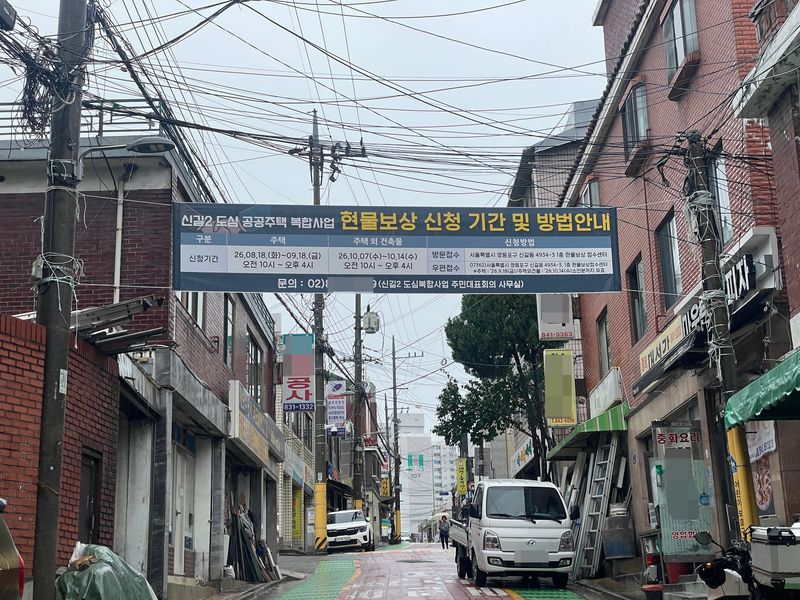
[Financial News] On Aug. 31, during a late-summer downpour, I visited a rather unusual "department store." As I walked the 1-km stretch from Yeongdeungpo Station on Subway Line 1 to Wushin Elementary School, signs along the street kept building anticipation for what this department store might offer.
A notice posted at the entrance of a real estate agency listed "redevelopment," "reconstruction," and "sale rights." Turning into the alley next to Wushin Elementary School, another banner caught the eye. In large letters, it read, "Period for applying for in-kind compensation."
This was the Singil-dong area of Yeongdeungpo District in Seoul, which a real estate expert described as a "department store" of public housing projects. Depending on the zone, urban public housing complex projects, housing redevelopment projects, public redevelopment projects, and public reconstruction projects were either planned or already under way.
Public housing policy has appeared in new forms and under new names every time the administration changed, and its types have become increasingly diverse.
Choi Eun-young, head of the Korea Center for City and Environment Research (KOCER), said, "During the Moon Jae-in administration, integrated public rental housing was introduced to combine the complicated rental housing categories. Under the current administration, new types such as universal public rental housing have been proposed again." She added, "It is difficult to abolish past systems immediately. But going forward, public housing types need to be combined and integrated to simplify them."
Public housing comes in many forms, including ownership models
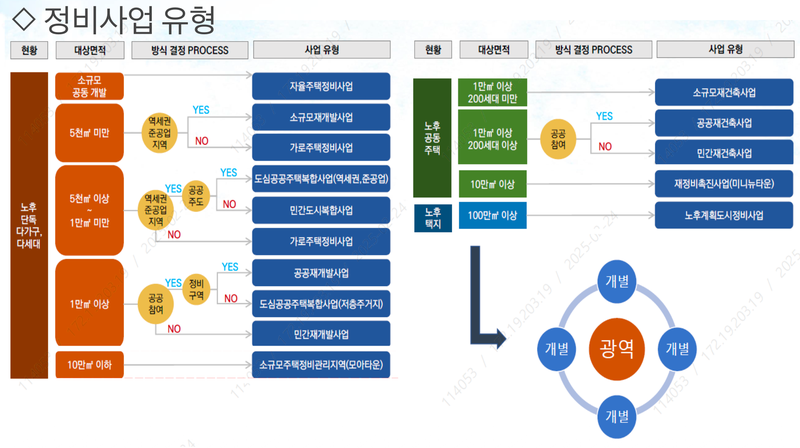
Under the current Public Housing Special Act, public housing refers to homes that public housing operators such as the state, local governments, Korea Land and Housing Corporation (LH), and local public corporations build, purchase, or lease with support from government funds or the Housing and Urban Fund.
Legally, the two main categories are public rental housing and public sale housing. Public rental housing is further divided into public construction rental housing, which is built directly, and public purchase rental housing, which is supplied by buying existing or newly built homes. Permanent public rental housing, public rental housing for low- and middle-income households, Happy Housing, long-term jeonse housing, public rental housing with conversion to sale, purchase rentals, and jeonse rentals also fall within the public rental system.
In the 1980s and 1990s, the main approach was for the public sector to develop land and directly build homes for rental or sale. In the 2000s, large-scale supply systems through public housing sites and public housing districts were reorganized, and purchase rentals expanded.
In the 2010s, supply methods became even more diverse. Under the Park Geun-hye administration, public rental REITs, in which the Housing and Urban Fund and LH supplied rental housing through REITs, public silver housing that combined senior housing with welfare facilities, and public remodeling rental housing that purchased and improved aging homes all emerged.
In 2018, public-supported private rental housing was introduced. In this model, private operators own and lease homes, but receive support from public housing sites and funds while being subject to regulations on rent and other terms.
The number of homes carrying the label "public" surged sharply in 2020 and 2021. Public redevelopment, public reconstruction, and public jeonse housing appeared one after another in 2020. In 2021, public-led 3080+, urban public housing complex projects, and public direct implementation redevelopment projects were added.
This reflected an expansion from directly building and leasing or selling homes to participating in existing urban development, redevelopment, and reconstruction projects.
The ownership structure of public sale housing also became more segmented. The equity-accumulation type allows buyers to acquire only an initial stake and then increase their share over 20 to 30 years. The profit-sharing type is structured so that public authorities share gains and losses when the home is sold.
The 'public' included in the Aug. 13 housing supply plan
The government's "Measures for Rapid Housing Supply to Stabilize the Jeonse and Sales Markets," announced on the 13th of last month, also included a large number of public housing policies.
Of the plan to add 230,000-plus homes to the Capital Region between 2026 and 2030, the effect from expanding public housing site supply alone amounts to 160,000-plus homes. First, the project period for new and existing public housing sites will be shortened from an average of 68 months to 37 months, and the start of construction for existing projects such as the Third New Towns will be brought forward by one to two years. New public housing districts will be designated on a scale of 100,000-plus homes.
The government is also pushing a plan to convert 490,000 pyeong of non-residential land, such as commercial and urban support facilities within public housing sites, into residential land and begin construction of 30,000 homes by 2030.
In urban areas, an additional 10,000 to 20,000 candidate sites for public housing complex projects will be identified.
Purchase rentals by LH and others will also be expanded, with 140,000 homes to begin construction in the Capital Region by 2030. Tax support will also be strengthened, including raising the acquisition tax reduction rate for builders of new public purchase rentals from 15% to 70% through 2027. Orders for modular public housing will also increase from 12,000 homes to 20,000 homes between 2027 and 2030.
The public sale housing model will also change. The government plans to supply about 15% of future public sale housing as either the equity-accumulation type or the profit-sharing type. Under the equity-accumulation type, buyers first acquire only 25% of the stake and then purchase the remaining shares over a long period. Under the profit-sharing type, buyers receive purchase funds from the Housing and Urban Fund and later share the profits generated with the fund.
A new category, universal public rental housing, will be introduced within public rental housing. It will be supplied mainly in preferred areas such as station areas in the Third New Towns and central Seoul, and more than half of the total units will be allocated to young people without homes. A youth-only town with 11,000 units will also be created.
A new "youth universal jeonse rental" program will also be launched. The support limit per person in the Capital Region will be raised from a maximum of 120 million won to 240 million won, and income eligibility standards will also be relaxed.
For public-supported private rental housing, a long-term model operating for more than 20 years will be added. Using HUG guarantees, operators will be able to receive long-term financial support for up to 34 years, and fund equity and loan support will also be expanded.
The public housing policies in the Aug. 13 plan can be summed up as expanding public housing sites, shortening project timelines, increasing urban public projects and purchase rentals, diversifying public sale methods, and introducing new public rental types. Through these measures, the government aims to speed up public-sector supply while also broadening rental and homeownership options for young people and those without homes.
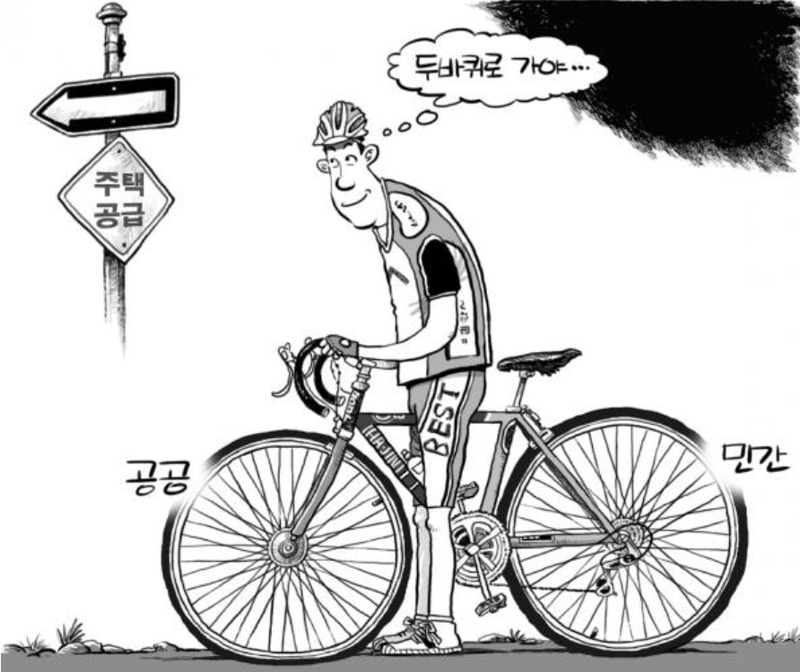
LH, which leads public housing projects, compared the role of public housing to a bicycle.
Lee Yong-ju, deputy head of LH's Metropolitan Area Redevelopment Project Headquarters, said during a recent lecture at Sejong University, "If we want to supply housing stably in central Seoul, I think the public and private sectors must move together on two wheels to solve the problem." The lecture was titled "Understanding and the Future of Urban Public Housing Complex Projects."
Public perceptions of public housing have also changed.
Kim Hwi-cheon, a real estate agent specializing in reconstruction, explained, "Policies on public housing have improved a lot compared with the past, to the point that people in our area are now asking for it to be done here as well." He added, "In the past, people disliked it because they thought brand value would fall if the public sector handled it, but that is no longer the case. Instead, business feasibility and floor-area ratio benefits have improved, so demand has risen."
[email protected] Seo Yoon-kyung Reporter