Jeju Province makes 100-day performance report public online... '23% progress' monitored in real time
- Input
- 2026-08-31 10:42:42
- Updated
- 2026-08-31 10:42:42
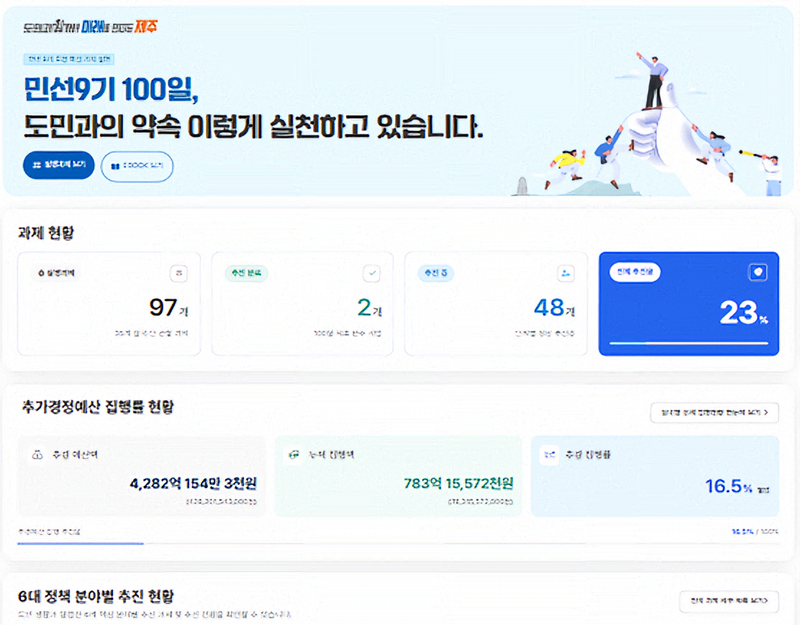
[Financial News Jeju = Reporter Jung Yong-bok] The Wi Seong-gon administration in Jeju has begun publishing online the progress of livelihood-focused tasks it pledged to deliver within 100 days of taking office. By allowing residents to check not only each policy's responsible official and target but also the overall implementation rate and supplementary budget execution status, the province aims to manage short-term results with numbers rather than just plans.
According to Jeju Special Self-Governing Province on the 31st, the province has posted an online dashboard on the provincial website that lets users see the implementation status of the 9th popularly elected administration's '100-day action plan' at a glance.
The first screen of the dashboard shows the overall task status, including completed and ongoing items, as well as the total implementation rate. Based on the published screen, two tasks have been completed, 48 are in progress, and the overall implementation rate is 23%.
Progress by policy area is also disclosed. The 100-day action plan is divided into six areas: economy and primary industry, culture and tourism, climate and innovation, construction and transportation, health, welfare and safety, and autonomous administration.
Each detailed task includes field demands, goals to be achieved by the 100th day in office, the official in charge, and impact indicators that allow residents to see tangible changes.
Rather than simply opening an internal administrative work chart, the system shows residents who is responsible for what and by when.
The 100-day action plan is a short-term performance management approach ordered by Governor Wi shortly after taking office. At the first expanded senior officials' meeting of the 9th popularly elected administration on July 2, he instructed each bureau, office and the two administrative cities to prepare tasks that residents could feel within 100 days of inauguration. At the time, he said, "Clearly define who will push forward what, by when, and in what way, with the person in charge and the deadline made explicit."
It is also different in nature from the election pledges. The 100 pledges of the 9th popularly elected administration are medium- to long-term commitments to be pursued over the full term, and their detailed implementation plans will be finalized in October after review by a separate pledge implementation committee and a citizen jury panel. By contrast, the 100-day action plan focuses on policies that can be launched immediately after inauguration and that residents can see change from in the short term.
In the economy and primary industry sector, the plan includes debt refinancing loans and special guarantees to ease the financial burden on small business owners, as well as support for mineral fertilizer prices to reduce farm operating costs. In culture and tourism, the art bank project is being promoted, while the climate and innovation sector includes reforms to the recycling collection system and the introduction of the 'Tamnaneun Electricity Forecast System.'
In the health, welfare and safety sector, the province is reviewing tasks directly tied to residents' daily lives, such as promoting designation of a tertiary hospital, building an emergency care cooperation system for mothers and newborns, and creating youth cafes.
One notable feature of the dashboard is that it also shows budget execution. For projects funded by supplementary budgets, the budget amount, actual spending and execution rate are displayed separately so that users can check both policy progress and how quickly the money is being spent.
Since simply labeling a policy as 'in progress' makes it difficult to judge actual results, the province plans to disclose whether the budget is being executed as planned and use that information to assess implementation.
The key question going forward is whether the current '23% progress' will translate into real changes in daily life by the 100th day in office. In particular, short-term action plans should be evaluated not by administrative steps or plan drafting alone, but by indicators residents can verify, such as lower financing costs, better access to medical care and changes in living conditions.
Jeju Province plans to keep updating the dashboard, monitor progress by task and revise plans for projects that fall behind schedule.
Governor Wi Seong-gon said, "The 100-day action plan is a process of turning our promise to residents into real results," adding, "We will review progress by task and create changes that residents can feel."
[email protected] Jung Yong-bok Reporter