KOSPI Falls 2% on Fed Fears, Moves Near 6,600 [fn Morning Market Report]
- Input
- 2026-08-31 10:38:20
- Updated
- 2026-08-31 10:38:20
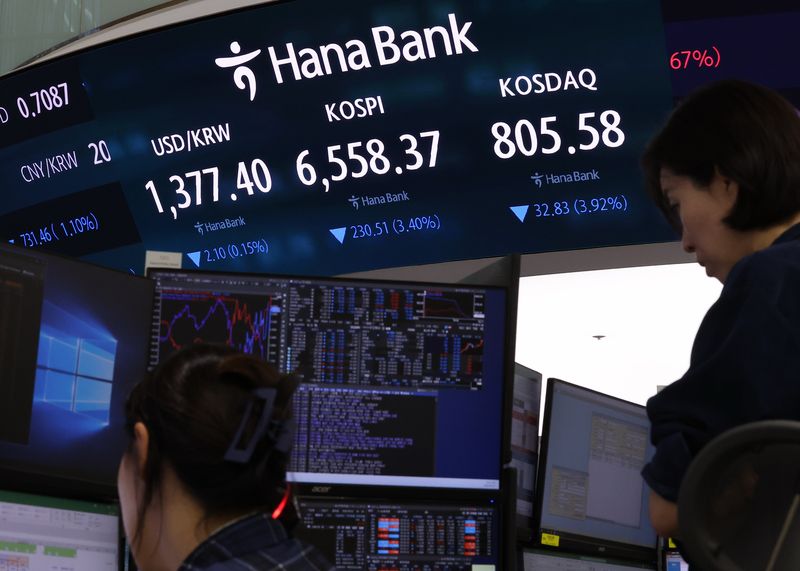
[Financial News] The KOSPI (Korea Composite Stock Price Index) fell more than 2% on heavy selling by foreign investors and institutions, trading near the 6,600 level. According to the Korea Exchange, the benchmark stood at 6,643.7 as of 10:30 a.m. on Aug. 31, down 2.14% from the previous session.
Foreign investors and institutions sold a net 498.9 billion won and 371.9 billion won, respectively, in the KOSPI. Retail investors bought a net 475.5 billion won.
Most large-cap stocks were also weaker. Samsung Electronics fell 2.14% from the previous session to 251,500 won, while SK hynix dropped 2.90% to 1,605,000 won. Samsung Electro-Mechanics (-2.11%) and SK Square (-2.04%) also declined.
At the same time, the KOSDAQ (Korea Securities Dealers Automated Quotations) was down 3.32% from the previous day at 810.61. On the KOSDAQ, foreign investors and institutions sold a net 133.2 billion won and 128.5 billion won, respectively, while retail investors bought a net 262.6 billion won.
Among major KOSDAQ stocks, Alteogen Inc. fell 247,500 won, or 7.73%, to 295,250 won. ILSUNG (-4.30%), WONIK IPS Co., Ltd. (-4.14%), LEENO Industrial Inc. (-3.82%), and Rainbow Robotics (-3.73%) also fell. EcoPro and ECOPRO BM dropped 2.99% and 3.05%, respectively. By contrast, HLB Co., Ltd. rose 950 won, or 2.64%, to 36,950 won.
On the external front, caution over U.S. monetary policy is weighing on investor sentiment. Kevin Warsh's Jackson Hole speech was interpreted as hawkish, raising concerns about a rate hike in September. On the New York Stock Exchange on Aug. 28 local time, the NASDAQ Composite Index fell 0.52%, while the Philadelphia Semiconductor Index (SOX) dropped 3.47%.
Han Ji-young, a researcher at KIWOOM Securities Co., Ltd., said, "Warsh's remarks appeared to emphasize the Fed's dual mandate of price stability and full employment in a fairly textbook way." She added, "It remains appropriate to continue placing high importance on inflation and employment data, as before."
[email protected] Han Young-joon Reporter