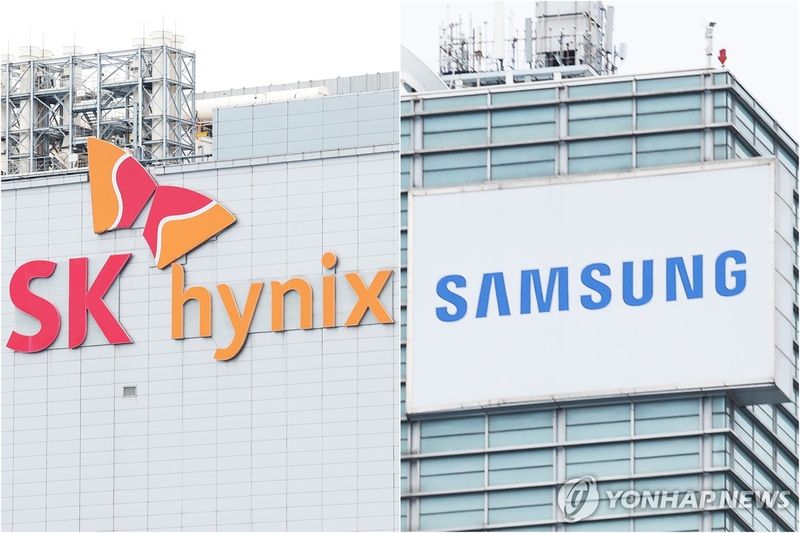
"SK hynix's target price slashed from 3.3 million won to 2.4 million won" as Samsung's HBM4 challenge intensifies... Samsung Electronics target price raised [Stocktopia]
- Input
- 2026-08-31 10:37:44
- Updated
- 2026-08-31 10:37:44
[Financial News] Here is a roundup of major brokerage reports for the morning of August 31.
For SK hynix, analysts said profitability expectations for HBM next year should be lowered as supply competition normalizes with Samsung Electronics' entry into HBM4. In contrast, Samsung Electronics was seen as likely to see the discount factors that have weighed on its share price ease as both HBM4 yield and shipment share improve.
Samsung Biologics was also assessed as facing not a burden, but a chance to invest cheaply in the company's growth through its 300 billion won paid-in capital increase.
SK hynix: Adjusting expectations for HBM profitability (LS Securities)
◆ SK hynix (000660)― LS Securities / Analyst Jung Woo-sung- Target price: 2.4 million won (down 27.3% from 3.3 million won) | Previous close: 1.653 million won
- Investment opinion: Buy (maintained)
LS Securities cut its target price for SK hynix from 3.3 million won to 2.4 million won, saying HBM profitability next year is unlikely to rise as much as initially expected.
Analyst Jung Woo-sung said, "The key to the revision is not slowing HBM demand or the end of the memory cycle, but a downward adjustment to HBM earnings forecasts that reflects the fact that the excess profitability we had assumed for next year is unlikely to materialize." He added, "We also reflected the possibility that Samsung Electronics' entry into HBM4 will partially ease the premium tied to supplier concentration."
The firm had originally expected HBM operating margins to rise to around 80% next year, but after reviewing the industry, it now believes they will remain at about 60%, similar to this year.
Jung said, "This should be seen not as a slowdown in the HBM market itself, but as a normalization of competition among suppliers." He added, "Going forward, the key variable for the stock will be less about absolute HBM demand and more about how well the company can maintain its technological edge in next-generation products and its high share among customers."※ High-bandwidth memory (HBM)HBM is a high-performance form of DRAM, the memory used when computers process tasks. It stacks multiple layers of DRAM and connects the chips vertically through tiny holes called TSVs. By widening the data path far more than conventional DRAM, it delivers faster speeds and lower power consumption. It is an essential component in AI accelerators such as NVIDIA Corporation's graphics processing units (GPUs). In this report, HBM4 refers to the latest sixth-generation product.
Samsung Electronics: Profit structure to change with HBM4 (LS Securities)
◆ Samsung Electronics (005930)― LS Securities / Analyst Jung Woo-sung- Target price: 450,000 won (up 12.5% from 400,000 won) | Previous close: 257,000 won
- Investment opinion: Buy (maintained)
LS Securities raised its target price for Samsung Electronics to 450,000 won, saying profitability could improve more quickly as both the HBM4 shipment mix and yield improve at the same time.
HBM4 accounted for about 5% of Samsung Electronics' HBM shipments in the first quarter and jumped to about 35% in the second quarter. Over the same period, yield, or the share of good chips among total output, is estimated to have improved by more than 5 percentage points. The broker said the HBM weakness that had weighed on the stock's valuation is beginning to fade.
Analyst Jung Woo-sung said, "Until now, the HBM business has acted as a valuation discount factor compared with competitors because of delays in customer certification and low mass-production efficiency." He added, "However, with HBM4, both a higher shipment mix and better yield are appearing at the same time, so that discount factor is likely to narrow gradually."
He also emphasized, "If HBM4 begins to contribute more to Samsung Electronics' memory business profits, the company's existing profit structure, which has centered on commodity DRAM, could also change."
Jung expects the stock's long-term direction to become more sensitive to HBM4 supply expansion and the pace of growth in new AI demand channels than to memory prices themselves.
Samsung Biologics: Why raise 300 billion won now? (Hana Securities)
◆ Samsung Biologics (207940)― Hana Securities / Analyst Kim Sun-ah- Target price: 2.05 million won (maintained) | Previous close: 1.486 million won
- Investment opinion: Buy (maintained)
Hana Securities kept its target price of 2.05 million won and its Buy rating for Samsung Biologics, which recently decided on a 300 billion won paid-in capital increase, saying the fundraising is not a short-term burden but a foundation for long-term growth. Of the funds raised, about 270 billion won will be used to acquire Switzerland's Swiss Polypeptide Group, and about 30 billion won will go toward expanding Plant 6.
The market's question is why the company is funding the entire acquisition price through a capital increase. Hana Securities said the math makes sense. If the full 300 billion won were financed through debt, the company would have to pay more than 13 billion won in annual interest, and its debt ratio would jump from 51% to 87%, sharply reducing future borrowing capacity.
Analyst Kim Sun-ah said, "The company's explanation is reasonable: rather than forcing itself to secure loans or corporate bonds all at once, it is leaving room to use them strategically when needed, and if another capital increase will likely be needed in the future anyway, then now, during a high-interest-rate period, is the right time."
Kim added, "This fundraising is not just about expanding domestic capital expenditure. Because it also includes securing global production bases and diversifying modalities, it is seen as the best time to invest cheaply in the company's long-term growth."※ Paid-in Capital IncreaseThis is a way for a company to raise funds by issuing new shares and selling them to investors for cash. Unlike bank loans or corporate bonds, it does not need to be repaid and carries no interest, but existing shareholders' ownership value can be diluted as the total number of shares increases. Samsung Biologics chose a structure in which new shares are first allocated to existing shareholders, with the remaining shares sold through a public offering.※ Capital Expenditure (CAPEX)This refers to the money a company spends to buy or build long-term assets such as factories, machinery, and buildings. It is not an immediate expense, but an investment to earn more in the future. Samsung Biologics' expansion of Plant 6 is a representative example.※ ModalityThis is a pharmaceutical term referring to the type of method or technology used to make a drug. It covers categories such as chemically synthesized drugs, antibody drugs, cell and gene therapies, and peptide drugs. Diversifying modalities means broadening the range of drugs that can be manufactured under contract.
[Stocktopia]is an AI-based stock report briefing service that compiles and delivers reports from major domestic brokerages. To keep receiving [Stocktopia], please subscribe to the reporter's page.
[email protected] Sung Min-seo Reporter