The 'Moving Target' system to change research goals in response to technological change will be introduced next year
- Input
- 2026-08-31 12:00:00
- Updated
- 2026-08-31 12:00:00
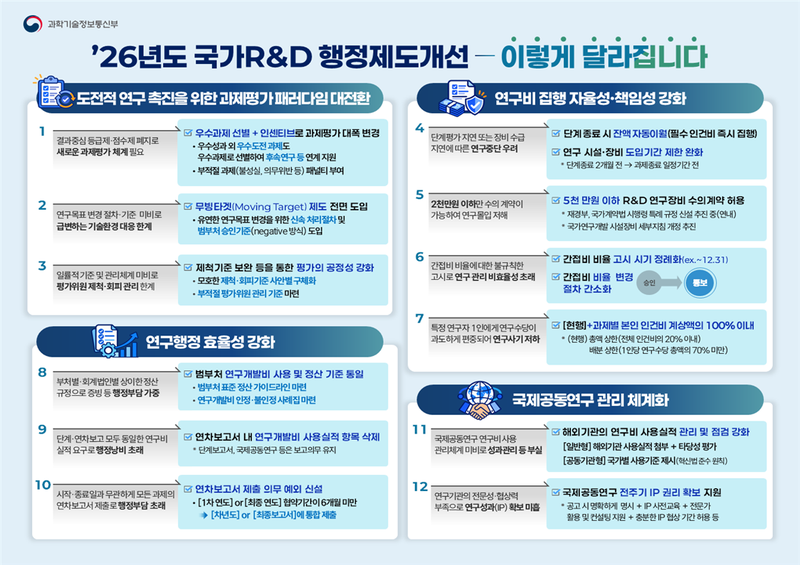
[Financial News] Starting next year, the 'Moving Target' system will be introduced to allow research goals to be changed quickly in response to rapidly shifting technological conditions.
On the 31st, the Ministry of Science and ICT said it had drawn up the '2026 administrative system improvements for national R&D' and notified related ministries, including the Ministry of Trade and Industry, the Ministry of SMEs and Startups, and the Ministry of Climate, Energy and Environment.
The improvement plan was based on 349 suggestions from research sites collected through various channels, including online platforms and on-site meetings. It was finalized after deliberation and approval at the 8th meeting of the Presidential Advisory Council on Science and Technology (PACST) on the 26th.
First, to respond quickly to the fast-changing global technology environment, the plan will fully introduce the 'Moving Target' system from next year, allowing researchers to flexibly revise research goals during a project. To make goal changes faster, the government will significantly shorten the approval process and present cross-ministerial guidelines on approval in a negative-list format to improve predictability.
As a follow-up to the abrupt abolition in July of the results-based grading and scoring system for project evaluations, the ministry plans to establish a new evaluation framework by October that can encourage innovative outcomes. Project evaluation will be overhauled to identify outstanding projects and provide incentives. In addition to projects with excellent results that have broad academic, technological, or industrial impact, projects that fall short of innovative goals but generate exceptional data and knowledge through trial and error will also be selected as outstanding challenge projects. They will receive incentives such as follow-up research links and government awards. By contrast, projects that show poor conduct during implementation, such as violations of law, failure to meet agreement obligations, or research misconduct, will be classified as 'inappropriate projects' and face strong sanctions, including the recovery of research funds and restrictions on participation.
To prevent research disruptions caused by delays in equipment procurement, the current rule requiring research facilities and equipment to be acquired by two months before the end of a phase will be relaxed to a point before the overall project end date. If procedures are delayed between the end of one phase and the start of the next, any unused direct costs at the end of the phase will be allowed to carry over automatically. This will also make it possible to spend essential personnel costs immediately, even before the results of the phase evaluation are finalized.
To prevent research allowances from being excessively concentrated on a single researcher, the ministry will introduce an individual cap of up to 100% of that person's labor cost charged to each project, in addition to the current total cap of 20% of labor costs and the distribution cap of 70% per person.
The ministry will also produce and distribute a cross-ministerial standard settlement guide and a collection of examples of research expenses that are recognized or not recognized, in order to ease the heavy administrative burden caused by different settlement standards across ministries and accounting firms, which often require extensive supporting documents. To reduce the burden of annual reports, projects in their first year or final year with a contract period of less than six months will be handled together with the following year's annual report and related documents.
The government will also push ahead with institutional reforms to prevent weak international joint research and improve results. It plans to strengthen monitoring of how research funds remitted to overseas institutions are used, and to expand support across the full R&D cycle so that the rights of domestic research institutions to outcomes such as intellectual property can be protected when agreements are signed with overseas partners.
The Ministry of Science and ICT plans to swiftly carry out follow-up measures in September, including revisions to related laws and regulations such as the Enforcement Decree of the National Research and Development Innovation Act, and to fully implement the improved research system next year.
[email protected] Yeon Ji-an Reporter