Residents' Autonomy Committees to Be Fully Implemented in October... Roadmap to Expand to 43 Towns, Townships, and Neighborhoods in 8 Areas of Jeju
- Input
- 2026-08-31 09:53:02
- Updated
- 2026-08-31 09:53:02
[Financial News, Jeju = Reporter Jung Yong-bok] The nationwide Residents' Autonomy Committee system will move beyond its 13-year pilot phase and become a legally established system under the Local Autonomy Act in October. In contrast, Jeju only began its first pilot operation in eight towns, townships, and neighborhoods last year. Based on the performance of those areas, Jeju Island is drawing up a new Jeju-style model that covers the authority of residents' general assemblies, participatory budgeting, committee representation, and even the operation of a secretariat.
According to Jeju Special Self-Governing Province and the Jeju Research Institute on the 31st, a policy forum titled "Successful Institutional Transition of the Jeju-style Residents' Autonomy Committee" will be held at 4 p.m. today at Witseoreum on the third floor of the Jeju Research Institute.
Officials from Jeju Island and the Jeju Special Self-Governing Provincial Council, along with experts and resident representatives, will discuss major policy tasks for the Jeju-style Residents' Autonomy Committee after legalization. More than 150 people, including members of residents' autonomy committees, village heads, local leaders, and ordinary residents, are expected to attend.
To understand this discussion, it is necessary to first look at the different starting points of the nation and Jeju. Nationwide, the Ministry of the Interior and Safety (MOIS) launched a pilot program for the Residents' Autonomy Committee in 2013. The experiment was designed to create a grassroots self-governance body where residents could directly discuss and resolve local issues at the town, township, and neighborhood level.
The 13-year pilot system reached a turning point with this year's legal revision. The revised Local Autonomy Act, amended on April 14, newly added Article 17-2, which provides for the establishment of Residents' Autonomy Committees. It allows towns, townships, and neighborhoods to set up resident-based committees and creates a legal basis for assigning some local government tasks, while also establishing administrative and financial support. The new provision will take effect on Oct. 15.
Jeju's timeline is later than the national one. Jeju Island enacted the "Ordinance on the Pilot Implementation, Establishment and Operation of the Residents' Autonomy Committee of Jeju Special Self-Governing Province" in January 2024, and it took effect on Jan. 1 last year.
The areas where Residents' Autonomy Committees were actually launched are Hallim-eup, Ido 2-dong, Yongdam-2-dong, Hwabuk-dong, Seongsan-eup, Andeok-myeon, Hyodon-dong, and Donghong-dong, eight towns, townships, and neighborhoods in all. These are Jeju's first Residents' Autonomy Committees. Through open recruitment and recommendations, 331 members were selected, and they have been working on community plans, residents' general assemblies, operation of residents' autonomy centers, and locally tailored projects. Of Jeju's 43 towns, townships, and neighborhoods, only eight are operating under the Residents' Autonomy Committee system, while the remaining 35 continue to use the existing residents' autonomy committee structure.
The Residents' Autonomy Committee is not merely a renamed organization. The existing residents' autonomy committees focused on operating programs at residents' autonomy centers and on reviewing and advising on local issues. By contrast, the Residents' Autonomy Committee is structured so that residents directly identify neighborhood agendas, draw up self-governance plans, and decide project priorities through residents' general assemblies. Its authority is broader because it can also take on some local administrative tasks previously handled by the government or link them to participatory budgeting.
Jeju's first task is to determine how quickly and in what manner this experiment in eight areas should be expanded to the remaining 35 towns, townships, and neighborhoods. According to the plan Jeju Island outlined at the Jeju Special Self-Governing Provincial Council in July, it intends to revise related ordinances and guidelines in the second half of this year and prepare a phased expansion roadmap based on the pilot areas' performance and local feedback.
The current plan is to continue operating the eight pilot areas, prepare for expansion through the second half of 2027, and then extend the system to all areas over three years from 2028 to 2030.
However, no final decision has been made on the order in which the 43 towns, townships, and neighborhoods will be converted. Urban neighborhoods, towns, and rural townships differ in population, living areas, and the nature of existing village organizations. Some argue that rather than applying the same model all at once, a type-specific design that reflects urban and rural characteristics is needed.
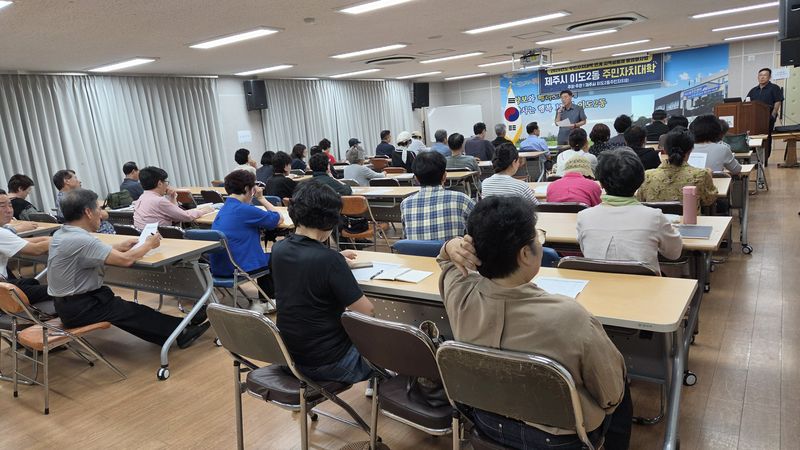
Resident representation is an even more sensitive issue. As the Residents' Autonomy Committee gains real influence over residents' general assemblies and budget processes, the question of who represents residents becomes more important. How members are selected, whether by open recruitment, lottery, or recommendation, and how representation by age, gender, and region is secured will determine the system's credibility.
The threshold for participation by committee members is also changing. The full revision of the model ordinance for Residents' Autonomy Committees distributed by MOIS in June removed the existing requirement that members must have lived in the relevant town, township, or neighborhood for at least one year, and proposed allowing foreign residents with certain qualifications to participate as members as well. Whether Jeju will reflect this standard in its own ordinance, and to what extent, is also under discussion.
The authority of residents' general assemblies is another key issue. The MOIS model ordinance states that operating rules and self-governance plans for the Residents' Autonomy Committee are to be decided at residents' general assemblies and linked to participatory budgeting. The goal is to create a structure in which neighborhood projects chosen by residents do not end as mere advisory opinions to administrative agencies, but are actually connected to budget allocation.
In Jeju, how much decision-making power the residents' general assemblies will be granted, and how much of the participatory budget will be linked to the Residents' Autonomy Committee, are expected to determine the real level of local autonomy.
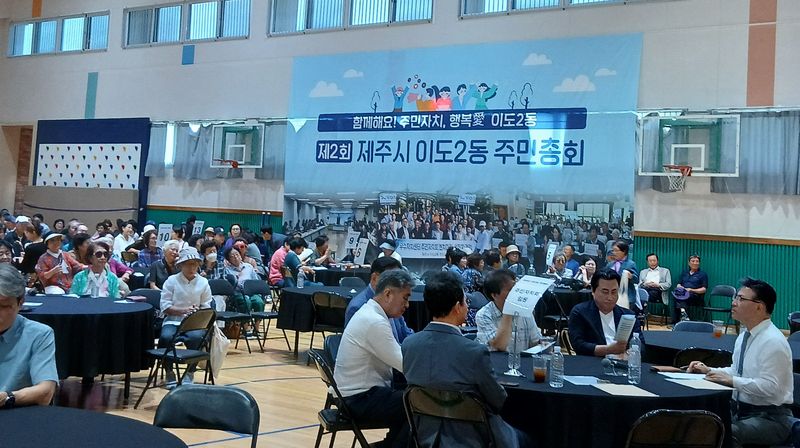
The residents' general assembly held in Ido 2-dong, Jeju City, on July 25 is an early example of these changes. Ido 2-dong is one of Jeju's first eight Residents' Autonomy Committees, and residents gathered directly to discuss local issues and proposals from residents.
The secretariat and operating staff are also issues that need to be resolved. If the Residents' Autonomy Committee is to handle self-governance plans, residents' general assemblies, commissioned tasks, and its own projects, it will be difficult to sustain the organization with volunteer committee members alone. The MOIS model ordinance also includes a basis for establishing a secretariat and a plan to carry out public services through affiliated entities such as social cooperatives.
It is also necessary to define the relationship with existing local organizations such as village heads, village associations, and residents' autonomy committees. Depending on whether the Residents' Autonomy Committee takes over the roles of existing organizations, divides functions with them, or connects through joint projects, acceptance on the ground may vary.
At the forum, Kim Myeong-sang, a research fellow at the Jeju Research Institute, will present on "Changes in Residents' Autonomy Following the Legalization of the Residents' Autonomy Committee and Policy Responses."
Professor Hwang Gyeong-su of the Department of Public Administration at Jeju National University (JNU) will serve as moderator. Kim Heung-ju, a research fellow at the Sejong Institute, Kang Cheol-ho, head of the Ido 2-dong Residents' Autonomy Committee, Lee Jeong-seok, vice chairman of the Seogwipo City Village Heads Association, Jwa Gwang-il, head of the Jeju Residents' Autonomy Solidarity, and Byun Young-geun, director of the Special Self-Governing Administration Bureau of Jeju Island, will take part in the discussion. Lee Gyeong-sim, chair of the Jeju Special Self-Governing Provincial Council's Administration and Autonomy Committee, and Kang Chang-min, vice president of the Jeju Research Institute, will also attend.
Jeju's experiment with the Residents' Autonomy Committee is now in its second year. As the nation moves from 13 years of pilot implementation into a legal system, Jeju faces the simultaneous challenge of turning the experience of its eight pilot areas into a model that fits all 43 towns, townships, and neighborhoods.
Going forward, success will depend less on how many places establish the Residents' Autonomy Committee and more on how much the decisions made at residents' general assemblies are reflected in actual policy and budgets, and how much authority and responsibility can be given to residents.
Byun Young-geun, director of the Special Self-Governing Administration Bureau of Jeju Island, said, "Rather than expanding quickly, it is more important that the transition to Residents' Autonomy Committees respects the characteristics of each region and existing communities, and takes root properly in local society." He added, "At this forum, we will listen broadly to views from the field and refine an operating model for the Residents' Autonomy Committee that fits Jeju's circumstances."
[email protected] Reporter Jung Yong-bok Reporter