Daejeon City to Apply Bold 360% Floor Area Ratio to Dunsan and Songchon, Adding 26,000 Housing Units
- Input
- 2026-08-31 08:58:13
- Updated
- 2026-08-31 08:58:13
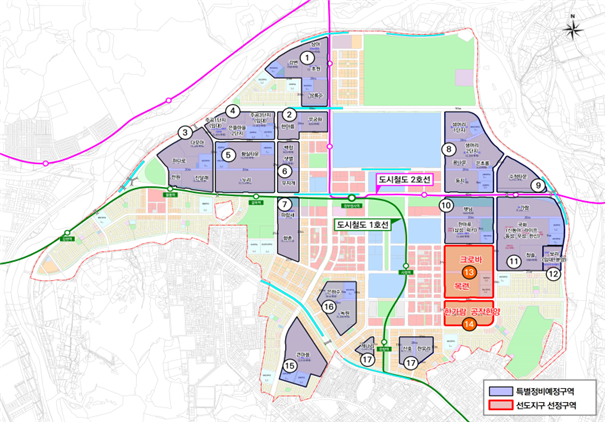
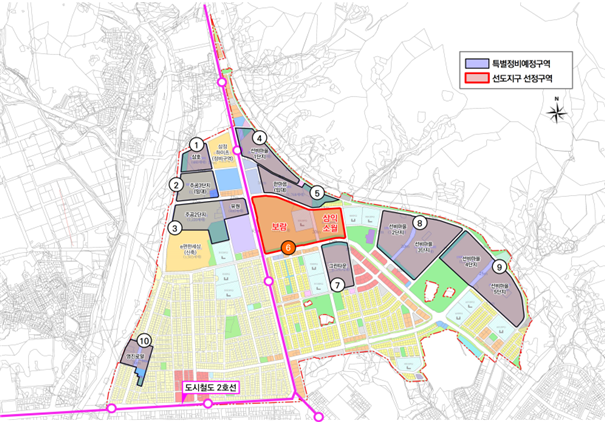
On the 31st, Daejeon Metropolitan City finalized and issued the 2035 Daejeon Aging Planned City Redevelopment Master Plan for Dunsan and Songchon Districts under the Special Act on the Redevelopment and Support of Aging Planned Cities. The project targets aging urban areas of more than 1 million square meters that were developed more than 20 years ago after land development, and it will serve as a guide for Daejeon's downtown redevelopment over the 10 years from this year through 2035.
The key feature of the master plan is a sweeping easing of building regulations. In Dunsan District, which covers 8.7 million square meters, the base floor area ratio has been raised sharply from 226% to 360%. As a result, the planned population will rise by 41,000, from 158,000 people in 74,000 households to 199,000 people in 94,000 households. Daejeon Metropolitan City presented the vision of a "vibrant city with a balanced work-life environment" and said it will build a multi-core downtown linked by administrative, knowledge, and residential functions, along with a park and green network that revitalizes the city center.
Songchon District, which spans 2.7 million square meters including Jungni and Beopdong districts, will also see its base floor area ratio rise from 239% to 360%. Its planned population will increase by 10,000, from 59,000 people in 27,000 households to 69,000 people in 33,000 households. Promoted as a "smart health city for a new daily life," Songchon District will also undergo a reorganization of its three-dimensional transportation network, including the creation of pedestrian-friendly neighborhood zones, the Urban Railway Line 2 tram, and development around Jochajang Station.
The notice also laid the legal and institutional groundwork for the redevelopment project at an early stage. In all designated special redevelopment candidate zones, a residents' representative group can be formally formed with the consent of a majority of landowners and approval from the designating authority. The group will take charge of selecting project operators and preparing special redevelopment plans. Zones already designated as leading districts this year are now moving ahead with the formal designation of special redevelopment areas, while zones not selected are expected to begin full-scale preparations in line with the announcement of next year's redevelopment quota in October.
Choi Jong-soo, head of Daejeon Metropolitan City's Urban Bureau, said, "This notice has established the broad framework for Daejeon's own aging planned city redevelopment." He added, "We will do our utmost not only to provide institutional support that residents can feel, but also to manage relocation demand systematically and expand infrastructure."
However, preventing a large-scale relocation crisis caused by the designation of major reconstruction complexes has emerged as Daejeon's biggest challenge, alongside efforts to speed up redevelopment projects. In addition, as higher floor area ratios pave the way for high-rise, high-density development, concerns are growing over the strain on urban infrastructure such as water and sewage systems, roads, and schools.
[email protected] Kim Won-joon Reporter