KTX and SRT to Be Operated Under Unified KTX Service Starting Sept. 1; More Seats and Discounts Ahead
- Input
- 2026-08-31 11:00:00
- Updated
- 2026-08-31 11:00:00
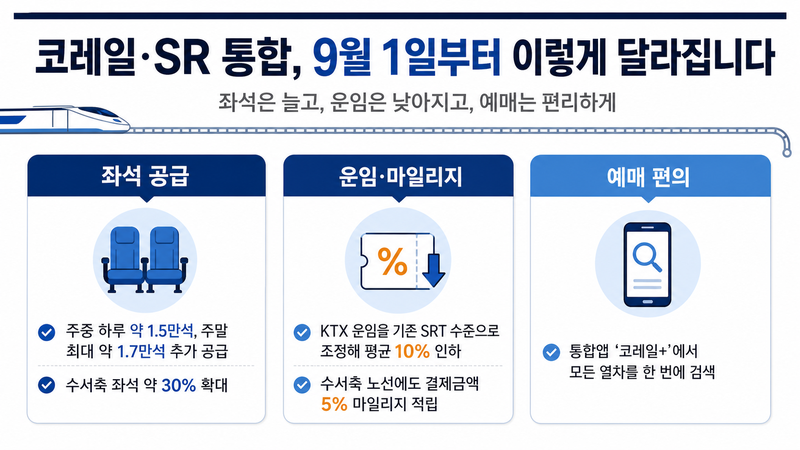
According to the Ministry of Land, Infrastructure and Transport on the 31st, the integration of KORAIL and SR will merge the previously separate systems for high-speed rail operations, ticketing, and services into one.
The first change passengers will notice is the integration of booking channels. The existing KorailTalk and SRT apps were unified into Korail+, which was launched on Aug. 3. This will reduce the inconvenience of having to check and buy KTX and the existing SRT tickets from Suseo through different apps.
Seat supply will also increase under the integrated train operation plan. The government tested cross-operation in February and coupled-train operation in May to check safety and actual operating conditions. It said the plan was designed to reflect demand and regional fairness.
Fares and the mileage system will also be merged into one. Public discounts and special discounts for pregnant women and young passengers, which were separately managed by KORAIL and SR Corporation, will be integrated in a way that benefits users.
In the medium to long term, additional seats will be supplied through fleet expansion. Starting in 2027, 31 new high-speed train sets, each with eight cars and 500 seats, will be introduced sequentially. Each new train set will have about 90 more seats than the existing KTX-Sancheon.
The number of high-speed train services will also increase in line with rail infrastructure expansion, including the double-tracking of the Pyeongtaek–Osong section. The government said it plans to continuously expand seat supply during peak times when tickets are hard to get, by adding new trains and increasing track capacity.
Station guidance and crowd-management systems will also be reorganized to match the unified operation. The ministry and related agencies will jointly inspect driver training, coupling and decoupling procedures for coupled trains, responses to train delays, and station crowd management caused by increased passenger numbers before and after the integration.
An emergency response team will be operated on a permanent basis through the end of the year to address operational issues and passenger inconvenience. In September, a comprehensive emergency drill will be held on the Suseo–Pyeongtaek high-speed railway, and manpower and facilities will be supplemented if needed.
After the integration, customer satisfaction, punctuality, booking convenience, and the information system will continue to be reviewed. Passenger feedback received through the VOC will also be reflected in service improvements.
KORAIL President Kim Tae-seung said, "Even after the integration, we will continue to place railway safety as the top value in management and pay closer attention to risk factors on site. We will do our utmost to ensure a railway that the public can use with confidence."
SR CEO Jung Wang-guk said, "SR has steadily built up its capabilities while operating the Suseo-based high-speed rail service. We hope that this experience and expertise will continue as a valuable asset at KORAIL and return to the public as safer and more convenient rail services."
Meanwhile, KORAIL will temporarily establish an "Integrated Business Management Division" within its existing organization to take over SR's duties. The division will be granted autonomous authority needed to operate the Suseo-based high-speed rail service.
The Integrated Business Management Division will operate during a stabilization period of up to three years. One year after the integration, the company plans to assess progress and organizational stability before deciding on the exact operating period.
SR employees will be fully transferred on the condition that their existing working conditions are maintained. Details such as employment, job duties, compensation, and welfare will be adjusted through labor-management consultations. After the integration, a tripartite consultative body will also be operated to review the protection of SR employees' employment and treatment, as well as the implementation of agreed measures.
[email protected] Choi Ga-young Reporter