Iceland Says It Will Halt EU Accession Talks After Referendum Rejection
- Input
- 2026-08-31 07:13:30
- Updated
- 2026-08-31 07:13:30
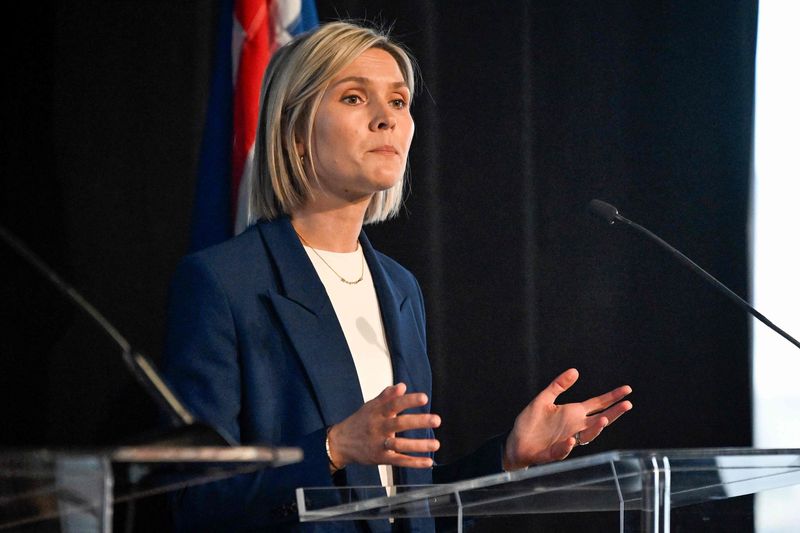
[Financial News] The Icelandic government said it will no longer seek European Union membership after a referendum on accession was rejected.
According to the public broadcaster RUV, Prime Minister Kristrún Mjöll Frostadóttir said at a press conference on the 30th (local time) that she respected the results of the vote held the previous day. She said she was proud that more than 80% of eligible voters had spoken, adding, "Our government will not pursue accession talks during this term, which runs until 2028." She also said, "We have learned a major lesson that the public is satisfied with the European Economic Area (EEA) agreement," and added, "We will continue to strengthen our relationship with the EEA." In connection with this, Iceland's Ministry for Foreign Affairs said it will discuss detailed issues, including the formal withdrawal of its EU membership application, at a meeting of the Foreign Affairs and Unification Committee on the 31st.
On the 29th, Iceland held a referendum on whether to resume EU accession talks. In the vote, which saw turnout of 82.5% among 225,000 eligible voters, the no camp led with 52.8%, ahead of 47.2% in favor. Support was stronger in urban areas around the capital, while opposition was more prevalent in rural and suburban regions.
With a population of just about 400,000, Iceland has faced repeated inducements and threats from both East and West since the Cold War because of its location near the Arctic Ocean and the former Soviet Union. After gaining independence from Denmark in 1944, Iceland joined the North Atlantic Treaty Organization (NATO) in 1949. Although it has no military or intelligence agency, it is protected by NATO under the condition that foreign troops are not permanently stationed there. In 1951, it signed a mutual defense agreement with the United States.
Iceland, a wealthy Arctic nation with the world's fifth-highest GDP per capita, is not an EU member but already belongs to the European Economic Area (EEA), allowing relatively free trade with the European Union. It is also part of the Schengen Agreement, which recognizes free movement within member states while accepting a large share of EU regulations.
Iceland first applied for EU membership in 2009, after the collapse of three major domestic banks pushed its financial crisis to a peak in 2008. After recovering from the economic downturn, Iceland froze accession talks in 2013 as concerns grew that the Eurozone, which uses the euro and includes 21 countries, could collapse amid the debt crisis in Southern Europe, including Greece. In March 2015, it asked the EU to remove its candidate-country status.
The ruling party led by Frostadóttir had supported EU membership on security grounds. Iceland has recently drawn the attention of major powers as global warming and the opening of Arctic shipping routes have prompted Russia and China to accelerate development in the Arctic. Meanwhile, U.S. President Donald Trump, who took office last year, had openly claimed even before his inauguration that he would annex Greenland, a Danish territory. Billy Long, the U.S. ambassador to Iceland, sparked controversy in January by telling members of the U.S. House of Representatives in a private meeting before his appointment that "Iceland will become the 52nd state of the United States" and that "I will be the governor."
Meanwhile, the anti-EU camp argued that joining the bloc could strip Iceland of its independent legislative and regulatory powers. In particular, it feared losing control over fisheries, a key industry that accounts for 40% of exports.
Nigel Farage, leader of Reform UK and a driving force behind Britain's exit from the EU, wrote on social media platform X on the 30th, "Congratulations to Iceland for choosing to preserve its independence." Marine Le Pen, a lawmaker from France's National Rally, also welcomed the vote, saying it showed "a Europe where free sovereign nations voluntarily cooperate for the common good."
[email protected] Reporter Park Jong-won Reporter