China's CXMT commercializes LPDDR6 before Samsung and SK hynix, to be used in Xiaomi's '18 Fold'
- Input
- 2026-08-30 18:44:58
- Updated
- 2026-08-30 18:44:58
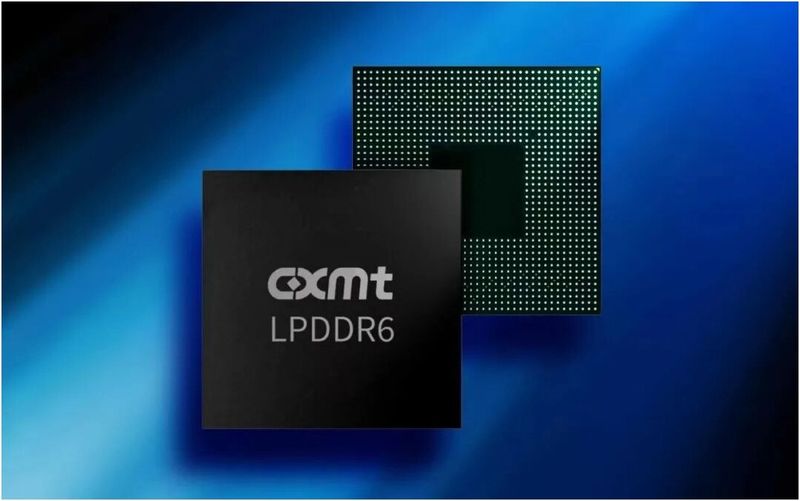
[Financial News] In the global DRAM market long led by Samsung Electronics and SK hynix, China's ChangXin Memory Technologies (CXMT) is closing the gap quickly. CXMT has officially announced mass production of its next-generation mobile DRAM, LPDDR6, and secured Xiaomi as its first customer.
The move is drawing attention because a Chinese company has formally announced mass production of next-generation high-performance memory before its Korean rivals.
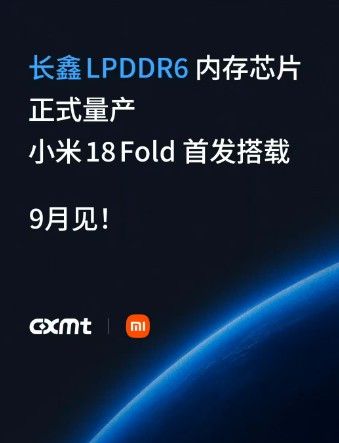
On the 30th, Yonhap News Agency, citing reports from Chinese media, said CXMT posted on Weibo the previous day that "CXMT's LPDDR6 memory has entered formal mass production" and that it "will be used first in Xiaomi's new foldable smartphone, the '18 Fold.' See you in September."
Xiaomi also made its partnership with CXMT official.
Xiaomi CEO Lei Jun wrote on Weibo, "Congratulations on CXMT's mass production of LPDDR6. It's truly remarkable," and said Xiaomi's latest artificial intelligence (AI) processor, the Xuanjie O3, will be the first to support CXMT's LPDDR6 and will be installed in the 18 Fold.
He added, "This is only the beginning," and emphasized, "I believe more outstanding Chinese science and technology companies will join forces and rise to the top in the future."
CXMT previously disclosed in its semiannual report that its LPDDR6 products support data transfer speeds of up to 12,800Mbps and a capacity of 16Gb. The report also said the company was supplying samples to key customers for validation and accelerating preparations for mass production.
LPDDR is a low-power DRAM mainly used in mobile devices such as smartphones and tablets. Because it can process data quickly while reducing power consumption, its importance is growing as smartphone AI features become more advanced.
The next-generation LPDDR6 standard is expected to expand beyond smartphones to PCs, smart vehicles and servers. China's Securities Journal reported that "as AI demand surges, LPDDR6 is being viewed as a key pillar supporting on-device AI computing power."
Competition to secure an early lead in the LPDDR6 market is already heating up across the global memory industry.
SK hynix announced in March that it had succeeded in developing 16Gb LPDDR6 using its 10-nanometer-class sixth-generation (1c) process. It also said it planned to complete preparations for mass production in the first half of the year and begin supplying products to customers in the second half.
Chinese media had predicted at the time that SK hynix might preempt the next-generation market by supplying LPDDR6 first to Chinese smartphone makers, including Xiaomi, to counter CXMT. In the end, however, CXMT secured Xiaomi as its first LPDDR6 supplier.
Samsung Electronics also showcased an LPDDR6 product at CES 2026 in Las Vegas in January. However, the company has not yet disclosed a specific timeline for mass production.
China's Securities Journal described CXMT's announcement as "the world's first commercialization of an LPDDR6 product." It also said this was the first time a Chinese memory maker had mass-produced a new international standard high-performance memory product ahead of the rest of the world.
[email protected] Seo Yoon-kyung Reporter