The era of buying U.S. Treasuries just because they are U.S. Treasuries is over... Higher rates driven by falling confidence [Global Report]
- Input
- 2026-08-30 18:24:14
- Updated
- 2026-08-30 18:24:14
On the surface, the move is meant to improve market liquidity. But the market sees it as a sign that the U.S. government is growing increasingly concerned about national debt that has topped $40 trillion and long-term rates that remain stubbornly high.
■ China, Japan and the U.K. all cut back
Donald Trump’s America First policy is making allies, which have long provided steady demand for U.S. Treasuries, more hesitant to buy. Allies have helped support Treasuries even when yields were slightly expensive, but recent signs point to a subtle shift. In other words, the world is still investing in the United States, but whether it will continue to lend money to the U.S. government as cheaply as before is another matter.
According to the international capital flow data (TIC) released by the U.S. Department of the Treasury on the 17th local time, foreign holdings of U.S. Treasuries stood at $9.299 trillion in June, down about $72 billion from $9.371 trillion in the previous month. That was still up 2.3% from a year earlier, but Japan, the U.K. and China, the three largest overseas holders of U.S. Treasuries, all reduced their holdings.
Japan, the largest holder, cut its U.S. Treasury holdings by 2.3% from $1.143 trillion in May to $1.116 trillion in June. The U.K., in second place, also reduced its holdings by 1% over the same period, from $948.6 billion to $939.9 billion. The most notable change came from China. Its U.S. Treasury holdings fell 4% in just one month, from $659.3 billion in May to $633.4 billion in June. Compared with a year earlier, the decline was more than 13%. China, once the largest creditor to the United States, has now fallen to third place behind Japan and the U.K.
That does not mean foreign investors are dumping U.S. Treasuries en masse. Total foreign holdings of U.S. Treasuries are still higher than a year ago. The TIC statistics also have a limitation: they make it difficult for the U.S. Department of the Treasury to identify the ultimate owners of Treasuries held through financial institutions in third countries.
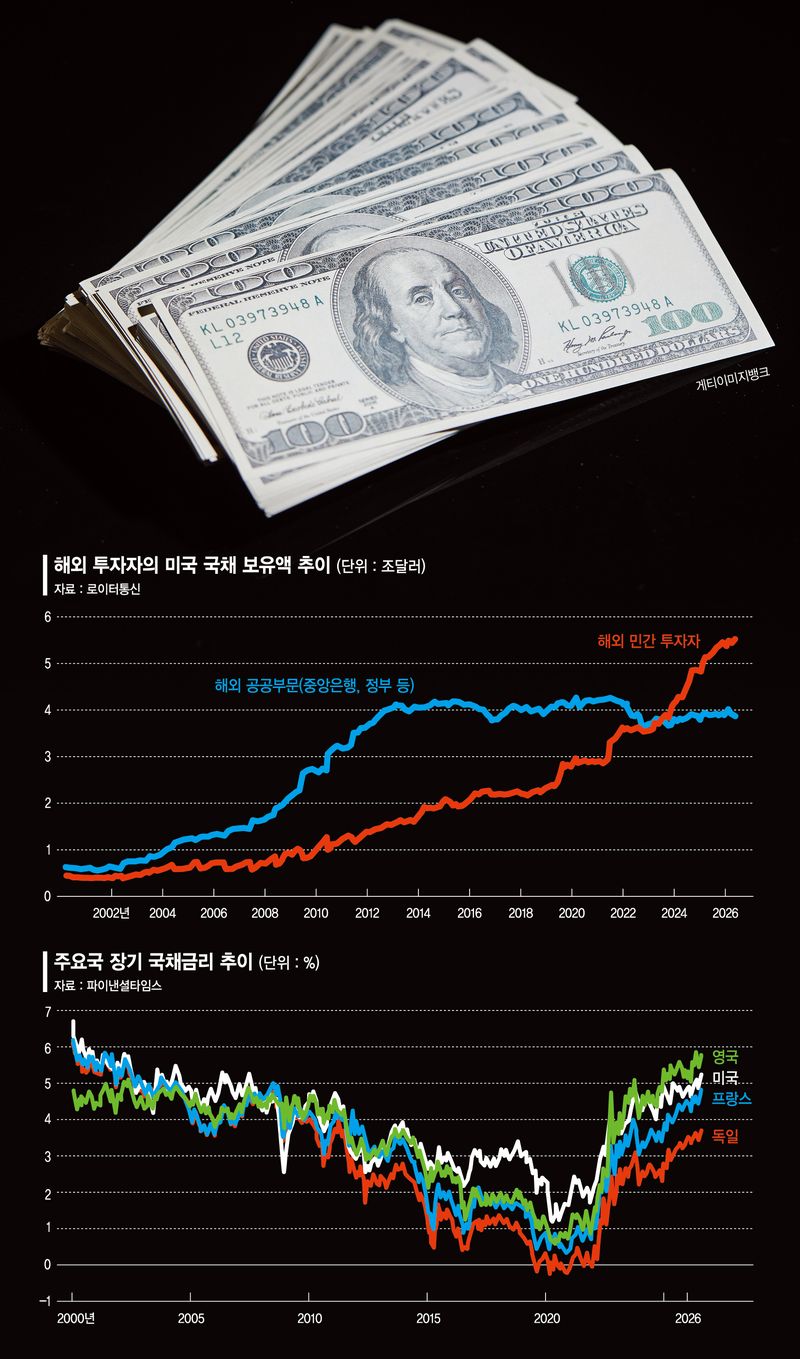
The more important change is not the absolute amount held, but who is taking on America’s debt. After the financial crisis, the share of U.S. Treasuries held by foreigners once rose to about 57%, but by the end of 2025 it had fallen to around 32%. In a separate annual survey by the U.S. Department of the Treasury, the foreign share has also remained at about 33% since 2020. Over the same period, the share of foreign-held U.S. Treasuries owned by official institutions such as central banks fell from 59% to 43%. In other words, while the amount of Treasury issuance by the U.S. government has surged, demand from foreign central banks, which once served as a stable source of funding, has not kept pace.
■ From 'I buy it because it's a U.S. Treasury' to 'How much will you pay?'
A shift in who buys U.S. Treasuries is more than a statistical change. One of the main reasons central banks in China and Japan bought Treasuries was to manage foreign exchange reserves. Even if the yield was somewhat low, they needed to hold dollar assets, which offer the world’s deepest liquidity and greatest safety. They were relatively price-insensitive buy-and-hold investors.
Their place is now being filled by mutual funds, banks, hedge funds, households and foreign private investors. According to Barclays PLC, the amount of U.S. Treasuries traded in the market has grown more than sevenfold, from about $4 trillion in 2006 to $29 trillion this year. In 2006, private and official sectors each held roughly half of the market. Today, private investors account for 73%, while the official sector, including the Fed and foreign central banks, has fallen to 27%. Barclays PLC said this means demand for Treasuries has become "materially more price sensitive" than before.
Private investors are different. They have no reason to accept lower yields simply because the bonds are issued by the U.S. government. They demand extra compensation for the uncertainty that comes with lending money for a long period, including inflation and interest-rate volatility. This is the so-called term premium.
Recent capital flows also show the change. Foreign private investors bought a net $329 billion in medium- and long-term U.S. Treasuries over the 12 months through June, down more than 40% from the same period a year earlier. Net buying in June was just $16.6 billion, the lowest since January, while official institutions such as foreign central banks sold a net $9.8 billion that month. Over the past 12 months, official institutions have also sold a net $34.9 billion in medium- and long-term U.S. Treasuries.
In the end, the more Treasuries the U.S. government issues, the more it must offer sufficient yields to attract price-sensitive private investors. That is why it is difficult to explain the 30-year yield moving above 5% solely through the Fed’s policy rate outlook.
■ The U.S. is not leaving America; it is buying U.S. companies
What is more interesting is that foreign money is not leaving the United States itself.
In June, foreign private investors bought a record net $144.7 billion in U.S. stocks. Over the past 12 months, the total reached $805 billion, up 26% from the same period a year earlier. By transaction basis, foreign investors posted net inflows of only $6.8 billion into U.S. Treasuries in June, while $181.4 billion flowed into U.S. stocks.
The world is not abandoning the United States. Instead, it is betting more on the growth of U.S. companies rather than lending to the U.S. government. The AI investment boom is making this trend even more complex. Expectations for growth at U.S. technology companies such as NVIDIA Corporation are drawing foreign capital into U.S. equities, while Big Tech names such as Amazon.com, Inc. and Alphabet Inc. are also raising massive sums in the bond market to build data centers and AI infrastructure.
This year, the volume of AI-related corporate bond issuance in the U.S. has already reached $220 billion, more than 17 times last year’s $12.5 billion. By mid-August, total U.S. corporate bond issuance this year had also reached $1.68 trillion, up 27% from a year earlier. As AI-related bond supply has surged, the spread on technology company bonds has widened to 89 basis points, 9 basis points above the broader investment-grade corporate bond market.
For global bond investors, that means more choices. They can not only lend to the U.S. government for 30 years, but also earn higher yields through long-term corporate bonds issued by top-tier Big Tech companies.
Of course, it is difficult to say that AI corporate bonds are the main cause of rising U.S. Treasury yields. The U.S. Treasury market is far larger than the AI corporate bond market. Still, it is clear that a structure is emerging in which the U.S. government and companies are simultaneously seeking large amounts of long-term funding and competing for global investors’ money.
■ A $40 trillion debt burden and the paradox of America First
The problem is that there is no sign the U.S. government’s funding needs will ease.
U.S. national debt surpassed $40 trillion for the first time on the 19th. Of that, privately held debt, including Treasuries, amounts to $32.3 trillion. Total national debt, which stood at $19.95 trillion when Trump first entered The White House in 2017, has more than doubled in less than 10 years. Interest costs have already surpassed Medicare and become the second-largest spending item in the federal budget after Social Security.
Since 2019, the U.S. fiscal deficit has exceeded 4% of GDP every year. Federal interest payments alone now amount to about 3% of GDP. The problem is that large deficits are becoming structural, even without an emergency such as a recession or war.
The Trump administration’s second-term tax cuts are adding to the burden. Corporate tax revenue is falling due to measures such as expanded expensing for AI capital investment, while structural spending on welfare and defense continues to rise. Based on the Congressional Budget Office (CBO)’s long-term outlook, federal debt held by the public, excluding intragovernmental holdings, could reach $56 trillion by around 2036.
■ The Treasury itself steps in... Is 5% the new normal?
If the role of foreign central banks continues to shrink and price-sensitive private investors take on more of the U.S. government’s debt, the story changes. Unless inflation and the fiscal deficit improve significantly, the 30-year yield may not easily return to the 3% range even if policy rates come down.
In the end, it is possible that 5% on the 30-year bond is not a temporary peak, but a new starting point. If long-term rates remain stuck in the 5% range, the impact will not be limited to the bond market. It will push up mortgage rates and corporate financing costs, weighing on housing and investment. At the same time, it will increase the interest burden on newly issued government debt. Higher interest costs could then widen the fiscal deficit again and lead to even more Treasury issuance. It is a vicious cycle: rising debt, more Treasury issuance, higher long-term rates, higher interest costs and a larger fiscal deficit.
In the long run, the debate over fiscal dominance is also likely to intensify. It refers to a situation in which government debt and interest costs become so large that central bank policy is influenced more by the government’s financing burden than by price stability. It is too early to say that the U.S. has entered fiscal dominance, but warning signs are already appearing. Janet Yellen, former Fed chair and former Treasury secretary, warned at the annual meeting of the American Economic Association (AEA) in January that "the preconditions for fiscal dominance are clearly strengthening." Yellen noted that if the government’s fiscal position overwhelms monetary policy, the Fed could face pressure to keep rates lower than needed to fight inflation or to buy large amounts of Treasuries to ease the government’s financing burden.
Dollar hegemony is not ending. Global money is still flowing into the United States. Only the destination has changed. In June, foreign capital left $6.8 billion in U.S. Treasuries and $181.4 billion in U.S. stocks.