Chey Tae-won: "Connecting Youth Labor Markets in Korea and Japan Could Be a Solution to Low Birth Rates"
- Input
- 2026-08-30 18:04:29
- Updated
- 2026-08-30 18:04:29
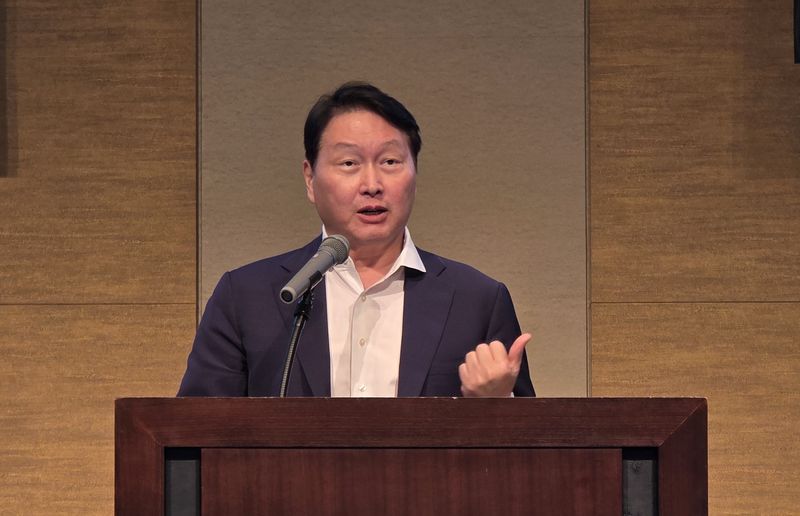
Voices were also raised calling for structural reforms that go beyond simple cash assistance to improve opportunities for jobs, housing, and mobility. ■ "Beyond Tourism to Employment and Settlement in Korea and Japan" In his opening remarks at the "1st Korea-Japan Symposium on Low Birth Rate Countermeasures" held at the Westin Hotel Sendai in Miyagi Prefecture, Japan on the 30th, Chairman Choi emphasized, "We must ensure that careers and qualifications acquired in one country can be utilized in another," adding that "young people must be able to broaden the horizons of income and opportunity. " Chairman Choi called for expanding tourism exchanges to include employment, education, and settlement, given that the number of people traveling between Korea and Japan exceeded 13 million last year.
He stated, "Tourism alone is insufficient," and added, "We must further expand opportunities to work and learn while traveling between the two countries. " He identified unstable employment and income among the youth as the core causes of the low birth rate. Chairman Choi diagnosed, "The biggest reason young people cannot choose marriage and childbirth is that stable employment and income have not been secured," adding that "they postpone marriage and childbirth or even give them up entirely.
" He also emphasized the responsibility of corporations. "The share of companies is clear," he said, "we must create good jobs and establish workplaces where people can raise children while working. " Chairman Choi proposed three measures for Korea-Japan cooperation: expanding employment and education opportunities between the two countries, revitalizing regional exchanges, and improving productivity using artificial intelligence (AI).
He also stated that exchanges, currently concentrated in the capital area and major cities, should be expanded to provincial regions to create jobs and business opportunities. He also called for addressing labor shortages and welfare burdens through AI and care robots.
"While the number of people available to work is decreasing, the number of people requiring care and medical services continues to increase," Chairman Choi said. "AI can serve as a tool to alleviate these burdens.
" He added, "By utilizing care robots and AI, we can reduce social costs while increasing the value created by a single young person. " He emphasized, "The people who will enter the labor market have already been born, but the value they will create has not yet been determined," adding, "We must start by enabling young people to travel between the two countries to work and learn, and by expanding exchanges to the local level.
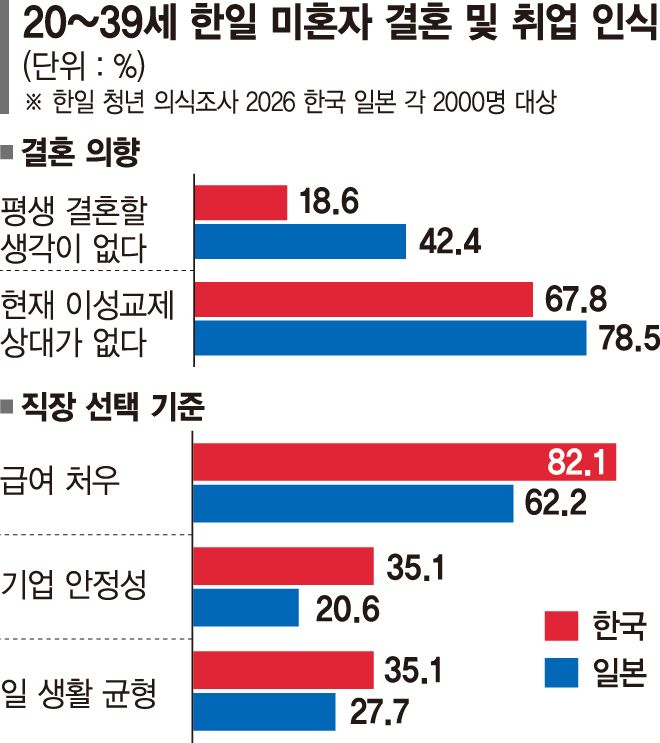
" ■ 42% of Japanese Will Not Marry. Employment and Housing Burdens in Korea The 'Korea-Japan Youth Awareness Survey 2026,' released on this day, also revealed that insecurity regarding employment and income is constraining marriage and childbirth.
6% in Korea. 3 times higher than Korea.
Korean youth showed a relatively high intention to marry, but faced significant burdens regarding employment and housing. 2% in Japan.
7%, respectively. 3 percentage points.
Regarding conditions for childbirth, both countries cited the reduction of economic burdens the most. Korea also generally had higher demands than Japan for improvements in the working environment, such as guaranteed leave of absence and return to work, reduction of long working hours, and adjustment of fathers' work schedules.
On this day, the business communities of Korea and Japan officially launched the "Korea-Japan Exchange Committee on Measures to Address Low Birth Rates. " Chairman Choi and Ken Kobayashi, Chairman of the Japan Chamber of Commerce and Industry, served as co-chairs.
The committee conducts joint research on youth employment, housing, social security, and imbalances between urban and rural areas, and also reviews policy recommendations.
[email protected] Reporter