Hyun Song Shin Says Preemptive Rate Hikes Strengthened the Won’s Resilience, Leaving Room for Further Gains in the Exchange Rate
- Input
- 2026-08-30 18:12:49
- Updated
- 2026-08-30 18:12:49
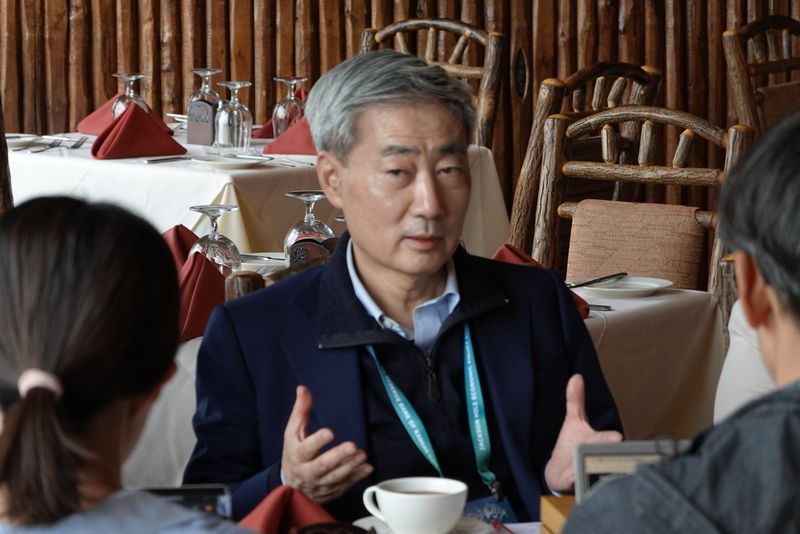
[Financial News] Hyun Song Shin, governor of the BOK, said South Korea’s preemptive rate hikes have improved the won’s ability to absorb external shocks, expressing confidence that the country can also carry out its investment plans in the United States without disruption.
At a meeting with Korean correspondents during the Jackson Hole Economic Policy Symposium in Wyoming on Aug. 28 local time, Shin said, "I think there is room for the won-dollar exchange rate to fall further." It was the first time he had attended the annual Jackson Hole meeting in his capacity as BOK governor, after participating every year while working at the Bank for International Settlements (BIS). He stressed that "the exchange rate is a very important variable that reflects all indicators, including confidence in the Korean economy," adding that "we are now well prepared for most shocks." In Seoul's foreign exchange market on Aug. 28, the won closed at 1,372.5 per dollar, down from the previous session and at its lowest level in 13 months.
Shin also pointed to the central bank's role in stabilizing the foreign exchange market, while citing SK hynix's recent listing of American Depositary Receipts (ADR) in the United States and increased dollar selling by exporters as short-term factors supporting the won. He also drew a line on the impact of South Korea's agreement to invest up to $20 billion a year in the United States. "The investment agreement with the U.S. means that if conditions are not right, we can invest less or not invest at all," he said. "As foreign reserves stood at $427 billion as of last month, it is a level we can fully manage."
On Kevin Warsh's Jackson Hole speech, Shin said the message was "much clearer than it was at the July FOMC meeting," underscoring the importance of the upcoming Sept. 15-16 meeting. He added that Warsh had established the logic that inflation has remained well above the 2% target for a long time and that the policy rate is the tool to address it. "It was clearly different from the July press conference in that it clarified the role of the central bank," he said.
Regarding the process of abolishing forward guidance, Shin said his personal relationship with Warsh had played a role. "Warsh and I often talked about the need to be careful with our words, and in this speech he even cited my paper on the importance of two-way communication between central banks and markets," he said. On South Korea's newly introduced dot plot, he said, "I do not view it that negatively," adding that it would be assessed comprehensively with the Monetary Policy Board members in a year.
On the U.S.-South Korea interest rate gap, Shin said, "Just because the U.S. raises rates does not mean we have to follow automatically." He added, "We will not mechanically track the gap, and in the second half of the year we will operate policy based on the Monetary Policy Board's own judgment," signaling an independent monetary policy stance.
Shin also said the BOK's digital currency experiment, Project Han-gang, was cited several times as a model case at the symposium. However, he said policy issues related to the administration, such as Treasury bond purchases being pursued by Scott Bessent, were not discussed because the event was centered on central bank governors.
[email protected] Yoon Jae-jun Reporter