Southeast Asia Sees a Surge in “Red Tech” as Chinese-Language Credentials Become the New Must-Have
- Input
- 2026-08-30 17:57:13
- Updated
- 2026-08-30 17:57:13
■ Chinese majors take the lead as university cutoff scores overtake Korean
The shift is first becoming visible in university admissions. In Vietnam, the arrival of production bases from Samsung Electronics and other Korean companies once made Korean-language departments a “golden ticket” to employment. This year, however, Chinese-related majors have pulled far ahead of Korean in admissions competitiveness at major universities.
At Hanoi University, the cutoff score for the Chinese major this year was 34.35 points, surpassing the Korean major at 34.10 points. At the University of Languages and International Studies under Vietnam National University, the Chinese language and culture major also outperformed Korean, with a score of 27.03 points versus 24.69 points. In the HSK, the Chinese proficiency test, Vietnam had more than 146,000 test takers in 2025, ranking first.
The trend is also changing among students who are not Chinese majors. Dr. Dinh Thu Hoai, a lecturer in the Chinese language and culture department at the University of Languages and International Studies under Vietnam National University, told this paper, "In the past, Chinese classes were mostly attended by students majoring in Chinese. Now, students from a wide range of majors are coming to learn Chinese." She added, "I can clearly feel that more students are studying Chinese for employment."
■ Chinese gains even more influence in the job market
Chinese is also gaining influence rapidly in the job market. According to an analysis by Vietnam’s recruitment platform JobOKO of more than 581,660 job postings over 10 months in 2025, about 13,000 jobs required Chinese proficiency, up nearly 50 percent from a year earlier. The pace of demand growth for Chinese-speaking workers was about twice that for Japanese and five times that for Korean.
The Chinese-language craze is also intense in Thailand. In university admissions, Chinese is the most commonly chosen second foreign language, more than twice as popular as Japanese, which ranks second. The base for Chinese education is also expanding quickly. More than 2,000 schools, including elementary, middle and high schools and vocational schools, now offer Chinese classes, and more than 1 million students are learning Chinese as part of the regular curriculum. In particular, as local production by Chinese electric vehicle makers increases, Chinese education is being strengthened at vocational schools that teach automotive technology and maintenance.
■ Chinese companies move south following Apple’s supply chain and EV plants
Behind the Chinese-language boom in Vietnam and Thailand is the southward expansion of Chinese tech companies. As the U.S.-China rivalry over technological supremacy intensifies, Chinese firms are dispersing production bases across Southeast Asia to avoid U.S. restrictions while also accelerating supply-chain building to secure local markets.
China’s expansion into Southeast Asia, which once centered on labor-intensive manufacturing such as textiles and shoes, is now rapidly broadening into advanced industries such as electronics, batteries, electric vehicles and solar power. As Chinese headquarters and local production and procurement networks move together, the areas where Chinese companies directly compete in Southeast Asia’s industrial sites are also widening.
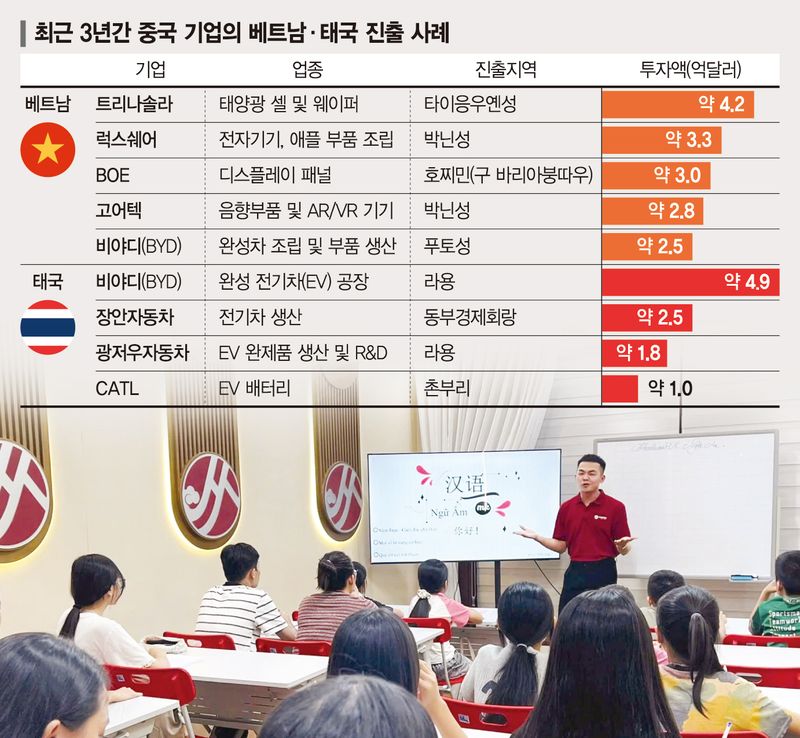
In Vietnam, Chinese companies are expanding production facilities mainly in the northern region. China’s FDI into Vietnam has ranked first in terms of new projects over the past two years. Luxshare Precision Industry and Goertek, major suppliers in Apple’s supply chain, have expanded their production facilities in Vietnam, while solar company Trina Solar and EV makers BYD and Chery Automobile are also increasing local production.
In Thailand, the relocation of China’s EV ecosystem is especially notable. BYD began by investing about $490 million in Rayong to build a plant with annual capacity of 150,000 vehicles. Changan Automobile, GAC Aion, Great Wall Motor and Chery Automobile have since followed with their own local production plans.
■ Competition for local talent intensifies as Chinese-speaking workers become highly valued
As Chinese companies move south, competition for talent is intensifying. Chinese firms are aggressively trying to secure not only local workers who can speak Chinese, but also employees who have already gained experience in Southeast Asia’s manufacturing sector. Hu, who works for a Chinese electronics company in Vietnam, landed a job before graduating from a Chinese-language department in Hanoi. "My salary is two to three times higher than that of ordinary Vietnamese companies, and in months with incentives it is even higher than Samsung’s," Hu said. "The company still lacks workers and is recruiting aggressively."
In Vietnam especially, Chinese electronics and parts companies are recruiting workers with hands-on experience in production, quality control and process technology, raising concerns that Korean companies may lose talent. From the perspective of Chinese firms, it is faster and more efficient to bring in workers who already have manufacturing experience at Korean companies than to train new staff from scratch after setting up local production facilities.
[email protected] Reporter