Housing tax controversy and stock market slump weigh on Lee administration's push for a turnaround [Lee administration's mid-scale cabinet reshuffle]
- Input
- 2026-08-30 17:52:46
- Updated
- 2026-08-30 17:52:46
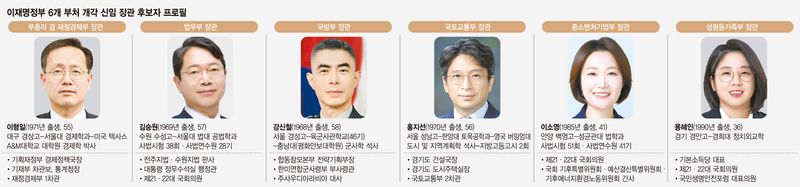
Among the appointments announced by Cheong Wa Dae, the most notable was the replacement of the deputy prime minister for economic affairs. Because Koo Yun-cheol's replacement had not been widely expected, analysts say the move carries a reform message amid recent controversy over economic policy, including housing taxes and the stock market.
Cheong Wa Dae, however, drew a line against interpreting the reshuffle as punitive. Chief of Staff Kang Hoon-sik said the successor was not chosen because of any assessment of the outgoing minister, and explained that Lee Hyoung-il was selected for his strong policy execution capabilities.
A senior Cheong Wa Dae official described the reshuffle as an effort to "tighten our shoelaces and run hard again." The remark suggests that the administration is not discarding existing policies or making a major course correction, but instead trying to speed up the point at which results are felt in people's daily lives.
The administration also promoted sitting vice ministers to lead both the economic team and the Ministry of Land, Infrastructure and Transport. The goal is to place officials who know the policy direction and internal workings best at the center of key areas such as the economy and housing, minimizing disruption from personnel changes and improving execution.
In the case of the land ministry, housing supply expansion has recently emerged as a major issue, making speed and results in implementation more important than policy design alone. The Ministry of Economy and Finance still faces the task of linking improvements in growth and tax revenue to conditions that people can actually feel. Promoting sitting vice ministers is seen as a way to preserve policy continuity while raising accountability and authority. Rather than rewriting the policy playbook, the administration is betting on how quickly and precisely it can carry out the measures already in place.
By contrast, ministries where legislation and interest coordination matter were assigned active politicians. The Ministry of Justice received a lawmaker who has handled criminal justice reform as the National Assembly's Legislation and Judiciary Committee secretary, while the Ministry of SMEs and Startups and the Ministry of Gender Equality and Family were also staffed with lawmakers active in related standing committees and policy fields.
With the Regular National Assembly session approaching, the reshuffle appears designed to strengthen momentum for turning major state tasks, including judicial reform and livelihood legislation, into actual bills and budgets.
Another hallmark of the reshuffle is that the talent pool was expanded beyond the Democratic Party of Korea. A lawmaker from the Basic Income Party was tapped as a candidate for the State Council, and a Rebuilding Korea Party lawmaker was appointed as Senior Presidential Secretary for AI Future Planning, who directly assists the president. Kang said the administration tried to bring in capable figures "who can work with the opposition as well," stressing that the only criterion was "ability." The move also aligns with the broader outreach Kim Min-seok has emphasized since taking office. It is being read as a message that the administration wants to widen the base for policy implementation by opening the door to the wider ruling bloc and specialists, not just internal party talent.
The appointments can also be seen as a way of using the strengths of bureaucrats and politicians differently depending on the task. For the economy and housing, the administration emphasized policy continuity and implementation experience. For judicial reform and livelihood issues, it leaned on coordination with the National Assembly. By bringing in figures from other parties to both Cheong Wa Dae and the cabinet, it also sought to broaden both policy expertise and political reach.
The reshuffle of the AI and political affairs lines follows the same logic. Ha Jung-woo, the former AI secretary, was moved to vice chair of the National AI Strategy Committee, while a new AI secretary and a megaproject aide were assigned to reorganize the control tower for future industries. Appointing Kim Kyung-soo, former chair of the Presidential Committee for the Era of Local Autonomy, as a political special adviser is seen as a move to reinforce the political function that connects the voices of the National Assembly and the regions to state affairs.
Attention is now turning to whether the personnel overhaul will end with this reshuffle. With the economic command center replaced, speculation is also growing over possible further adjustments to the Cheong Wa Dae policy team, including Kim Yong-beom, and to the economic and financial line, including Lee Eok-won, chairperson of the Financial Services Commission. Cheong Wa Dae has not officially confirmed any additional appointments, but if follow-up changes are made, this mid-scale reshuffle could effectively complete the administration's second-term governance structure. In the end, the success of the reshuffle will depend on whether the new lineup can deliver visible results quickly without disrupting policy continuity.
Meanwhile, as Lee carried out a sweeping reshuffle across six ministries, the Regular National Assembly session beginning on Sept. 1 is expected to see a fierce standoff between the ruling and opposition parties over personnel vetting. The ruling party is likely to push for swift adoption of confirmation hearing reports, arguing that the nominees have already demonstrated policy expertise and that government disruption must be minimized. The opposition, by contrast, is expected to launch a full-scale offensive with rigorous scrutiny.
[email protected] Sung Seok-woo Reporter