Construction Institute Says August 13 Measures Are Positive, But Low Start Rates Remain the Problem
- Input
- 2026-08-30 17:10:29
- Updated
- 2026-08-30 17:10:29
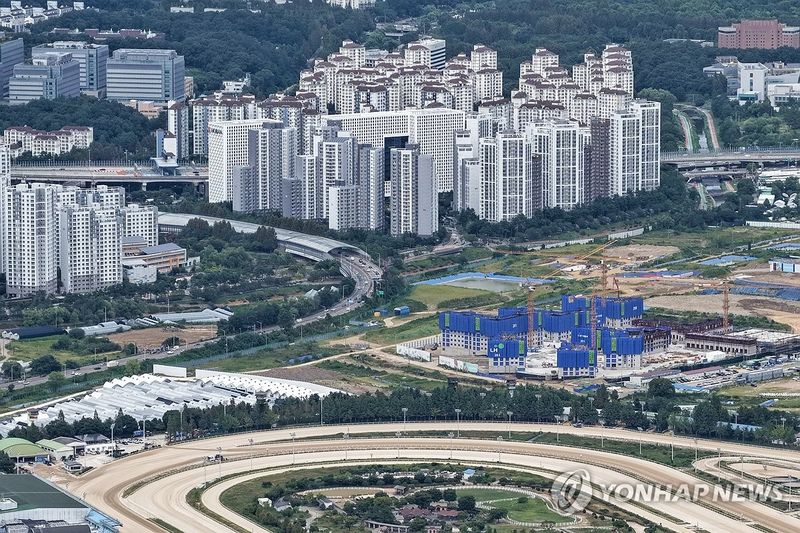
[Financial News] The government’s goal of building an average of 294,000 homes a year in the Capital Region is proving to be a difficult task in light of recent construction start figures. Because Korea’s housing supply system relies heavily on buyers’ funds through pre-sales, the target volume is unlikely to translate into actual starts unless demand-side measures such as financing and tax policy move in tandem. In the first half of this year, construction starts in the Capital Region fell far short of even one-quarter of the annual target.
According to the Construction Economy Research Institute of Korea on the 30th, the institute said in its report, "Key Contents and Evaluation of the August 13 Measures," that the government’s August 13 package had a positive direction because it aimed to expand supply. It added, however, that "the consistency among policy tools such as financing and tax measures needs to be improved."
Housing starts in the Capital Region totaled just 65,000 units in the first half of this year, meeting only 24.2% of the 269,000-unit annual target set by the September 7 measures. In Seoul alone, the figure was just 19.3%. Last year, construction starts in the Capital Region reached 167,000 units, equal to 56.8% of the annual target under the August 13 measures.
Over the 16 years from 2010 to 2025, annual construction starts in the Capital Region exceeded 294,000 units in only four years: 2015, 2016, 2017 and 2019. The institute said that over the next five years, annual starts would need to exceed 1.5 times the recent five-year average of 181,000 units in order to reach the target. Since the private sector handled 83.4% of Capital Region starts over the past five years, the recovery of the private construction and development market was identified as the biggest variable in meeting the goal. The report also called for concentrated administrative and financial support in the second half of the year to speed up implementation and send the market a clear signal of firm policy commitment from the outset.
The reason the institute emphasized demand-side support lies in the pre-sale structure. The report said that most housing supply in Korea uses a pre-sale model that draws on buyers’ funds. It added that without effective demand-stimulating measures, developers’ ability to secure financing would inevitably remain limited. That, the report said, could constrain the feasibility of large-scale supply roadmaps.
The report also cited overseas examples. It noted that even Germany, which pairs supply measures with demand support and builds 400,000 homes a year, and the United Kingdom, which targets 300,000 homes a year, achieved only 50% to 70% of their supply goals. This, it said, suggests that supply policy alone is not enough to meet targets.
The latest package raises the target for the Capital Region during the current administration to 1.47 million homes plus alpha by 2030, up from the 1.35 million homes in the September 7 measures, with an additional 120,000 homes plus alpha. The extra supply is composed of 57,000 homes plus alpha from public land, 5,000 homes plus alpha from expanded urban supply, and 59,000 homes plus alpha from private financing, tax support and deregulation. If supply after the current term is also counted, the additional effect rises to as many as 230,000 homes plus alpha.
As sales, jeonse deposits and monthly rents have all continued to rise at the same time, the government has rolled out its fifth comprehensive package, following last year’s June 27 measures, the September 7 measures, the October 15 measures and this year’s August 3 tax revision plan. The institute interpreted this as an effort to send an early signal to the market that supply will be expanded and accelerated.
A key tool for speeding up supply is the "fastest-start model," which aims to cut land development time by roughly half. Target sites include urban areas in Gangseo, Seoul, Namyangju and the Gyeonggi Gwangju Station Area 2 district, with construction set to begin within three to four years. The institute said, however, that because the 37-month start model was designed on the assumption of some regulatory improvements, there could be limits to shortening land development time unless follow-up reforms are carried out.
There were also large differences among Third New Towns sites. From the announcement of candidate sites to the first land development construction start, Incheon Gyeyang took about 40 months, while Namyangju Wangsuk and Hanam Gyosan took 54 to 57 months. The report said, "Because project timelines vary greatly depending on local conditions such as compensation, relocation and demolition, field-oriented project management is needed to identify and resolve the main delay factors by district and block."
On urban redevelopment projects, the institute said that "easing the consent threshold for establishing associations is a positive change," but added that "key issues that directly affect project feasibility, such as the reconstruction excess profit recovery system and restrictions on transferring association membership rights, were left out of this package."
The scope of floor area ratio incentives was also flagged as a problem. The report said that "the special rule allowing 1.3 times the maximum floor area ratio specified in any relevant statute applies only to public redevelopment projects, raising fairness concerns with the private sector." It added that incentives should be shifted toward a model based on public value and performance, rather than the project operator itself. The report concluded that only an approach that combines supply with demand, financing, tax policy, lease policy and urban planning can solve the structural problems in Capital Region housing supply, and that policy goals should not be limited to simply securing volume.
The August 13 measures refer to the combined package announced on the 13th at Government Complex Seoul by Kim Yun-duk, Minister of Land, Infrastructure and Transport of South Korea, Lee Eok-won, Chairperson of the Financial Services Commission, Im Gi-geun, head of the Office for Government Policy Coordination, and Lee Hyoung-il, first vice minister of the Ministry of Economy and Finance. The package included the "Rapid Housing Supply Plan for Stabilizing the Jeonse and Sales Markets" and the "Comprehensive Financial Measures for Stabilizing the Real Estate Market." The financial measures include expanded guarantees and funding for real estate project financing, support for young people and other end users, and this year’s household debt management plan.
Immediately after the announcement, the construction and housing industries, including the Korea Construction Association and the Korea Housing Association, welcomed the measures as easing financing burdens. They added, however, that follow-up steps such as passage of related bills in the National Assembly and implementation checks should be expedited. The Ministry of Land, Infrastructure and Transport and the FSC recently held regular meetings with the financial and construction industries to discuss ways to launch a support center for PF and construction firms facing financing difficulties, and the FSC decided to first implement 11 of the financial support tasks in the August 13 package that can be carried out within this month.
[email protected] Ahn Seung-hyun Reporter