Kim Seung-won, nominee for Minister of Justice, a hardliner who led the revision of the Criminal Procedure Act... Focused on stabilizing the system
- Input
- 2026-08-30 15:07:25
- Updated
- 2026-08-30 15:07:25
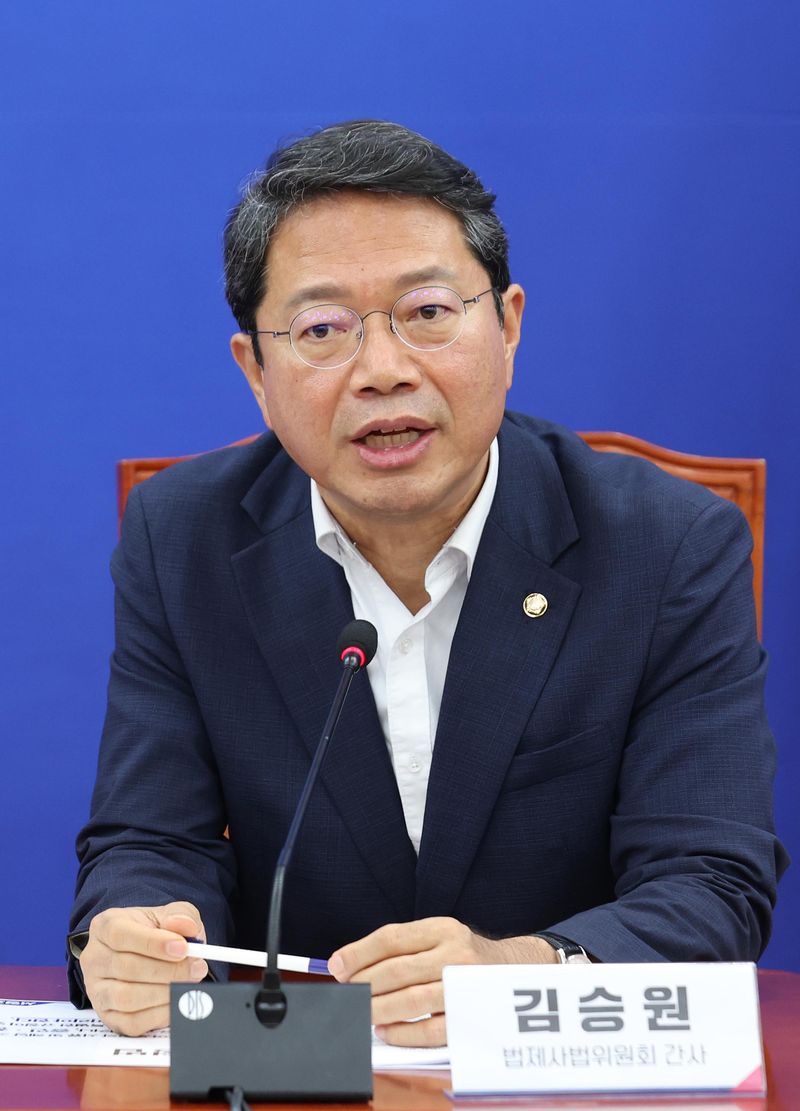
[Financial News] As President Lee Jae-myung nominated former judge Kim Seung-won, a Democratic Party of Korea lawmaker, as the new Minister of Justice, attention is turning to whether the government will accelerate its policy drive ahead of the Oct. 2 implementation of the amended Criminal Procedure Act. Because Kim represented the hardline camp during the revision process, including calls for the complete abolition of prosecutors’ supplementary investigative authority, he is expected to focus on stabilizing the system after the law takes effect.
According to the legal community on the 30th, Kim served on the Democratic Party’s Criminal Procedure Act task force and helped draft the revision that abolishes prosecutors’ supplementary investigative authority while strengthening their authority to request supplementary investigations, corrective measures and reinvestigations.
At the time, the Prosecution Service and the opposition party objected, saying that eliminating prosecutors’ supplementary investigative authority would make it difficult to correct poor police investigations and could lead to delays in investigations and gaps in victim protection. Even within the government and the ruling party, some called for caution and argued that part of the authority should remain.
Kim, however, maintained that the principle that "public prosecutors do not investigate" is both the starting point and the completion of prosecution reform, insisting that the separation of investigation and prosecution must be written into law.
In the end, the revision bill passed the subcommittee of the Legislation and Judiciary Committee under the leadership of the ruling party despite opposition backlash, and later completed approval by the plenary session of the National Assembly and the promulgation process.
Kim’s nomination as Minister of Justice is being interpreted as a move to entrust him not only with designing the bill and steering it through the National Assembly, but also with the follow-up work needed to settle the new system in practice. The fact that a former judge, rather than a former prosecutor, was chosen also supports that view.
The idea is that the administration selected someone who would build a new criminal justice system based on the principle of separating investigation and prosecution, rather than appointing current or former prosecutors familiar with the inner workings of the Prosecution Service to ease organizational resistance.
The Ministry of Justice must complete related follow-up legislation and subordinate regulations before the revised Criminal Procedure Act takes effect. Another task is to establish detailed standards for the authority to request supplementary investigations, corrective measures and reinvestigations, in order to prevent poor or delayed investigations that could result from abolishing prosecutors’ supplementary investigative authority. The ministry is also expected to place greater weight on minimizing prosecutors’ involvement in investigations while strengthening the National Police Agency’s duty and responsibility to carry out supplementary investigations.
Accordingly, if Kim takes office, follow-up measures for the revision of the Criminal Procedure Act are likely to move ahead quickly.
As Kim has been at the forefront of calling for the dismissal of President Lee Jae-myung’s case, attention is also focused on whether such a move will actually be carried out.
Kim currently serves as co-chair of the lawmakers’ group pushing for the dismissal of President Lee Jae-myung’s case and a parliamentary inquiry, together with lawmaker Yun Kun Young.
Kim has repeatedly argued that the prosecution in President Lee Jae-myung’s case should be dismissed.
At a press conference in January, he said, "Fabricated indictments should be discarded," and added, "The case against President Lee Jae-myung, which was fabricated by political prosecutors, should be dismissed immediately."
[email protected] Yun Hong-jip Reporter