"Borrowing 300 million won costs 2.2 million won a month"... Mortgage rates near 8% as leveraged investors face alarm
- Input
- 2026-08-30 15:10:19
- Updated
- 2026-08-30 15:10:19
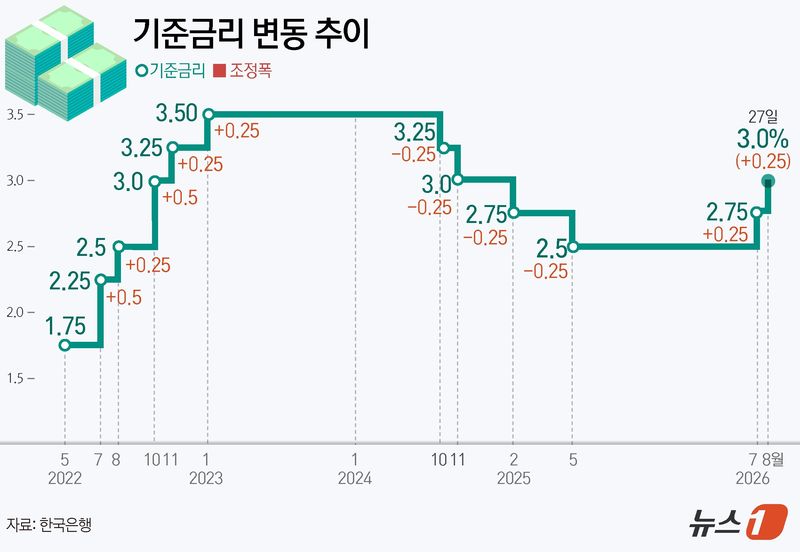

[Financial News] As monetary tightening accelerates with the Bank of Korea (BOK) Monetary Policy Board's back-to-back rate hikes and a return to the 3% base rate era, market interest rates are also rising sharply. Under these conditions, the upper end of mortgage loan rates at banks is increasingly likely to enter the 8% range in the fourth quarter of this year. In particular, while commercial banks have sharply expanded group loan supply by applying an exemption from total lending caps under the Aug. 13 measures, their targets for individual mortgage loans and personal loans have already reached the increase limit, leaving end users to continue their loan 'open runs.'
"Borrowing 300 million won costs 2.2 million won a month"... Mortgage loan rates near 8%
According to the financial sector on the 30th, the five-year fixed-rate mortgage loan rates at the five major banks — KB Kookmin Bank, Shinhan Bank, Hana Bank, Woori Bank, and Nonghyup Bank — stood at 4.68% to 7.15% annually as of that day. The upper end, which had surpassed 7.5% last month, eased somewhat this month, but still remained above 7%.
After the BOK Monetary Policy Board raised the base rate by 0.25 percentage point from 2.75% to 3.00% on the 27th, loan rates are likely to rise further. The BOK had already raised the base rate by 0.25 percentage point from 2.50% to 2.75% last month, and then carried out another increase this month, marking two consecutive hikes. The market expects the BOK to hold rates steady at its October Monetary Policy Board meeting before making another increase in November.
Bank bonds, which serve as the benchmark for fixed mortgage loan rates, are also expected to come under upward pressure as they reflect the possibility of further base rate hikes in advance. If rising bank bond yields are passed through to mortgage loan rates with a time lag, some observers say the upper end of fixed-rate mortgage loans could exceed 8% within the year.
The interest burden felt by borrowers is already rising sharply. Last month, the average mortgage loan rate for new bank lending stood at 4.48% annually, up 0.12 percentage point from 4.36% the previous month. It was the highest level in two years and eight months, since November 2023, when it reached 4.485%. Fixed-rate mortgage loans rose 0.23 percentage point from the previous month to 4.76%, while variable-rate loans also climbed 0.08 percentage point to 4.35%.
If the upper end of mortgage loan rates rises to 8% a year, borrowers' repayment burdens will become even heavier. For example, if a borrower takes out 300 million won at an annual rate of 8% for 30 years under an equal principal-and-interest repayment plan, the monthly payment would be about 2.2 million won. Under the same conditions, a borrower with a 4% rate would pay about 1.43 million won a month. The difference in monthly repayments between the two borrowers would widen to as much as 770,000 won.
Banks are not lowering the lending threshold
The problem is not only interest rates, but also the fact that lending standards remain high. On the 13th, financial authorities raised this year's target growth rate for household lending in the financial sector from 1.5% to 3%. In response, banks are using the additional lending capacity to supply more loans, mainly through group loans. However, the lending threshold for ordinary mortgage borrowers has not eased enough to be felt in practice.
KB Kookmin Bank cut the maximum mortgage loan limit for home purchases from 600 million won to 300 million won starting on the 10th of last month, and has kept the cap at 300 million won. Woori Bank has also maintained restrictions after capping monthly housing-related lending at 1 billion won per branch.
Nonghyup Bank has resumed variable-rate mortgage lending and decided to lift restrictions on refinancing from other banks and mortgage credit guarantees, but other banks are still limiting mortgage credit insurance and mortgage credit guarantees.
A financial industry official said, "Even if lending capacity increases as the total volume of household loans expands, it is still difficult to easily relax lending restrictions." The official added, "Competition among banks for group loans has intensified, leaving almost no margin for banks, and as funding costs themselves rise, the burden on borrowers will increase."
An official at Bank A said, "If households face a heavier mortgage interest burden, disposable income will fall, so a slowdown in consumption is only natural." The official added, "From a bank's perspective, we will look for ways to minimize the burden on borrowers."
[email protected] Park Moon-soo Reporter