"I Worried It Was a Stroke Because of the Dizziness"...The Culprit Was a 'Stone in the Ear' [Health Talk]
- Input
- 2026-08-30 13:16:00
- Updated
- 2026-08-30 13:16:00
[Financial News] When sudden dizziness strikes, it is easy to worry first about a stroke. In many cases, however, one of the most common causes is benign paroxysmal positional vertigo, or BPPV, which occurs when tiny crystals in the inner ear become dislodged.
Recently, a woman in her 60s, identified as A, felt severe dizziness, as if the world were spinning, while getting out of bed in the morning. Fearing a cerebrovascular disease such as a stroke, she visited the emergency room and neurology department before finally being diagnosed with BPPV by the otorhinolaryngology (ENT) department.
According to HIRA's health care big data, about 500,000 patients received treatment for BPPV in 2024. It is especially common among women in their 50s and 60s. Researchers say this may be linked to hormonal changes after menopause, reduced bone density, and changes in calcium and vitamin D metabolism.
The 'stone in the ear' is the problem...characterized by intense dizziness lasting less than one minute
Lee Il-woo, head of the ENT department at Busan On Hospital, explained, "BPPV is a condition in which otoconia, calcium crystals that should remain in the otolith organs of the inner ear, break loose and move into the semicircular canals, where they stimulate the nerves." He added, "It is characterized by intense rotational dizziness lasting less than one minute, along with vomiting and nausea, when moving the head, getting up from lying down, or turning the head." With an accurate diagnosis, symptoms can improve relatively quickly through canalith repositioning maneuvers that return the crystals to their original position.
The bigger issue, however, is the high recurrence rate. Depending on the literature, recurrence after treatment has been reported at 5% to 47%, making relapse a common feature of the condition. That is why lifestyle management after treatment is extremely important.
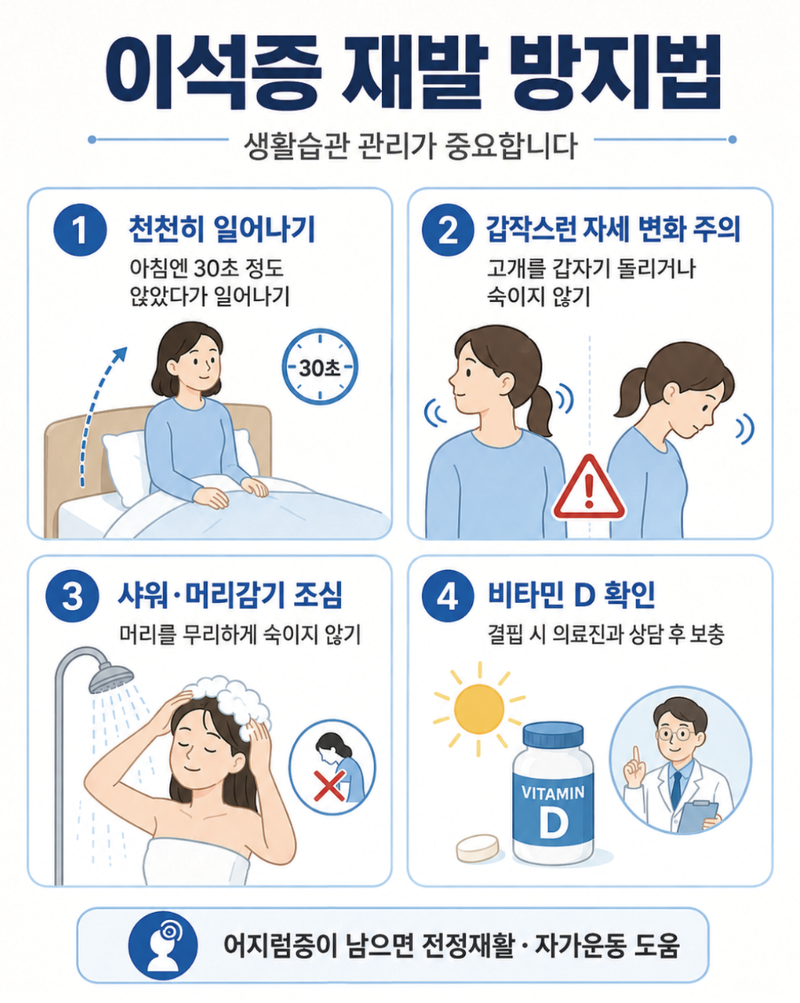
Lee advised, "If dizziness remains even after treatment, be careful because sudden changes in posture can increase the risk of falls." He added, "When getting up in the morning, sit for about 30 seconds first to steady yourself before standing. It is also better not to bend your head down forcefully when washing your hair or showering."
Studies also suggest that if a person has a vitamin D deficiency, proper supplementation may help reduce the recurrence of BPPV. If needed, it is advisable to check vitamin D levels and consult medical staff about appropriate supplementation.
Recurrence can reach 47%...Lifestyle management is key
If dizziness persists after hospital treatment or balance problems continue, vestibular rehabilitation or self-exercises may be performed. One representative self-exercise is the Brandt-Daroff exercises. The method involves sitting upright, turning the head 45 degrees to one side, then quickly lying down on that side. Once the dizziness subsides, the patient sits up again and repeats the movement on both sides. However, the frequency and number of repetitions should be guided by medical staff depending on the patient's condition.
Lee emphasized, "BPPV is a condition that can recover quickly if it is properly diagnosed early on." He added, "When sudden dizziness occurs, do not panic. Seek out medical professionals, identify the exact cause, and combine proper lifestyle habits with rehabilitation exercises. That is the best way to protect ear health."
He also noted, "If sudden dizziness is accompanied by slurred speech, weakness in the arms or legs, difficulty walking, or severe headache, a central nervous system disorder such as a stroke cannot be ruled out, so you should go to the hospital immediately."
[email protected] Reporter Jeong Myeong-jin Reporter