AI Matches Overseas Buyers... Seven Jeju Agri-Food Firms Hold One-on-One Export Talks With Four Countries
- Input
- 2026-08-30 12:25:06
- Updated
- 2026-08-30 12:25:06
[Jeju = Financial News, Reporter Jung Yong-bok] Jeju's agri-food export support is moving beyond online promotion. It is evolving into a system that uses artificial intelligence and global trade data to find overseas buyers and connect them to actual negotiations over price and volume.
According to the Jeju Economic and Trade Promotion Agency on the 30th, the agency held buyer invitation consultation sessions on the 26th and 28th as part of its 2026 support project for operating the Jeju agri-food promotion pavilion in cooperation with a global food-tech platform.
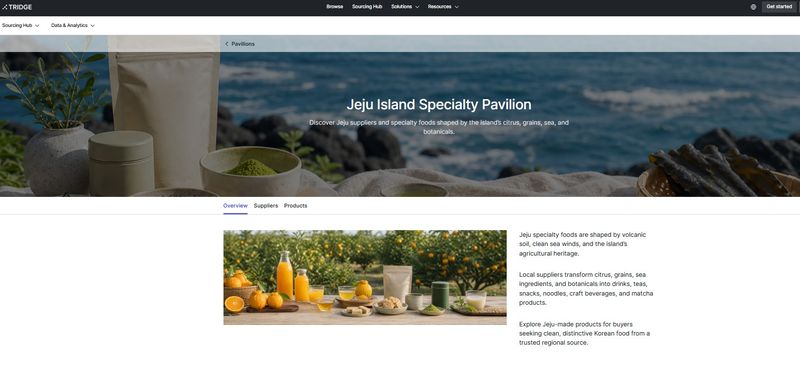
The starting point of the project is the Jeju Pavilion set up on Tridge, a global business-to-business agri-food platform.
At present, 11 Jeju agri-food companies are listed in the online Jeju Pavilion, promoting their products to overseas buyers. Unlike conventional online export support, the program does not stop at posting products and waiting for inquiries.
Using AI and global trade data, the agency identifies buyers suited to each company's products and target market, then filters out those who show real interest and connects them with the companies. If interest confirmed online becomes concrete, the process continues with one-on-one consultations and even visits to production or cultivation sites.
Tridge is a platform that connects overseas buyers and suppliers based on data on agri-food prices, trade and production. It also offers AI-based supplier search and buyer discovery functions.
Seven Jeju-based companies and institutions took part in the consultations, including Jeju Natural Food, Pureundeul, Bio Jeju, Korea Beauty Industry Development Institute, HL International, Jeju Mami and Sosodang.
On the overseas side, four companies from four countries participated: Home Chen of Taiwan, Sido Muncul of Indonesia, PharmaDi of Vietnam and Mipama of Poland.
The consultation format also varied depending on the level of interest from buyers and companies. On the 26th, Jeju Natural Food held an online consultation with Home Chen of Taiwan. That same day, at Tridge's headquarters in Seoul, Pureundeul held face-to-face consultations in sequence with Home Chen, Sido Muncul and PharmaDi.
On the 28th, a buyer from Mipama in Poland visited the Jeju Economic and Trade Promotion Agency in person and held one-on-one consultations in sequence with Bio Jeju, Korea Beauty Industry Development Institute, Jeju Natural Food, HL International, Jeju Mami, Sosodang and Pureundeul.
The talks focused on actual transaction terms. The companies discussed export feasibility, product prices, supply volumes and distribution methods with the buyers. For products that drew additional interest, the process also includes visits to the company or production and cultivation sites to verify production processes and supply capacity.
The reason this approach is drawing attention lies in Jeju's export concentration among a few companies. According to an analysis by the Jeju branch of the Korea International Trade Association of first-half results from 142 Jeju export companies this year, Jeju exports reached $442.31 million, up 245.6% from the same period last year and the highest first-half figure on record.
However, the top five companies accounted for 92.3% of total exports, and a single company in first place made up 76.5% alone. Exports from the remaining 137 companies, excluding the top five, actually fell 20.4%. In other words, even as total regional exports surged, overseas sales channels did not expand equally for most small and medium-sized firms.
In the agri-food sector as well, it is not easy to secure stable buyers through overseas trade fairs or one-off consultation sessions alone. Performance depends on how accurately export-oriented companies can be matched with buyers who actually intend to purchase.
This project is an attempt to address those limits by first exposing products in the online Jeju Pavilion, then screening buyers through data and linking them to face-to-face consultations and follow-up negotiations.
The key measure of success will be whether consultations lead to actual transactions, rather than the number of meetings held. Going forward, the project's effectiveness will likely depend on whether price negotiations, sample testing and site verification lead to real orders and sustained trade.
The Jeju Economic and Trade Promotion Agency plans to continue supporting follow-up discussions between buyers and participating companies after the consultations, with the goal of turning demand identified online into actual exports.
Agency President Go Byeong-gi said, "We will connect the contact points between overseas buyers identified online and Jeju companies into real business opportunities, and we will support follow-up discussions as well."
[email protected] Reporter Jung Yong-bok Reporter