Jeju Produces Two 250 kW Water Electrolysis Stack Sets, Accelerating Green Hydrogen Hub Demonstration
- Input
- 2026-08-30 11:48:28
- Updated
- 2026-08-30 11:48:28
[Financial News, Jeju = Jung Yong-bok] Jeju's green hydrogen technology development, which produces hydrogen by splitting water with renewable electricity, is moving from the materials and components stage to actual electrolysis equipment and the establishment of a demonstration base.
According to Jeju Technopark on the 30th, a review of first-half results for the second year of the Regional Technology Innovation Hub Project, which is being carried out with support from the Ministry of Science and ICT and Jeju Special Self-Governing Province, showed that the main R&D goals are progressing as planned.
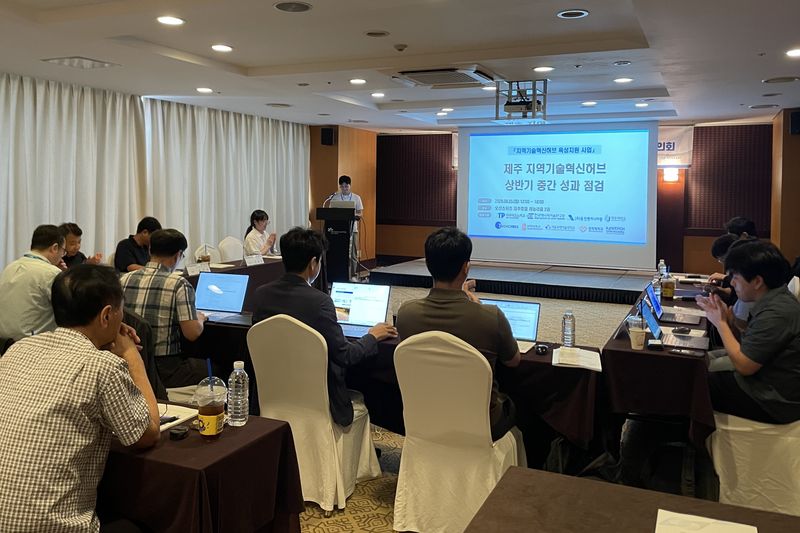
Jeju Technopark held a midterm review of first-half results on the 25th at Ocean Suites Jeju Hotel in Jeju City, with participating institutions and industry-academia experts in attendance.
The project involves nine institutions, including the lead organization Jeju Technopark, KIER, Woongjin Engineering, JNU, Techcross, Sogang University, Seoul National University of Science and Technology (SeoulTech), Kyung Hee University, and KENTECH.
The most concrete achievement confirmed so far is the production of two 0.25 MW water electrolysis stack sets. A 0.25 MW system is equivalent to 250 kW.
Water electrolysis is a technology that uses electricity to split water into hydrogen and oxygen. The key device that stacks multiple electrolysis cells to enable actual hydrogen production is called a stack. When renewable electricity is used, the process can produce green hydrogen, reducing dependence on fossil fuels.
The researchers also designed a control system to operate the two 250 kW stack sets stably.
Core materials development is also under way. Jeju Technopark developed non-precious-metal hydrogen electrodes that can reduce dependence on precious metals such as platinum, and it described the research performance as being at a "world-class level."
The first-half results also included the development of next-generation materials and electrodes with improved hydrogen permeability and reaction activity. The work goes beyond developing materials and devices, as it is also building the foundation needed to operate electrolysis facilities in Jeju's renewable energy environment.
The basic framework for an AI-based green hydrogen integrated platform has been designed, and an intelligent load-adaptive controller has been built.
Solar and wind power output changes frequently depending on weather conditions. For electrolysis facilities to operate stably in line with these power fluctuations, control technology is needed to raise hydrogen production when electricity is abundant and adjust operations when supply falls. A load-adaptive controller is a key device for reflecting the variability of renewable energy in electrolysis system operations.
The basic design for the electrolysis facility has also been finalized, making the groundwork for future demonstration more concrete.
The ultimate success of the project will depend on how smoothly it can move from developing individual materials and devices to producing hydrogen for long periods in connection with actual renewable energy sources and accumulating data.
In Jeju, in particular, there has been a persistent issue of curtailing solar and wind power output during periods when generation exceeds electricity demand. If surplus renewable energy can be used for hydrogen production, it could help address one of the limitations of renewable energy: the difficulty of storing electricity.
This is why green hydrogen is so important to Jeju's energy policy. Along with battery storage, producing hydrogen with renewable electricity, storing it, and then using it for transportation, industry, and power generation when needed can expand the use of renewable energy.
The Jeju Regional Technology Innovation Hub is focused on demonstrating these production technologies in Jeju's actual environment and linking the technologies and data it secures to commercialization by companies.
Going forward, the key indicators for assessing the technology will be the actual operating performance and efficiency of the 250 kW electrolysis system, its stability under changes in renewable energy output, and the durability of the non-precious-metal electrodes. It will also be necessary to verify how effectively the AI integrated platform connects different electrolysis facilities and power data, and whether it leads to lower operating costs or higher hydrogen output.
Jeju Technopark plans to continue R&D and demonstration platform development in the second half of the year and strengthen technological cooperation among participating institutions to connect research achievements with commercialization in Jeju's green hydrogen industry.
Go Yong-je, head of the Energy Center at Jeju Technopark, said, "We will continue R&D and demonstration platform development in the second half of the year to strengthen the foundation for commercializing Jeju's green hydrogen technology."
[email protected] Jung Yong-bok Reporter