"Stalled Growth in Home Markets" Regional Banks Bet on Expansion Outside Their Core Areas
- Input
- 2026-08-30 16:49:21
- Updated
- 2026-08-30 16:49:21

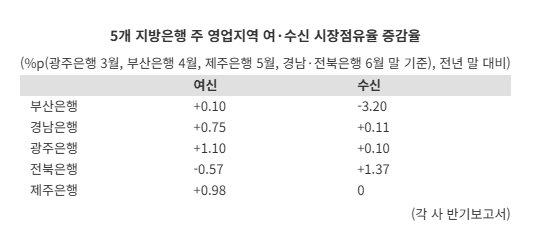
Regional banks' home-market shares remain flat
An analysis of the first-half reports released by each bank on the 30th showed that the five regional banks — Busan Bank, Kyongnam Bank, Kwangju Bank, THE JEONBUK BANK and Jeju Bank — generally maintained similar deposit and lending shares in their main operating areas, with only slight increases or declines from the end of last year.
Busan Bank's total lending share in Busan stood at 28.2% at the end of April, roughly unchanged from 28.1% at the end of last year. Over the same period, its total deposit share fell from 32.2% to 29.0%. It still holds around 30% of the deposit and lending market in Busan, but it is struggling to expand further.
Kyongnam Bank, Kwangju Bank, THE JEONBUK BANK and Jeju Bank also maintain market shares above a certain level in their main operating regions. At the end of the first half, Kyongnam Bank's lending share in the South Gyeongsang and Ulsan areas was 24.71%, while its deposit share was 29.30%, both roughly in line with the end of last year. During the same period, THE JEONBUK BANK's shares in Jeonbuk State were 16.93% for lending and 23.81% for deposits.
Regional banks have a stable business base in their home regions, but analysts say they have limited room to raise market share further. Population outflows to the Capital Region continue, the working-age population is shrinking, and weak local economies are keeping corporate and household funding demand subdued.
Competition from commercial banks and internet-only banks is also a burden. A regional bank official said, "Even if we have a branch network in the region, mobile banking has become standard, especially among younger customers, and commercial banks and internet banks are also competing. It is difficult for regional banks to monopolize local financial demand," adding, "There are practical limits to further increasing market share in the region."
Expanding specialized branches and strengthening digital channels
Regional banks are looking for a breakthrough by opening branches outside their core areas or operating specialized branches aimed at specific customer groups.
As of the end of the first half, the number of branches operating outside their main business areas was 41 for Busan Bank, 20 for Kyongnam Bank, 19 for THE JEONBUK BANK, 11 for Kwangju Bank and 3 for Jeju Bank.
In particular, THE JEONBUK BANK is targeting a niche market by opening the Busan Foreigner Financial Center in Busan. The strategy is to enter Busan, Busan Bank's core market, without competing head-on with the local flagship bank, while securing financial demand from a specific customer base. Analysts say regional banks' outside-market strategies are becoming more segmented, shifting from simple branch expansion to specialized services for different customer groups.
Digital channels are also becoming a way to expand customer contact beyond the limits of physical territory. Regional banks are upgrading mobile apps and internet banking services to strengthen their non-face-to-face competitiveness. This year, Kwangju Bank became the first regional bank to launch a hometown donation service on its mobile app, "Wa Bank." Since this month, Busan Bank has also introduced an electronic braille service for internet banking to make financial services more accessible for visually impaired customers.
A regional bank official explained, "Regional banks are expanding their business reach into neighboring areas where daily life and economic activity overlap," adding, "As non-face-to-face transactions such as internet banking have become widespread, the importance of a branch's physical location has weakened compared with the past, and barriers between regions have in effect fallen significantly."
However, some also warn that regional banks' expansion outside their home markets should not lead to a weakening of their role in local finance. A financial industry official said, "Regional banks have already secured substantial market shares in their main operating areas, so further external growth is not easy and they are looking for new growth engines," adding, "In the process, they must preserve their role as local banks and ensure that funding supply within the region does not shrink."
[email protected] Lee Hyun-jung Reporter