42% of unmarried people in Japan say they will never marry; in South Korea, many say they need a stable job first
- Input
- 2026-08-30 14:00:00
- Updated
- 2026-08-30 14:00:00
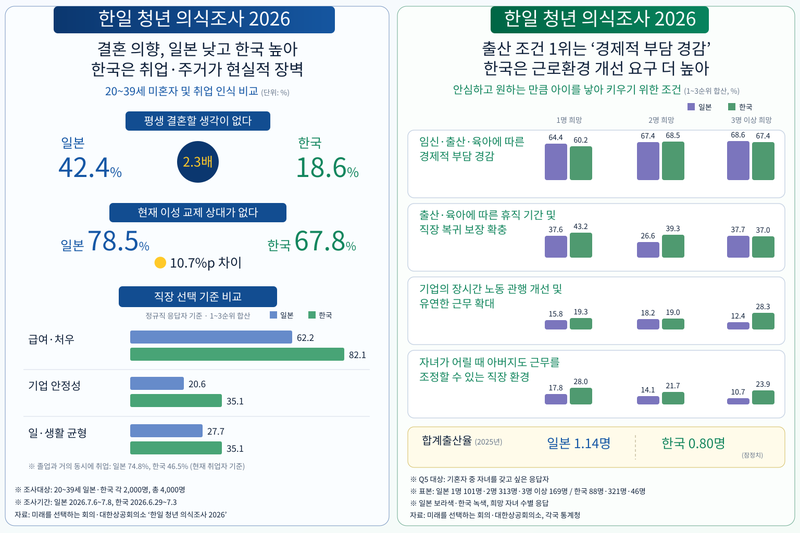
[Financial News, Sendai = Correspondent Seo Hye-jin] A survey found that 42.4% of unmarried young people in Japan do not plan to marry in the future. That is 2.3 times the rate in South Korea, at 18.6%. By contrast, young people in South Korea are relatively more willing to marry, but they face greater concerns about practical conditions such as jobs and housing.
According to the first "Korea-Japan Youth Awareness Survey 2026," released on the 30th by the Conference for Choosing the Future, a Japanese private think tank on population issues, and the Korea Chamber of Commerce and Industry (KCCI), 42.4% of unmarried respondents in Japan and 18.6% in South Korea said they had no intention of marrying. Among unmarried respondents, the share with no current dating partner was also higher in Japan, at 78.5%, compared with 67.8% in South Korea, a gap of 10.7 percentage points.
The survey was conducted online among 4,000 people, with 2,000 respondents aged 20 to 39 in each country. The Japanese survey was carried out from July 6 to 8, while the South Korean survey ran from June 29 to July 3.
■ Japan shows weaker marriage intent, while jobs and housing are barriers in Korea
When asked what conditions are needed for young people who want to marry, respondents in South Korea placed strong emphasis on practical factors such as stable employment and income, lower housing costs, and an environment that is good for raising children. In Japan, opportunities to meet people and the ability to maintain personal hobbies and private life even after marriage were seen as relatively more important.
The difference in views on employment was even clearer. Among full-time workers, 82.1% of respondents in South Korea said they value "corporate stability" when choosing a job, compared with 62.2% in Japan, a gap of 19.9 percentage points. The share that cited "corporate stability" was 35.1% in South Korea and 20.6% in Japan. The proportion that said they value work-life balance was also 35.1% in South Korea and 27.7% in Japan.
Among non-regular workers, 78.1% in South Korea and 56.2% in Japan said they prioritize wages and treatment, while 31.6% in South Korea and 15.4% in Japan cited corporate stability. The share that chose work-life balance was 34.7% in South Korea and 32.0% in Japan.
There was also a large gap in labor market entry. Among respondents who are currently employed, 74.8% in Japan and 46.5% in South Korea said they started working almost immediately after graduating from school, a difference of 28.3 percentage points. The share that took more than a year after graduation to find a job was 14.8% in Japan and 30.8% in South Korea. The survey report analyzed that the difficulty of finding work after college graduation in South Korea may have affected marriage behavior as well.
Hitoshi Igarashi, chairman of the Hokkaido General Research Association, said, "In South Korea, marriage and child-rearing are still closely linked, but among young people in Japan, the very idea that 'marriage means having children' seems to be changing." He also noted that the anxieties felt by young South Koreans were concrete, such as housing and employment, while young Japanese people showed a more vague sense of unease that is harder to put into words.
■ Economic burden ranks first as a condition for childbirth; Korea also demands better working conditions
At the childbirth stage, concerns in the two countries became more similar. When asked what conditions would allow them to feel secure about having and raising as many children as they want, respondents in both countries most often chose reducing the financial burden of pregnancy, childbirth, and child-rearing. Depending on the desired number of children, the share was 64.4% to 68.6% in Japan and 60.2% to 68.5% in South Korea.
In South Korea, demands went beyond financial support and also focused on jobs and working conditions. The share that cited income replacement during maternity and parental leave, as well as guarantees of returning to work, was 37.0% to 43.2% in South Korea, higher than Japan's 26.7% to 28.4%. The share that wanted companies to improve long working-hour practices and expand flexible work arrangements was also 19.3% to 28.3% in South Korea, compared with 12.4% to 18.8% in Japan. The proportion that cited a workplace environment where fathers can adjust their working hours when children are young was also higher in South Korea, at 21.7% to 28.0%, versus 10.7% to 17.8% in Japan.
On the 28th, the South Korean government announced a plan to replace the existing First Meeting Voucher, Parental Allowance, and Child Allowance with a new "Childbirth Grant" for newborns starting in July next year. The grant will be 10 million won for a first child, 12 million won for a second child, and 15 million won for a third child or more. In preferred regions, up to 20 million won will be paid in cash.
By contrast, Japan's low birthrate policy is expanding from reducing financial burdens to improving employment and working styles. Hiroya Masuda, co-chair of the Conference for Choosing the Future, said at a pre-briefing on the 26th, "Japan initially focused its policy on reducing financial burdens, but later expanded the scope of its measures to include employment and various institutional reforms."
Birth rates in both countries remain low. Japan's total fertility rate stood at 1.14 last year. South Korea's rate rebounded from 0.72 in 2023 to 0.75 in 2024 and 0.80 last year, but it remains below Japan's level.
Meanwhile, South Korea and Japan officially launched the Korea-Japan Low Birthrate Countermeasures Exchange Committee and held its first symposium in Sendai City, Miyagi Prefecture, on the same day. On the Japanese side, the committee is chaired by Ken Kobayashi, chairman of the JCCI, while on the South Korean side it is chaired by Chey Tae-won, chairman of the KCCI.
Business leaders and experts from both countries plan to jointly study low birthrate issues, including youth employment and working styles, and are also considering future joint recommendations.
[email protected] Seo Hye-jin Reporter