Nuclear Energy ETFs Surge Across the Board, Up as Much as 19% in a Week [ETF Square]
- Input
- 2026-08-30 13:57:49
- Updated
- 2026-08-30 13:57:49
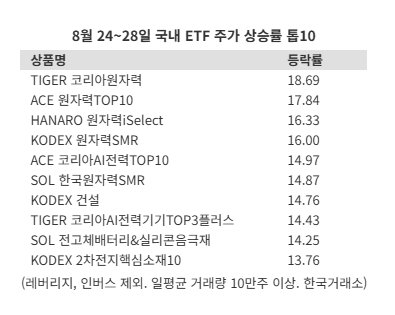
According to the Korea Exchange on the 30th, among domestically listed ETFs traded from August 24 to 28, TIGER Korea Nuclear rose 18.69% to rank first in performance. ACE Nuclear TOP10 gained 17.84%, HANARO Nuclear iSelect advanced 16.33%, KODEX Nuclear SMR climbed 16.00%, and SOL Korea Nuclear SMR rose 14.87%, all placing near the top.
The strength in nuclear energy ETFs appears to have been influenced by reports that the United States government proposed South Korea acquire a stake in Westinghouse Electric Company. If the deal goes through, domestic nuclear supply-chain companies are expected to expand their presence in the U.S. market and continue participating in nuclear projects in the United States and Europe. However, the Ministry of Trade, Industry and Energy has officially denied the reports, and no specific investment structure or ownership stake has been decided.
Jung Hye-jung, a researcher at KB Securities, said that if the South Korean government and KEPCO secure a stake in Westinghouse Electric Company, domestic nuclear supply-chain firms would have greater opportunities to enter the U.S. nuclear market. She added that this could lead to continued participation in North American nuclear projects, revenue sharing, and broader access to the global large-scale nuclear construction market.
Expectations for rising power demand from AI data centers also supported gains in related products. ACE Korea AI Power TOP10 ETF rose 14.97%, while TIGER Korea AI Electrical Power Equipment TOP3 Plus climbed 14.43%. In addition, KODEX Construction gained 14.76%, SOL All Solid State Battery & Silicon Anode ETF rose 14.25%, and KODEX Secondary Battery Core Materials 10 advanced 13.76%, all ranking among the top performers.
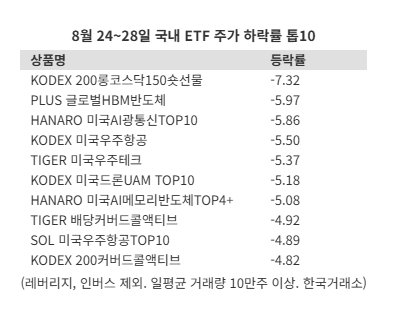
On the other hand, the biggest loser was KODEX 200 Long KOSDAQ 150 Short Futures, a strategy that buys the KOSPI 200 and sells the KOSDAQ 150, which fell 7.32%. U.S. aerospace-related ETFs also filled the lower ranks. KODEX US Aerospace ETF dropped 5.50%, TIGER U.S. Space Tech ETF fell 5.37%, KODEX U.S. Drone UAM TOP10 declined 5.18%, and SOL US Space Aerospace TOP10 slipped 4.89%.
Over the same period, Rocket Lab USA, Inc. fell 11.27%, Firefly Aerospace dropped 13.05%, and AST SpaceMobile declined 15.44%. Archer Aviation and Joby Aviation also fell 8.73% and 7.30%, respectively. Because many aerospace ETFs include growth companies that have yet to generate profits, uncertainty over the U.S. interest-rate path appears to have intensified selling pressure on related stocks.
AI semiconductor products also underperformed. Hanwha PLUS Global HBM Semiconductor ETF fell 5.97%, and HANARO U.S. AI Memory Semiconductor TOP4+ declined 5.08%. Although NVIDIA Corporation continued to post revenue growth, concerns over slowing profitability and rising inventories and accounts receivable increased the market’s focus on whether AI investment will actually translate into better earnings and cash flow.
Kim Seok-hwan, a researcher at Mirae Asset Securities, said that investors need to shift their focus from revenue growth rates to the quality of growth. He added that they should watch for revenue conversion from Vera Rubin supply expansion, stability in gross margin, and a recovery in free cash flow.
[email protected] Bae Hangeul Reporter