Seven of 10 Deaths from Disease in the Construction Industry Involve Cerebrovascular or Occupational Cancer, Raising Cumulative Health Risks [Warning Lights Over Construction Site Diseases]
- Input
- 2026-08-30 15:16:26
- Updated
- 2026-08-30 15:16:26
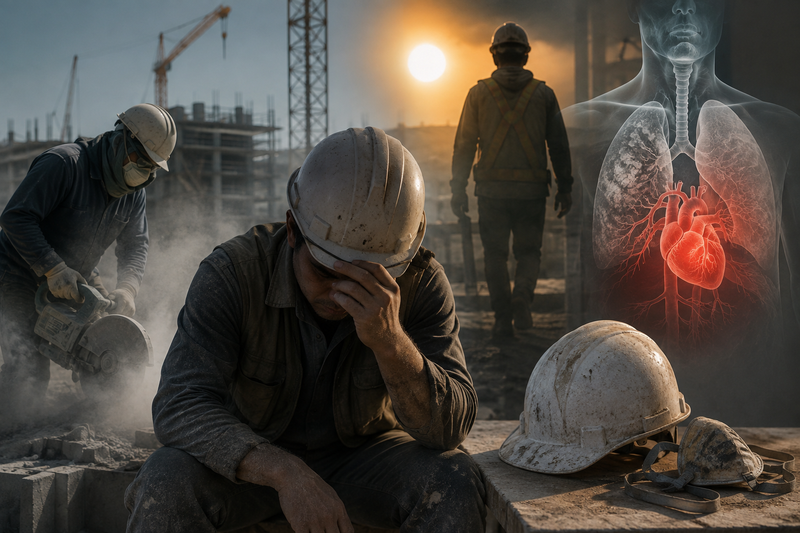
According to data submitted by the office of Park Soo-min of the People Power Party, a member of the National Assembly Committee on Climate, Energy, Environment and Labor, and provided by the Korea Occupational Safety and Health Agency (KOSHA), 58 of the 144 disease-related deaths from 2021 through the first quarter of this year were caused by cerebrovascular disease, while 46 were caused by occupational cancer. Together, the two diseases accounted for 72.2% of the total. Deaths from cerebrovascular disease were recorded every year, with 15 in 2021, 12 in 2022, 6 in 2023, 7 in 2024, and 10 last year. This year, 8 workers had already died in the first quarter alone.
At construction sites, heavy physical labor is often combined with overtime and night shifts, leaving workers on the job for more than 18 hours a day. Conditions that make it hard to get enough rest, as well as repeated exposure to extreme heat and cold, add to the physical strain. For workers with underlying conditions such as high blood pressure, hyperlipidemia, or diabetes, overwork and stress can further raise the risk of heart attacks and strokes.
Meanwhile, deaths from occupational cancer rose from 2 in 2021 and 4 in 2022 to 10 in 2023. The figure reached 13 in both 2024 and last year. Four more cases were recorded in the first quarter of this year.
In the case of occupational cancer, long-term exposure to carcinogenic hazards such as dust and chemicals during site work processes is considered a major cause. A typical example is crystalline silica dust generated when cutting or grinding concrete and stone. During the processing of wood or building materials, workers may also be exposed to formaldehyde. In summer or during high-intensity work, there are practical difficulties in wearing protective gear such as masks at all times. After prolonged exposure to such hazards, cancer may be discovered only after retirement, following a long latency period.
However, even when disease risks have accumulated over many years, it is not easy to fully establish a work-related connection during the industrial accident compensation process. This is due to the employment and work structure unique to the construction industry. In particular, day laborers often move from one company and site to another, making it difficult to trace and prove what work they did, and where, before the disease occurred.
By the time a worker applies for disease-related industrial accident compensation, the site where they previously worked has often already been completed. To determine whether the illness is work-related, personnel records, workplace exposure measurements, and health examination data are needed. But in many cases, those records are not sufficiently preserved. In unregistered companies or illegal subcontracting structures, even the fact that a person worked there may be missing from official records, because they were not enrolled in the four major social insurance programs or were paid in cash.
These gaps in records also create blind spots in industrial accident statistics. Cases that are not recognized as industrial accidents because work history or exposure to harmful factors cannot be proven are not reflected in official figures. The same is true for workers who never apply because they do not know their illness is linked to their job. Occupational cancers with long latency periods are especially likely to pass without the connection to past work being recognized.
Attorney Imi-so said, "Even though working at unregistered or unqualified workplaces is not the worker's fault, industrial accident claims are often rejected because excessive proof is required." She added, "The burden of proof placed on workers is far too heavy right now."
To reduce blind spots in disease-related deaths, experts say companies need to systematically record and manage workers' employment histories. One proposal is to ensure that not only four major social insurance enrollment records, but also business income, expense processing, and wage payment histories are fully documented and reported so that work can be verified even after a worker leaves the site. Another idea is to extend to private construction sites the system used in public projects contracted by the central government or local governments, which requires related reporting at the contract stage, and to impose penalties such as fines when companies fail to comply.
Expanding workers' access to their own past work records is another option. In some countries, including the United States and Japan, companies are required to respond when workers request records of their job and work history. In South Korea, too, there is a need for an institutional framework that would allow workers to obtain data on their work history and exposure to harmful factors more easily.
Professor Jeong Jin-woo of Seoul National University of Science and Technology (SeoulTech) said, "To properly determine whether a case is work-related, workers must be able to secure the materials needed to prove it." He added, "It is important to build an infrastructure that gives people easy access to their own job and work history."
[email protected] Kim Ye-ji Reporter