[Local Focus] Wonju Mayor Gu Ja-yeol: "We will develop Wonju into an AI advanced city"
- Input
- 2026-08-30 17:00:00
- Updated
- 2026-08-30 17:00:00
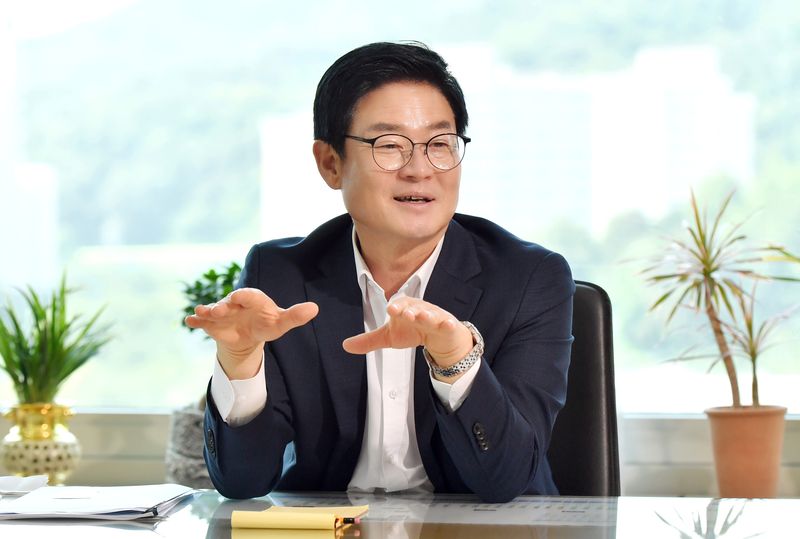
【Wonju=Reporter Kim Gi-seop】With two months left before he marks his first 100 days in office, Wonju Mayor Gu Ja-yeol has identified an "AI advanced city" as a key pillar that will shape Wonju’s future. His plan is to build Wonju into a leading city in the medical AI industry by combining artificial intelligence with the nation’s largest medical device industrial base. When Financial News met him in his office on August 4, Gu answered a question about how he felt after taking office calmly, saying, "All I’m thinking about is delivering results," without showing any excitement.
The foundation he cites for an advanced city is the solid base Wonju already has. Wonju is home to the country’s largest medical device industrial cluster, as well as NHIS, HIRA, excellent medical institutions, and universities. He believes that adding AI and data technologies to this base will allow the city to lead the medical AI industry. He pointed to the recent investment agreement with Shinhung MST, the largest ever for a single company in Wonju, as a signal of that potential.
Along with the advanced city vision, he also emphasizes another pillar: the "Citizen Sovereignty Era." The idea means that citizens are the owners and the mayor is merely a representative hired by them. It reflects a philosophy that policy should begin with citizens, not with the administration. He cited the demolition of the Academy Theater during the eighth popularly elected administration as a representative failure, saying the decision-making structure should be turned upside down from the bottom up. "If a few people had not made the decision behind closed doors, but had opened it up, social conflict would have been greatly reduced," he said.
He added three directions for the city: an identity-based city grounded in civic inclusiveness, a garden city revived through the Wonju Stream, and the advanced city vision. Gu indicated that he intends to realize these plans step by step during his term. The following is an interview.
— You have just passed your first month in office. How do you feel now?
▲People ask me that a lot, but I feel calm. I’m simply focused on taking responsibility for the many promises I made and delivering results. I have never thought of the mayor’s authority as something extraordinary. Since I worked in the provincial government in my own capacity, the system and work style are not unfamiliar to me. If anything, now that I am in charge of a single local government, the challenges of budget, finance, and the different characteristics of each district feel much larger. The person I served under emphasized humility and communication in leadership, and I think that influenced me as well. Right now, my only focus is on producing results.
— You have put forward the "Citizen Sovereignty Era" as your guiding philosophy. What does it mean?
▲It is not a difficult concept. It simply means understanding the relationship in which citizens are the owners and the mayor is a representative hired by them. Policy should not be decided one-sidedly by the administration; instead, citizens’ opinions should be the starting point, and the process and outcome should be built together with them. In the past, there were many top-down decisions, and conflict grew because communication was lacking. When I explain the idea of citizen sovereignty to residents, many of them suddenly bring up issues that had been left unresolved and express their expectations. The more important the policy, the more we need to listen and discuss, so that citizens’ views are reflected in actual policy and budgets.
— To put that philosophy into practice, you will need a supporting framework.
▲A declaration of intent and the design of a structure are different matters, so I plan to start by changing the organization. In the October reorganization, I plan to create a Citizen Sovereignty Office and establish a Citizen Sovereignty Era Committee under it. Since all 370,000 citizens cannot participate in every decision, the committee will be composed of people from different age groups, social classes, genders, and professional backgrounds. Sensitive projects will be brought to this committee so that rational decisions can be made within a citizen-participation framework. It is similar to the way the previous government used a public deliberation committee to decide whether to keep or shut down nuclear power plants. The same applies when the administration builds a facility. The people who actually use it are citizens, yet there are surprisingly many facilities that cannot be used because they do not fit their needs. If we check with actual users from the design stage through completion, we can reduce waste and improve satisfaction.
— What issue will the committee tackle first?
▲The waste incinerator issue will probably come first. There are many opposing views, but there are also quite a few people who want it built in their neighborhood. That is partly because they have seen crematoriums become models that generate jobs and revenue for local residents. If I or a few others push ahead with such a sensitive project on our own, it will inevitably lead to social conflict. That is why I want to create a framework for citizen participation and discuss it within that structure. On an ongoing basis, I also want to strengthen the residents’ autonomy council so that it can identify neighborhood issues and decide how to address them. The current residents’ autonomy committees only run local programs, which is not enough. As this kind of training accumulates, citizens will gain the ability to decide the direction of their own communities.
— What kind of city do you want Wonju to become?
▲Broadly speaking, three things. First, a city with identity. Wonju is one of the few cities in the country whose population is gradually increasing, and I believe that is rooted in civic inclusiveness. Since the city is associated with important modern and contemporary figures such as Pak Kyongni, who completed Land, and Jang Il-soon, who championed the philosophy of life, I want to weave those assets together and build cultural content on top of an identity as an "inclusive growth city." Second, an advanced city that combines medical devices with AI. Third, a garden city revived through the Wonju Stream. Even the Wonju Stream is now just a place for walking, but there is a way to turn it into a garden with little budget. A well-made trail can also become a garden if the surrounding area is developed into flower fields and groves of flowering trees. Rather than following other cities, Wonju can become a leading city.
— The advanced city vision stands out in particular among the three.
▲In the past, we focused on semiconductors, but that was not easy. Wonju already has the nation’s largest medical device cluster, along with NHIS, HIRA, excellent medical institutions, and universities. If we add AI and data technologies to that, we can lead the medical AI industry. The recent investment agreement with Shinhung MST was the largest ever for a single company in Wonju and showed that potential. Going forward, we will also attract outstanding companies in medical devices, digital healthcare, and biotech, and build an ecosystem in which companies, universities, research institutes, and hospitals work together. Industry can only sustain itself when R&D, startups, investment, and talent development move in sync. With that virtuous cycle in place, we will develop Wonju into a leading medical AI city in Korea.
— In the end, the key issue is young people. What is needed to ensure that this industrial base leads to jobs and keeps young people from leaving?
▲The way to retain young people is ultimately to create a city that is good to live in. Rather than forcing population growth, if jobs, housing, education, culture, and transportation are balanced, young people and population will naturally follow. Above all, the key is high-quality jobs that young people want. We will make every effort to attract a second advanced medical complex and develop the Seowonju station area into a "second Pangyo" by bringing together research institutes, R&D centers, and startups. We are also discussing with Gangwon State the attraction of aerospace drone companies using idle military land. If we revive the long-neglected former prison site and former livestock breeding center site as a civic plaza and a hub for cultural and creative industries, and turn the former Wonju Station site and the Jungang-dong area into a cultural growth district, Wonju will become a city where young people can work, enjoy life, and stay.
— The principle running through all these plans seems to be citizen sovereignty. What do you hope Wonju will look like when your term ends?
▲The core of the ninth popularly elected administration is citizen sovereignty. I hope Wonju will become a city where citizens’ voices become policy, citizens’ participation becomes change, and public officials put citizens’ wishes first—a city where citizens are truly the owners in both form and substance. It will take time, but I will carry out each plan one by one so that citizens can feel the change.
[email protected] Kim Gi-seop Reporter