34,000 Ordered to Evacuate in Japan's Fukui Prefecture After 327 mm of Rain in a Day
- Input
- 2026-08-30 10:15:44
- Updated
- 2026-08-30 10:15:44
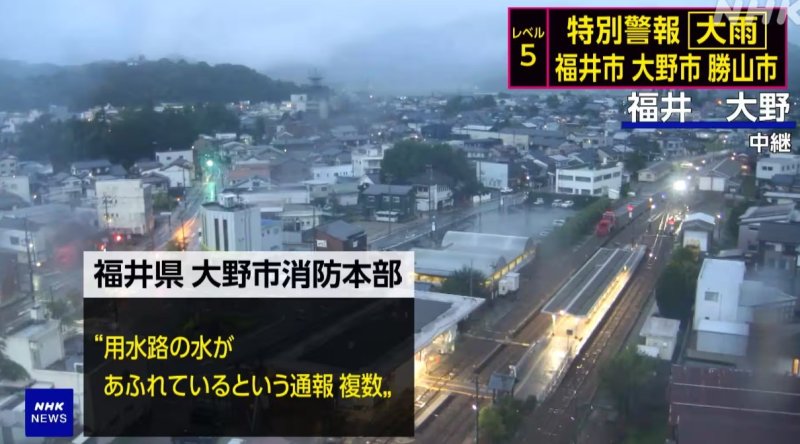

[Financial News, Tokyo = Reporter Seo Hye-jin] Fukui Prefecture in Japan was drenched by record rainfall for a full day starting on July 29, with precipitation exceeding the average amount for an entire August. On July 30, the Japan Meteorological Agency (JMA) issued a Level 5 special heavy rain warning, the highest alert level, and local governments ordered or urged emergency evacuation measures for more than 340,000 residents.
According to the JMA, 24-hour rainfall from 8:00 a.m. the previous day to 8:00 a.m. that day reached 327 mm in Katsuyama City, 307.5 mm in Sakai, 296.5 mm in Miyama in Fukui, and 253.5 mm in Ōno. All were the highest on record and far above the average rainfall for the entire month of August.
At 4:30 a.m. that day, the agency issued Level 5 special heavy rain warnings for Fukui, Ōno, and Katsuyama. Level 5 is the highest of the five alert levels and means people must secure their safety immediately because their lives are in danger.
In a joint press conference, the JMA and the Ministry of Land, Infrastructure, Transport and Tourism (MLIT) said, "It is highly likely that serious damage has already occurred due to rainfall at a level never experienced before." They added, "If moving to an evacuation shelter is dangerous, please secure your safety immediately by going to the second floor or higher of a building."
Fukui Prefecture applied the Disaster Relief Act to six municipalities, including Fukui, Ōno, Katsuyama, Awara City, Sakai, and Eiheiji. Emergency safety orders or evacuation directives were issued to 344,225 residents in seven municipalities, including Fukui, Ōno, Katsuyama, and Sabae. As of 8:00 a.m. that day, no casualties had been confirmed.
Flooding and river overflows also continued. The Arakawa River in Fukui and the Akanegawa River in Ōno exceeded the water level at which overflow begins, while the Yoshino River in Fukui, the Kiyotaki River in Ōno, and the Tajima River in Sakai surpassed the danger level for flooding. An actual overflow was reported on the Arakawa River.
In Katsuyama and Ōno, flooding was confirmed on the ground floor of one house and below-floor flooding was reported in four others. Ryugahana Dam in Sakai may need to carry out an emergency release. If that happens, the water level of the Takeda River, which flows through Sakai and Awara City, could rise sharply.
There were also a series of reports of vehicles being stranded and roads being flooded. Fukui Prefectural Police had received 25 related reports by 6:00 a.m. that day. In Fukui, two people trapped in a vehicle were rescued by firefighters.
Power outages also occurred. According to Hokuriku Electric Power Company, as of 8:10 a.m. that day, electricity had been cut off to about 40 households in Fukui and about 410 households in nearby Hakusan, Ishikawa Prefecture.
The heavy rain occurred even though a linear rain band, which forms when developed rain clouds stretch out in a belt and dump intense rain on the same area, had not formed. Instead, heavy rain of 50 to 60 mm per hour continued for a long time over roughly the same area. The cause was the continued inflow of warm, moist air into a front extending from the Sea of Japan toward eastern Japan.
The JMA forecast up to 120 mm of rain in Fukui Prefecture and up to 100 mm each in Ishikawa and Toyama prefectures over the 24 hours through Wednesday morning. It urged residents to remain on high alert for river overflows, flooding in low-lying areas, and landslides, and to watch for lightning and strong winds as well.
[email protected] Seo Hye-jin Reporter