Applications for Early Admissions Open in 7 Days... How to Avoid Being "Dragged Into Early Admissions" and Prevent Submission Mistakes
- Input
- 2026-08-30 09:43:51
- Updated
- 2026-08-30 09:43:51
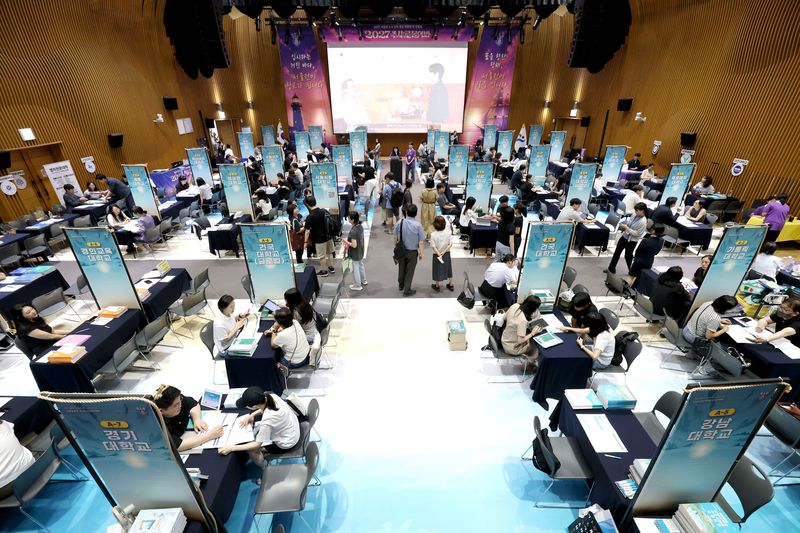
[Financial News] With early admissions applications for the 2027 college entrance cycle set to open in one week, admissions experts urged students to quickly establish a minimum early-admissions target to avoid being "dragged into early admissions" and to carefully check for submission errors. Because early admissions allow only six applications in total, mistakes in application combinations or minor carelessness during submission can immediately lead to rejection. This year's early admissions application period runs from September 7 to 11.
According to an admissions company on the 30th, experts advise students to first define their "minimum early-admissions target" before submitting applications. Since the basic principle of early admissions is to aim for universities above the level they could target through regular admissions, students should first assess their objective competitiveness on the CSAT through a quick preliminary score check right after the September mock exam.
Kim Byung-jin, head of the Etoos Education Evaluation Institute, said, "It is never a good strategy to give up on regular admissions because early admissions seem too difficult, or conversely to abandon regular admissions and focus only on early admissions." He added, "Right after the September mock exam, students should quickly check their preliminary standardized scores, percentile ranks, and grade estimates, and use them to identify the universities they can realistically target through regular admissions."
Kim also explained, "A successful early-admissions strategy depends on clearly deciding where to set your minimum early-admissions target." He added, "If that floor is set in advance, students can avoid the so-called 'early-admissions trap,' where they score higher than usual on the CSAT but still get accepted through early admissions and lose the chance to apply through regular admissions." He also noted, "Students should consider the trends in this year's academic assessments and the June and September mock exams together, but they should not become overly optimistic by combining only their best scores. They must carefully review whether they can meet the CSAT minimum requirement."
Administrative mistakes during the application process also require attention. Common errors students make every year include violating duplicate-application rules within the same university, applying to a track for which they do not meet eligibility requirements such as graduation year or school type, and confusing campuses, departments, or similar majors, including second campuses and evening programs.
Incomplete payment and mistakes over the deadline are among the most common reasons applications are invalidated every year. Even if all application details are entered, the submission will not be accepted unless payment is completed properly and an application number is issued. Deadlines also vary by university. Among major universities in Seoul, Korea University (KU) and Yonsei University close at 5 p.m. on September 9, while Seoul National University closes at 6 p.m. on the same day. Ewha Womans University closes at 5 p.m. on September 10, and Sogang University, SKKU, Hanyang University, and Chung-Ang University close at 6 p.m. on September 11.
Woo Yeon-cheol, head of the Jinhaksa Admissions Strategy Institute, said, "During early admissions applications, even simple carelessness can immediately lead to rejection." He added, "Applicants must double-check eligibility, duplicate-application rules, payment status, and deadlines." He emphasized, "Because unexpected errors can occur during the application and payment process, it is safer to submit well before the deadline rather than waiting until the last day."
[email protected] Kim Man-gi Reporter