Even self-service was 26 won more expensive per liter... Where will the '30-won gap' in Jeju gasoline be caught?
- Input
- 2026-08-30 09:49:10
- Updated
- 2026-08-30 09:49:10
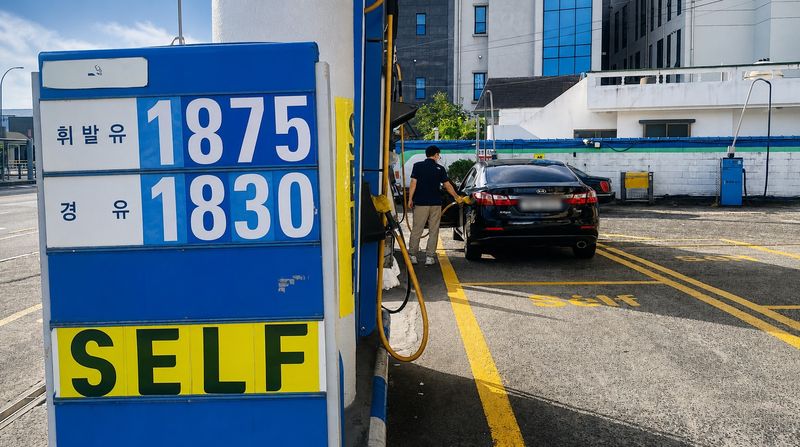
/Photo by Reporter Jeong Yong-bok 【Financial News Jeju = Reporter Jeong Yong-bok】 While gasoline in Jeju is the second most expensive in the country after Seoul, it was found to be more than 26 won higher per liter than the national average even when comparing only self-service gas stations.
70 won per liter. 78 won.
Among the 17 cities and provinces nationwide, Seoul is the only place where gasoline is more expensive than in Jeju. 42 won.
Diesel fuel showed a similar trend. 78 won. 46 won.
The regional average on Opinet is the arithmetic mean calculated by summing the sales prices of individual gas stations and dividing by the number of gas stations in the corresponding region. Prices are collected through automatic reporting via card terminals and direct reporting by operators, and the previous day's average price is disclosed every morning. This is not a figure based on a simple comparison of prices at a few specific high-end gas stations, but rather an indicator of the overall price level of the regional gas market.
Even after removing differences based on refueling methods, prices in Jeju remained high. 18 won per liter. 82 won for self-service stations.
49 won.
Since drivers refuel directly at self-service stations, the burden of labor costs is relatively lower than at regular gas stations. Even when comparing identical operational models, Jeju is more than 26 won higher per liter, making it difficult to explain the regional price difference solely based on whether or not employees refuel.
92 won is immediately due to distribution margins or unfair practices in the Jeju region.
Additional costs are incurred in Jeju for maritime transportation, storage, and unloading when importing petroleum products from the mainland.
A "Survey on Petroleum Product Prices and Distribution in the Jeju Region," commissioned by Jeju Province to the E-Consumer Energy and Petroleum Market Monitoring Group in 2022, also analyzed that fuel transportation costs at the time were higher than on the mainland. During the survey, responses indicated that refineries incurred an additional transportation cost of approximately 10 won per liter, while gas stations incurred about 20 to 30 won.
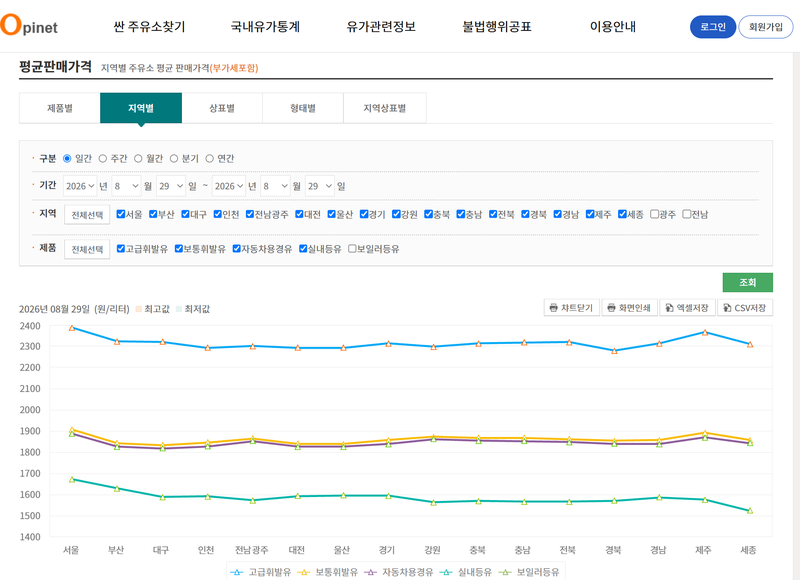
/Source: Korea National Oil Corporation Opinet The same survey also raised issues separate from logistics costs. The research team analyzed that while price competition takes place on the mainland through various agencies and spot markets, competitive factors are weak in Jeju due to strong vertical integration between a small number of agencies and gas stations and the virtual absence of spot trading.
What is more noteworthy is that a recent investigation by the Fair Trade Commission (FTC) confirmed that actual price collusion had occurred following this inquiry.
05 billion won.
According to the FTC investigation, from September 19, 2022, to July 10, 2024, the Jeju Gas Station Association received the next day's selling prices for gasoline, diesel, and kerosene in advance from the Jeju Agricultural Cooperative and the Seogwipo Agricultural Cooperative, set these as standard prices, notified member gas stations, and demanded compliance. It was found that Jeju Agricultural Cooperative and Seogwipo Agricultural Cooperative also actively participated in the process of raising and maintaining prices.
What is needed now is to break down and verify the costs that constitute the price difference.
We must first determine whether the estimated maritime transport costs presented in the 2022 survey are still valid, and how much the supply prices from refineries to distributors in the Jeju region, as well as storage and unloading costs, differ from those on the mainland.
By separating the distributor supply margin, gas station retail margin, the price difference between budget and regular gas stations, and the supply prices by refinery, we can more specifically verify whether the price difference of around 30 won per liter borne by consumers stems from logistics costs or is added during the distribution stage.
In particular, given that the need for improving the distribution structure was raised in a past Jeju investigation and actual price collusion was subsequently detected, it is necessary to examine how much the current competitive structure of the market has changed since then.
Jeju Province also manages fuel prices as a major target for price control. In response to the surge in international oil prices last March, the provincial government began disclosing the lowest and highest selling prices of gas stations within the province twice a day and started operating a price-fixing reporting center. The intent was to encourage consumers to choose relatively cheaper gas stations and stimulate price competition among them through the disclosure of price information.
However, as gasoline and diesel prices in Jeju continued to rank second highest in the nation after Seoul even at the end of August, the question of whether price disclosure and market monitoring alone can reduce structural regional price disparities remains a challenge. Ultimately, the core issue regarding Jeju's fuel prices does not lie in concluding with a single explanation such as "it is expensive because it is an island" or "it is due to the distribution structure.
" To identify the root cause, the exact amount of maritime transportation and storage costs, as well as the fees added at the agency and gas station stages, must be disclosed again using the latest data. Transparently revealing the price structure of the fuel consumers pay in Jeju is the starting point for substantive price competition.
[email protected] Jeong Yong-bok Reporter