Death toll from massive floods in Nepal and China rises to 682, with nearly 3,000 missing
- Input
- 2026-08-30 08:46:44
- Updated
- 2026-08-30 08:46:44
[Financial News] Casualties are mounting rapidly after massive floods struck the Himalayan mountain region along the border between Nepal and China. As of the 29th local time, the fourth day since the disaster, the confirmed death toll in the two countries had risen to 682, while the number of missing people had approached 3,000. According to foreign media reports on the 30th, 675 people were confirmed dead in floods in Bagmati Province in central Nepal. In Xigaze, Tibet Autonomous Region (TAR), China, seven people were killed by landslides triggered by the flooding.
The death toll in the two countries jumped by more than 100 in a single day from 579 the previous day because search efforts in the affected areas of Nepal were expanded, leading to the discovery of additional fatalities.
The number of missing people also rose sharply. Nepal has confirmed 2,426 missing people, up by about 500 from the previous day. Including 554 missing people in China's Tibet region, the total number of missing across the two countries reached 2,980. More than 500 of them were identified as foreigners from about 30 countries, including India and the United States.
Nine South Koreans missing as helicopter searches are disrupted by bad weather
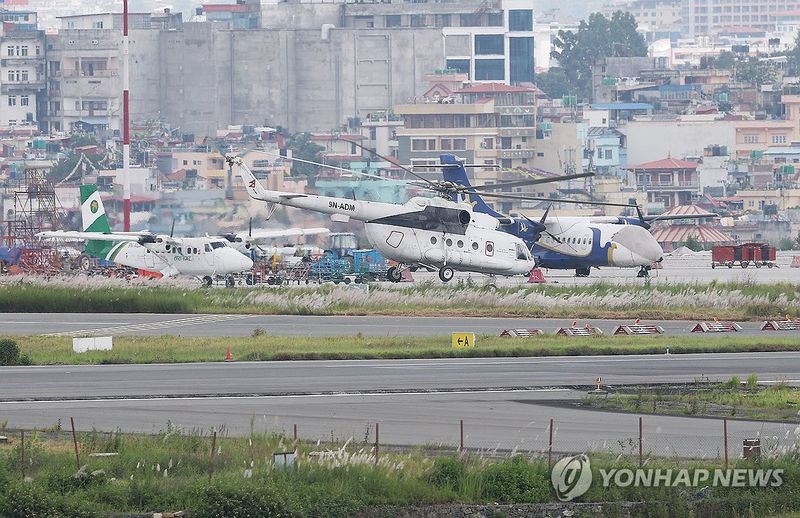
Efforts to rescue the missing South Koreans are also facing difficulties. Nine South Koreans, including six Doosan Enerbility employees and three Korea South-East Power employees working at the Upper Trishuli-1 Hydroelectric Project construction site in Nepal, remain out of contact.The South Korean government sent a rapid response team to the site and secured helicopters for the search. The joint government rapid response team, along with Doosan Enerbility and Korea South-East Power, secured a total of six helicopters in Kathmandu.
On the 29th, a helicopter secured by the South Korean government was deployed for the first time to search the disaster area. However, the helicopters secured by Doosan Enerbility and Korea South-East Power could not fly because of severe weather and issues with flight approval from Nepalese authorities. The previous day, only one helicopter rented by Korea South-East Power took part in the search.
The South Korean Ministry of Foreign Affairs said it will send an additional nine-member rapid response team to Nepal, consisting of one ministry official and eight members from the National Fire Agency (NFA). Earlier, on the 27th, an 11-member response team led by Im Sang-woo, the government representative in charge of overseas Korean protection and consular affairs at the ministry, arrived on site.
Doosan Group Chairman Park Jeong-won also arrived in Nepal on the day. He visited the hydroelectric project construction site where six Doosan Enerbility employees went missing to inspect the rescue situation and provide company-level support.
More than 100 people believed trapped in hydroelectric tunnel
Rescue authorities are focusing their search on missing people at the Upper Trishuli-1 Hydroelectric Project. As floodwaters inundated the facility, more than 100 people are believed to have been trapped in the tunnel.A local official said mud 1.2 to 1.5 meters deep had built up inside the tunnel, and that the limited space for helicopter landings was making rescue operations extremely difficult.
Bad weather, including rain and thick fog, is also hampering the rescue effort. Helicopter operations were temporarily suspended in some parts of Nepal, and rescue authorities are also working to secure ground transport to move survivors to Kathmandu.
The floods have also caused significant damage to Nepal's power infrastructure. The Nepal Electricity Authority (NEA) said operations at 11 hydroelectric plants and one solar power plant have been suspended.
The total installed capacity of the halted facilities is 431.1 MW, accounting for about 10% of Nepal's total capacity. The number of workers missing from hydroelectric plants alone has been tallied at 933.
Damage has also been reported at schools and other educational facilities. According to UNICEF, 18 schools were destroyed and 10 were damaged in the floods, affecting about 10,000 school-age children.
Water level at natural dam falls, but second flood remains a concern
In China's Tibet region, the water level of a lake formed by a natural dam is falling, but the possibility of further damage remains.China Central Television (CCTV) reported that the water level of the natural-dam lake formed upstream of the Gyirong trade port had fallen by about 10 meters from its peak. However, Nepal's disaster authorities warned that the risk of a second flood cannot be ruled out until the lake is completely drained.
Climate change in the Himalayan region is also being cited as a possible factor behind the disaster. At an elevation of 5,200 meters on Langtang Lirung, a glacier about 600 meters wide collapsed along with surrounding rock, generating an impact comparable to a magnitude 5.2 earthquake.
Analysts say the collapsed glacier and debris flowed downstream along the Rende River and the Trishuli River, triggering the massive flood. As rescue authorities continue searching for the missing, concerns are also growing over the possibility of further collapses and a second flood, keeping tensions high in the area.
[email protected] Kang Jung-mo Reporter