"Jeju Autonomous Schools Expand to 101 Campuses" ... System to Be Redesigned in 2027
- Input
- 2026-08-30 08:43:19
- Updated
- 2026-08-30 08:43:19
[Financial News, Jeju = Reporter Jung Yong-bok] Jeju's flagship education autonomy policy, the "Jeju autonomous schools," will undergo a fresh review of its operating results and support system. The program began with nine schools in 2007 and has expanded to 101 schools, covering more than half of the province's elementary, middle and high schools. The focus is now shifting from simply increasing the number of schools to examining how much the policy has contributed to student growth, curriculum change and school autonomy, while redesigning the designation standards, evaluation process and financial support system.
According to the Jeju Special Self-Governing Provincial Office of Education on the 30th, the office will push ahead with a "Comprehensive Diagnosis and Restructuring Study on Jeju Autonomous Schools."
The project budget is 50 million won, and the study will run for five months from the start date. The bidding process will run from Sept. 3 to 8, proposal evaluations are scheduled for the 10th, and the price bid opening is set for the 14th.
The study will not examine the entire Jeju autonomous school system, but will focus on operating results over the past 12 years, from 2015 to 2026. It will also review each school's self-evaluation and comprehensive evaluation results from 2015 to 2025.
Jeju autonomous schools are special education schools designated by the superintendent of education under the Jeju Special Act. They differ from regular schools in that they can autonomously diversify and specialize their curricula to fit the characteristics of each school and local community.
Principals can vary parts of the curriculum and subject organization, and they can flexibly manage the school year, semesters and class days. After going through the required procedures, schools may also use domestic and foreign books in addition to standard textbooks. Greater autonomy can also be applied to teacher placement and school management than in regular schools.
The system began in 2007 with nine schools: five elementary schools, three middle schools and one high school.
As of March 1 this year, Jeju autonomous schools numbered 101 in total, including 77 elementary schools, 18 middle schools and six high schools.
They are being operated under 15 types, including 28 Dahondi Learning Schools, 18 IB schools and 12 arts, physical education and culture schools, as well as global competency schools, play schools, digital schools, village ecology schools, future technology talent schools, future competency schools, invention schools, global citizenship schools, character education schools, Jeju culture schools, creative convergence schools and health ecology schools.
Based on the school status as of April 1 this year, Jeju's elementary, middle and high schools total 195, including 120 elementary schools, 45 middle schools and 30 high schools.
There are some differences in the reference dates and counting methods, but if the 101 autonomous schools are compared simply with the total number of elementary, middle and high schools, they account for 51.8 percent. In other words, more than one out of every two schools in Jeju is an autonomous school.
As the system has grown, the policy questions have changed as well. In the early years, the key issue was how far school autonomy could be expanded by using the Jeju Special Act. Now, the question is whether the 15 school types are actually producing different educational outcomes, and whether the special privileges and financial support given to autonomous schools have led to changes for students, schools and the local education community.
The research team plans to establish performance indicators and a diagnostic framework to measure student growth, curriculum operation, school autonomy, changes in the educational community and future competencies. It will also reflect the changing education environment, including a declining school-age population, regional education gaps, digital transformation and the expansion of customized education for students.
Another research target is how to build a performance management system that can connect each school's self-evaluation and comprehensive evaluation results to future designation and support policies in a practical way.
A more sensitive issue is the school types and the designation and support methods. Depending on the results of the study, the current 15 types may be reorganized, and changes could be considered to the criteria for new designations, the extension of designation periods and the financial support system. For autonomous schools, the study may influence not only policy evaluation but also future school status and support methods.
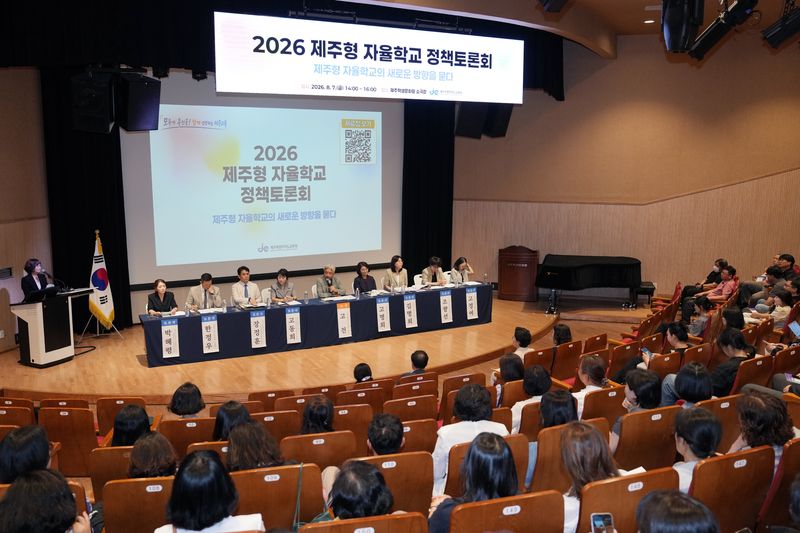
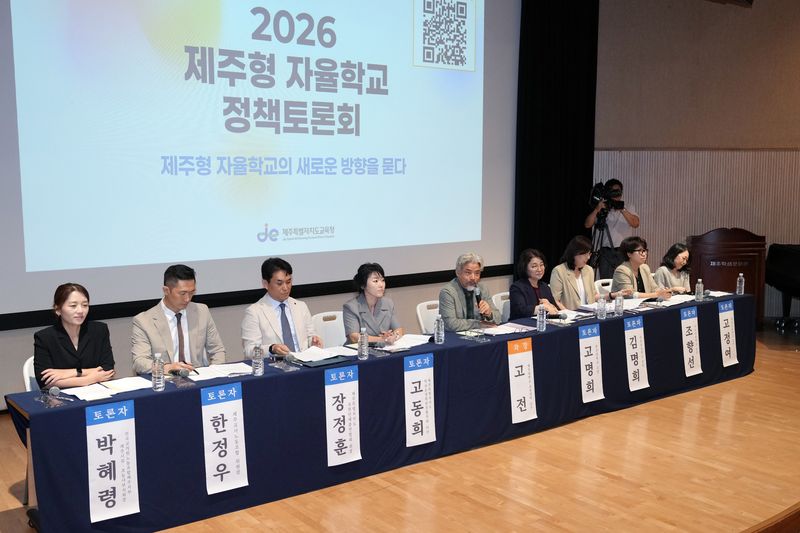
Before launching the study, the provincial education office also sought input from the education community. The 2026 Jeju Autonomous School Policy Forum, held at the Jeju Students' Culture Center on the 7th, brought together teachers' groups, parents, school administrators and teachers. JNU professor Ko Jeon chaired the session, which included a presentation on the current status of operations, designated discussions and an open forum.
Participants called for a redefinition of school types that reflects each school's characteristics and designation purpose, improvements to the operating system, stronger student-centered education, wider sharing and spread of best practices, greater cooperation among schools and a sustainable support framework.
The provincial education office will directly link the opinions raised at the forum to the comprehensive diagnosis and restructuring study. The goal is to determine whether the autonomy granted to schools has actually led to educational outcomes, while also building an operating model that balances school autonomy with the public nature of education.
The key question going forward is whether the quantitative expansion to 101 schools can be shown to be truly connected to educational outcomes.
It is also necessary to examine how autonomous school designation has affected student growth, curriculum diversification and regional education gaps, depending on school size and local conditions. An evaluation system is also needed to connect the financial resources invested with educational outcomes. With more than half of the province's schools now autonomous schools, the difference between regular schools and autonomous schools must also be reconsidered.
Types that show clear results could be further developed as a model for public education in Jeju. On the other hand, types that do not show clear special privileges or educational effects may face possible consolidation, restructuring or adjustments to the support method.
The study results are expected to serve as basic data for improving the operating system of Jeju autonomous schools after 2027 and for drawing up a mid- to long-term development strategy. Attention is now turning to whether Jeju's flagship experiment in education autonomy, which began with nine schools in 2007, will shift from an expansion-driven approach to one centered on performance and accountability in the era of 101 schools.
[email protected] Jung Yong-bok Reporter