Ministry of Education says it will expand scholarships for top students at private universities in the provinces amid backlash over support for local private colleges
- Input
- 2026-08-30 09:00:00
- Updated
- 2026-08-30 09:00:00
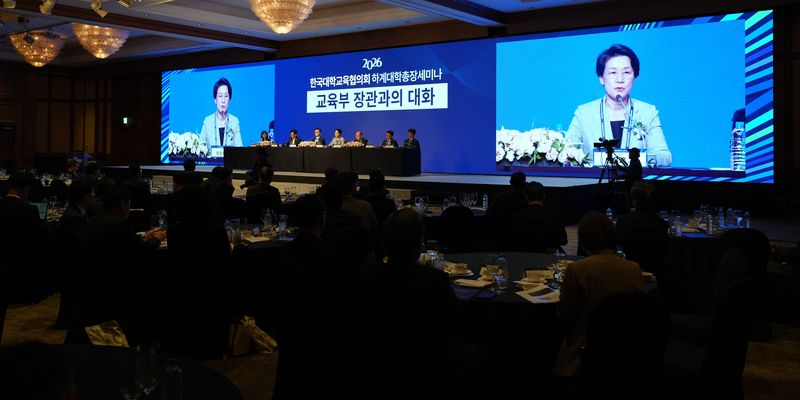
At the '2026 KCUE Summer University Presidents' Seminar' in Jeju on the 28th, Vice Minister CHOI said of the full scholarship program for regional national universities, "The biggest reason for introducing this system was to give more opportunities to students who are financially struggling but still want to go to college, dream about their future, and choose their path."
CHOI estimated that the additional budget needed for the full scholarship program for freshmen at regional national universities would be less than 100 billion won. She explained that the extra fiscal burden would not be large because about 60% of students at regional national universities already receive national scholarships. The goal is to create regional national universities where students can attend without tuition burdens and to widen options for students who are considering college because of financial constraints.
Support for private universities will also be expanded. CHOI said, "We have set aside next year's budget so that outstanding students who enroll in private universities can receive full scholarships." The exact scale of the support has not yet been disclosed.
The existing regional talent scholarship will be reorganized into a balanced regional scholarship. Until now, support was available when students from the same region enrolled in local universities, but the ministry plans to expand eligibility so that outstanding students from the Seoul metropolitan area can also receive scholarships if they enroll in private universities in the provinces. The Ministry of Education expects this to help regional private universities attract talented students from the capital area.
The ministry also said it has significantly increased the budget for improving educational conditions at regional private universities in next year's budget proposal. Separate from student scholarships, the plan is to invest in better educational environments and strengthen the academic competitiveness of regional private universities.
The ministry's explanation came after the Korean Association of Private University Presidents urged the government to redesign its support system based on students and regions, rather than on whether a university is national or private. The association argued that if only national universities receive full tuition support, recruitment at regional private universities could suffer.
Higher education funding itself will also be expanded. The Ministry of Education plans to ease sharp fluctuations in elementary and secondary education finances through a revision of the Local Education Subsidy Grants, and to establish an education talent account within the Future Response Fund to ensure steady investment in higher education.
CHOI said, "Since higher education funding is raised with taxpayers' money, how efficiently we invest the funds and produce results will become an important benchmark for future expansion of support." Her remarks mean that universities will be given greater autonomy, but they will also be expected to show accountability and results in line with the financial support they receive.
Support for regional universities will be linked to the Five Mega-Regions and Three Special Self-Governing Provinces Policy, as well as industrial and settlement policies. The ministry aims to train talent needed by local industries around hub universities, connect that effort with corporate relocation and job creation, and encourage young people to settle in the regions. It said that preventing regional decline requires not only education, but also jobs, housing, and an environment where people can raise children.
In the AI sector, the ministry plans to support universities' transition to AI step by step, including by allowing nearby universities to jointly use infrastructure built by AI hub universities.
[email protected] Kim Man-ki Reporter