University council says regional universities will be hit hard, calls for tuition deregulation and bigger AI budget
- Input
- 2026-08-30 09:00:00
- Updated
- 2026-08-30 09:00:00
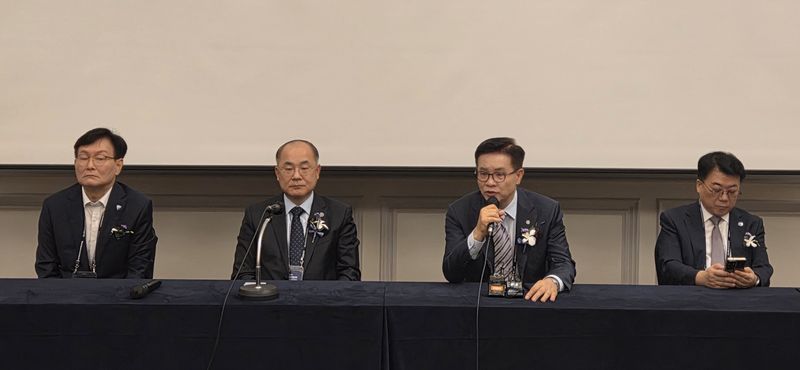
[Financial News] University presidents publicly acknowledged the looming disappearance of regional universities amid the sharp decline in the school-age population, and urged the government to allow greater autonomy in tuition setting and expand the budget for the transition to Artificial Intelligence (AI) in order to strengthen higher education competitiveness.
At a press briefing for the '2026 Summer Seminar for University Presidents' held on the 28th at Lotte Hotel Jeju, the KCUE leadership pointed to the risk of regional university collapse and the financial limits facing universities, and called for the measures.
At the briefing, Jeong Tae-ju, president of Gyeongkuk National University and vice chairman of KCUE, said, "As you reporters can probably already predict, universities in regional areas will likely be hit very hard, universities in Seoul will be less affected, and universities in the greater Seoul area will be less affected as well." He added, "The government should first present a roadmap for how to prevent this and how to restore some balance." He went on to say, "Only when the roadmap comes first, and support follows accordingly, can universities, whether national or private, accept how they should develop."
■"Tuition should be left to autonomy, not regulation"
The leadership stressed that guaranteeing autonomy in tuition setting is essential to easing universities' financial strain.
Lee Ki-jeong, president of Hanyang University and chairman of KCUE, said, "When it comes to tuition, I do not think this should be framed as a question of whether to raise it or not." He added, "What we have always emphasized is that it should truly be left to autonomy."
Lee explained, "Each university has a tuition review committee, and all budgets and settlements are reported transparently, so there is absolutely no situation in which tuition can be raised at will." He added that last year's actual tuition increase rate was far below the legal ceiling. "I hope people will trust universities a little more," he said.
Regarding the controversy over free tuition at regional national universities, Jeon Min-hyeon, president of Inje University and a KCUE vice chairman who attended the briefing, suggested that if the purpose of regional balance scholarships is to be fulfilled, support should also go to students at private universities located in depopulating areas, not just national universities. Of the 154 four-year private universities nationwide, about 50 are located in depopulating regions, and the idea is that student support should help ease regional decline.
Lee strongly argued that public education must be normalized before any discussion of admissions reform. Referring to his experience as head of the college entrance exam question-setting committee, he asked, "If more than 70 percent of the college entrance exam comes from EBS workbooks, why would students need to learn from textbooks at school?" He continued, "Public education has been collapsing in a truly devastating way, to the point where teachers who passed the difficult teacher certification exam regret it after just three months, and students sleeping in class are the most welcome ones." He emphasized, "We need an admissions system linked to measures that can strengthen public education."
■"AI adoption needs 10 billion won over three years, and facility upgrades are urgently needed"
Toward the end of the briefing, the discussion turned to the government's financial support needed for the AI transition and complaints about the poor educational environment at private universities.
Jeon Min-hyeon said, "After holding several meetings with major Big Tech companies for university AI adoption and receiving proposals, they usually talked about about 10 billion won over three years." He urged the government to quickly support universities' AI adoption by using the Future Response Fund and other resources, saying that individual universities cannot afford the cost.
Jeon also pointed to the deteriorating facilities at private universities after 17 years of tuition freezes. He said, "When we meet with freshmen who have just graduated from high school and come to university, the first thing they ask for is better restrooms." He added, "High schools these days have very good restrooms, but universities are such a mess that even hot water does not come out properly, so students avoid using university restrooms."
He continued, "Some people worry about corruption or irregularities, but private universities are now subject to transparent accounting and financial oversight, so there is no structure that allows subsidies to be used for anything other than student education." He asked that people set aside their suspicions and come up with alternatives to save higher education.
A KCUE official added, "Industry is moving ahead at a rapid pace, but universities are falling behind because their experimental and practical training equipment is outdated, and safety-grade issues are also emerging in old buildings that are 40 to 50 years old." The official said, "Expanding higher education funding for breakthrough R&D and research infrastructure is more urgent than ever."
[email protected] Kim Man-ki Reporter