A Worker in Their 30s Asks, "I Want to Move Out in a Year... Will Marriage and Buying a Home Still Be Possible?" [Personal Finance Q&A]
- Input
- 2026-08-30 05:00:00
- Updated
- 2026-08-30 05:00:00

[Financial News] A man in his 30s, identified as A, has been working for seven years and currently lives with his parents, but plans to move out in a year. He is trying to save as much as possible from his salary, continues to contribute regularly to a pension savings plan for year-end tax settlement, and has paused some of his investments. However, he is also planning to get married and buy a home in the future, so he is worried that higher housing costs after moving out could strain his other financial goals. He applied for advice on whether he can move out in a year with his current assets and savings capacity, and how he should prepare for future marriage and home-buying funds.
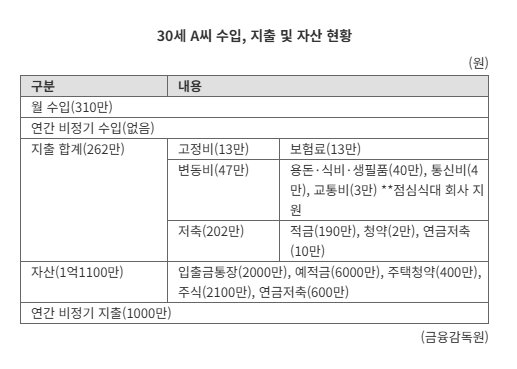
A 30-year-old A earns 3.1 million won a month. There is no irregular annual income. Fixed expenses include 130,000 won in insurance premiums. Variable expenses total 470,000 won a month, including pocket money, food, and living expenses (400,000 won), mobile phone bills (40,000 won), and transportation costs (30,000 won). Lunch is subsidized by the company. Savings include 1.9 million won in installment savings, 20,000 won in a housing subscription account, and 100,000 won in pension savings each month. Other expenses have not been identified. Assets total 111 million won, including 20 million won in a checking account, 60 million won in deposits and savings, 4 million won in a housing subscription account, 21 million won in stocks, and 6 million won in pension savings. Annual irregular spending amounts to 10 million won.
According to the Financial Supervisory Service on the 30th, when items that may arise as expenses over a lifetime after entering working life are organized, they include marriage, childbirth, home purchase, children's education, children's marriage, and retirement preparation.
The 'moving out' A is considering is also part of that list. However, moving out would inevitably increase living costs, including rent or jeonse loan interest, as well as food, maintenance fees, and transportation. That would reduce the amount of money available for marriage or buying a home.
The FSS said A's monthly living costs are relatively low because lunch is provided at work and he lives with his parents, so he does not bear separate household expenses. On the other hand, it said annual irregular spending of 10 million won needs to be reduced. Although A tried to increase savings, irregular spending kept him from reaching his target amount. Based on an analysis of past spending, the FSS suggested that A cut irregular spending to no more than 7.6 million won a year while keeping monthly fixed and variable expenses at the current level of 600,000 won.
It is advisable to manage bank accounts separately for automatic transfers, living expenses, and irregular spending. For pocket money and food expenses of 400,000 won a month, it is better to set a weekly spending plan. Irregular spending should also be set aside separately from monthly available funds in line with the annual budget.
The FSS recommended that A postpone moving out until the time of marriage. If irregular spending is reduced to 7.6 million won a year, A could save about 1.87 million won a month at present. That works out to about 22.4 million won in annual savings after subtracting monthly fixed and variable expenses of 600,000 won and annual irregular spending of 7.6 million won from annual income of 37.2 million won.
The FSS estimated that if A moves out, he would face about 900,000 won in additional monthly expenses, including 500,000 won in rent, 100,000 won in maintenance fees, and 300,000 won in food costs. In that case, his monthly savings capacity would fall from 1.87 million won to 970,000 won.
An FSS official said, "The moment you move out, housing-related costs rise and savings tend to drop sharply." The official added, "It would be better to redirect the costs of moving out toward marriage and home-buying funds, while combining saving and investing."
The FSS set a goal for A of building 70 million won in three years. Saving about 23 million won a year would make that achievable. The funds should be prepared separately according to when they will be needed. Marriage funds needed within three years should be built through installment savings with low principal volatility, while home-buying funds needed after five years should be accumulated through regular investments using ISA.
An FSS official advised, "Rather than setting moving out itself as the goal, it is better to prioritize future life-cycle financial goals such as marriage and buying a home, and make full use of current savings capacity."
If you enter the FINE financial consumer portal operated by the Financial Supervisory Service into an internet search box or call the Financial Supervisory Service Call Center 1332 (▶ option 7, financial counseling service), you can receive free customized financial consumer counseling.
[email protected] Park Ji-yeon Reporter