Operating profit of 14.9 billion won, but a 25 billion won broadcasting fund burden: "Pay TV regulations need to be improved"
- Input
- 2026-08-30 16:29:33
- Updated
- 2026-08-30 16:29:33
[Financial News] As over-the-top media services (OTT) spread and pay TV operators face a structural decline in profitability, calls are growing to overhaul outdated regulations. In particular, industry voices say the imbalance among broadcasters should be addressed first, including the fact that cable TV (SO) operators are also required to pay the Broadcasting and Communications Development Fund even when they are in the red.■ Cable TV operators still pay hundreds of billions of won in the fund despite lossesAccording to the broadcasting industry on the 30th, cable television (SO) operators are classified as broadcasters and must go through procedures such as licensing and relicensing under the Broadcasting Act. They are subject to various regulations on channel composition, terms and conditions, user protection, disaster broadcasting and the fulfillment of regional obligations. By contrast, OTT services and YouTube are classified as value-added telecommunications service providers, so although they offer similar content, they are not subject to these rules.
The SO industry says management difficulties are worsening as subscriber losses to OTT, known as "cord-cutting," are compounded by regulatory burdens and an uneven distribution of the fund burden among broadcasters. In particular, it says the current system, which requires even loss-making operators to pay the fund, is unfair compared with other operators that receive reductions based on their financial condition.
Terrestrial broadcasters and comprehensive programming channels are subject to different collection rates depending on their financial condition. JTBC, which posted an operating loss of 28.7 billion won in 2024, did not pay the fund, while KBS, which recorded a deficit of 88.1 billion won, paid only 18 million won.
However, SO operators, despite carrying out a public role, remain outside the scope of fee reductions. Article 25 of the Framework Act on Broadcasting Communications Development allows different collection rates to be set for each operator, taking into account public interest and financial condition. But under the enforcement decree, exemptions based on net losses apply only to terrestrial broadcasters and comprehensive programming and news channel program providers (PP), leaving SO operators out.
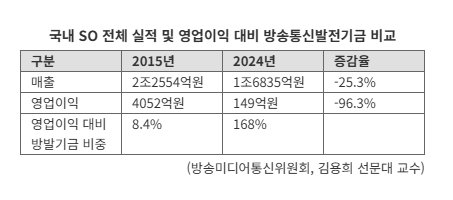
According to the Korea Cable TV Broadcasting Association, 90 SO operators posted 14.9 billion won in operating profit in 2024 and paid 25 billion won into the fund, meaning the burden reached 168% of operating profit. Another 38 loss-making SO operators recorded a combined operating loss of 117.8 billion won, yet still paid 9.52 billion won in the fund.■ Rate remains at 1.5% this year as well, with system reform under reviewThe collection rate applied to SO operators has not changed this year either. The Korea Communications Commission must notify operators of this year's fund payments by the end of the month, and it has been confirmed that SO operators received notices applying the same 1.5% rate of broadcasting service revenue as last year. The SO fund collection rate has not been adjusted once since 2017.
The Ministry of Science and ICT had previously considered lowering the SO collection rate from 1.5% to 1.3%, but the Korea Communications Commission, which took over the related duties after its launch in October last year, believes that reducing the rate for only one industry could create fairness issues. It has therefore shifted to reviewing ways to improve the fund system for broadcasters as a whole rather than cutting rates for a specific sector alone.
The SO industry is reportedly reviewing a range of responses, including administrative lawsuits. An industry official said, "We have continuously explained to the government the difficulties in the pay TV market and requested regulatory reform, but it has not led to any change."
Beyond the fund, content fees and regional channel regulations are also seen as issues that need reform. SO operators pay about 90% of their subscription fee revenue to PP providers as content fees, but they rely on annual negotiations among operators without clear standards for calculating compensation. They have also operated regional channels for 30 years, but because they are not included in regional broadcasting under current law, it is difficult for them to receive related support. Commentary and analysis, which are allowed on YouTube and other platforms, are also restricted.
An industry official stressed, "Cable TV is still subject to regulations that have remained in place for 30 years, but the market has already shifted rapidly toward digital and OTT platforms. The issues discussed by the public-private consultative body must not stop at discussion; they must lead to system reforms that fit the changed market environment."
[email protected] Choi Hye-rim Reporter