Why the Bank of Korea Was Wary of Demand Pressure: "It Could Lift Inflation by Another 0.4 Percentage Point"
- Input
- 2026-08-30 12:00:00
- Updated
- 2026-08-30 12:00:00

According to the Bank of Korea (BOK)'s report released on the 30th, titled "The Impact of Demand-Driven Inflationary Pressure on Core Inflation," in a "high-demand phase" where the GDP gap is positive and core inflation stays above 2.5% for at least two consecutive quarters, a 1 percentage point increase in the GDP gap lifts inflation for demand-sensitive items by 0.42 percentage point.
Given that demand-sensitive items account for 60% to 90% of core inflation, the increase in core inflation was estimated at 0.2 to 0.4 percentage point.
The estimate was derived using the Phillips curve, which shows the relationship between the GDP gap and inflation. It suggests that as the GDP gap rises, real GDP is moving further above potential GDP.
When the direct effect on core inflation was examined instead of this indirect approach, the figure came to 0.14 percentage point. Taken together, the findings mean that a 1 percentage point widening in the GDP gap can push core inflation up by 0.1 to 0.4 percentage point.
Since 2000, there have been four periods in which such demand-side pressure and strong core inflation appeared together in the Korean economy. The first was from the first quarter of 2002 to the fourth quarter of 2002, before the card crisis. The second lasted for more than a year from the second quarter of 2007, just before the Global Financial Crisis (GFC). The third was the recovery period in 2011. The last was the post-COVID-19 recovery period, from the first quarter of 2022 to the first quarter of 2024.
These periods were marked by strong consumption, pass-through of higher costs into prices, stronger comovement among individual items, and personal services leading the rise in core inflation.
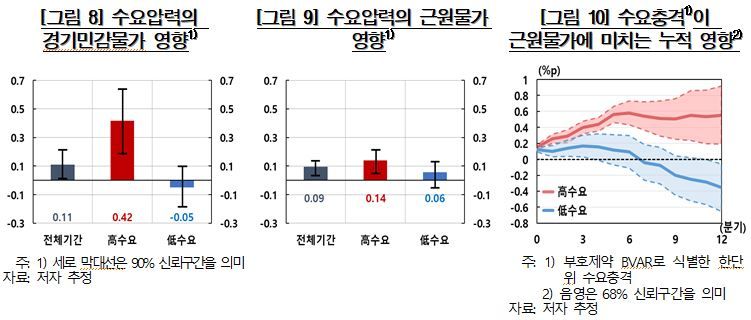
In addition to the GDP gap, gross domestic income, or GDI, was identified as another factor affecting core inflation. It was analyzed as creating stronger upward pressure than shocks based on actual GDP. In a high-demand environment, one unit of a GDI demand shock, or one standard deviation, was estimated to raise core inflation by an additional 0.05 to 0.2 percentage point.
Jung Won-seok, deputy head of the inflation trends team at the BOK's Research Department, explained, "An improvement in the terms of trade can generate additional demand pressure that is not captured by the GDP gap alone, as it expands consumption through higher real income and purchasing power, in addition to supporting production activity." He added, "However, if the increased income is saved or used to acquire assets, the pass-through to prices may be limited."
Jung also noted, "Core inflation in Korea is expected to remain elevated as demand pressure gradually expands." He added, "If core inflation rises above the mid-2% range, price comovement across items could intensify, allowing inflationary pressure to spread to a broader range of products."
These findings also help explain why the BOK's Monetary Policy Board raised the benchmark interest rate for the second straight meeting on the 27th, following the July increase. The key goal was to rein in inflation preemptively. The latest forecasts for core inflation were also revised up to 2.5% from 2.4% for this year and 2.3% for next year.
[email protected] Kim Tae-il Reporter