65 Transfer Centers to Be Built Nationwide by 2030, with Total Project Cost of 22.7533 Trillion Won
- Input
- 2026-08-30 11:00:00
- Updated
- 2026-08-30 11:00:00
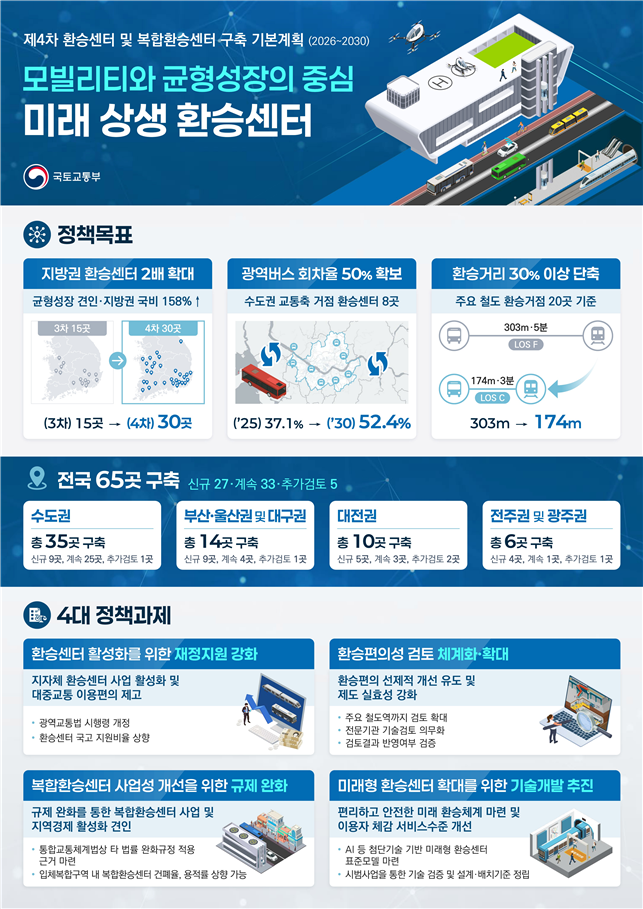
According to the Metropolitan Transport Commission under the Ministry of Land, Infrastructure and Transport on the 30th, the '4th Basic Plan for the Development of Transfer Centers and Integrated Transfer Centers (2026-2030)' was finalized after review by the National Transportation Committee. Of the total project cost, 137 billion won will come from the central government budget.
The plan sets three main goals: expanding transfer centers in regional areas, improving the turnaround rate of intercity buses in the Capital Region, and shortening transfer distances at major railway stations. It will also introduce a transfer system that combines artificial intelligence (AI) with future mobility.
By region, the plan calls for 30 sites in regional areas, double the 15 sites in the third plan. Related central government support will also rise from 17.3 billion won to 44.7 billion won. By area, there will be 14 sites in the Busan-Ulsan and Daegu regions, 10 in Daejeon, and 6 each in Jeonju and Gwangju.
The share of central government funding for new projects allocated to regional areas will also increase. Under the third plan, regional areas accounted for 16% of the budget, or 15.3 billion won, while the Capital Region accounted for 84%, or 81.4 billion won. Under the new plan, the figures have been adjusted to 59% for regional areas, or 32.2 billion won, and 41% for the Capital Region, or 22.8 billion won.
A total of 35 transfer centers will be developed in the Capital Region. To improve the operating efficiency of intercity buses entering central Seoul and Gangnam, eight hub transfer centers will be operated or newly built to serve nine major transport corridors. New hubs will be established at six locations, including Gimpo Airport Station, Chang-dong station, Sangbong Station, Daegok station, Yangjae station, and Sadang station.
The plan will also reduce the transfer burden for rail passengers. For 20 major high-speed and regional rail stations nationwide, it will seek to cut transfer distances and travel time by more than 30%.
To meet demand from intercity buses using highways, the government will also diversify the types of transfer centers. Depending on transport demand and location, it plans to create highway-linked transfer hubs divided into stop-type, rest-area-type, and terminal-type facilities.
A future-oriented transfer center tentatively named the 'AX Mobility Hub' will also be promoted to accommodate new transport modes such as deep underground rail and Urban Air Mobility (UAM). The government plans to develop technologies such as real-time congestion prediction and detection inside stations, walk-through fare payment, personalized route guidance, and parking robots, and apply them to pilot projects.
Kim Yong-seok, chair of the Metropolitan Transport Commission, said, "Through the implementation of the 4th Basic Plan for Transfer Centers, we will substantially address the inconveniences people experience in daily transfers and create a 'mutually beneficial transport transfer system' that provides growth momentum for regional areas and mobility efficiency for the Capital Region."
[email protected] Choi Ga-young Reporter