Asia-Pacific climate practitioners hold BTR2 hands-on training in Jeju, with ESS program to follow next week
- Input
- 2026-08-29 13:25:05
- Updated
- 2026-08-29 13:25:05
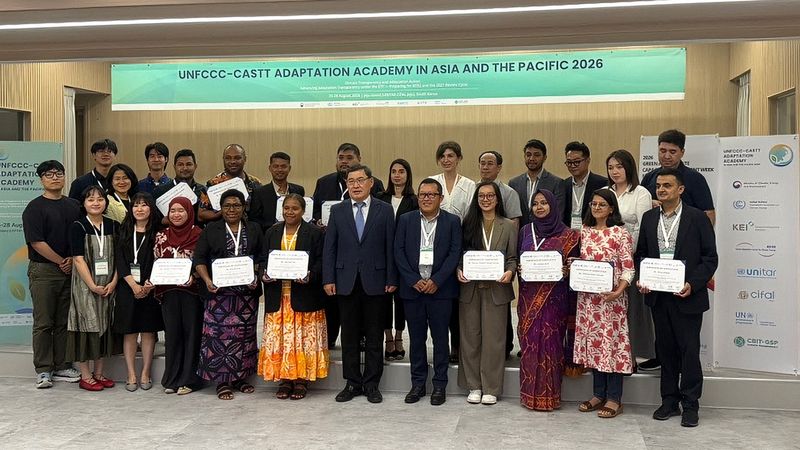
[Financial News Jeju = Jung Yong-bok] Climate policy practitioners from developing countries in the Asia-Pacific have completed a four-day hands-on training course in Jeju to prepare for the second biennial transparency report (BTR2) and international review. The program focused on how countries facing the year-end BTR2 submission deadline can measure their climate adaptation results and explain them to the international community.
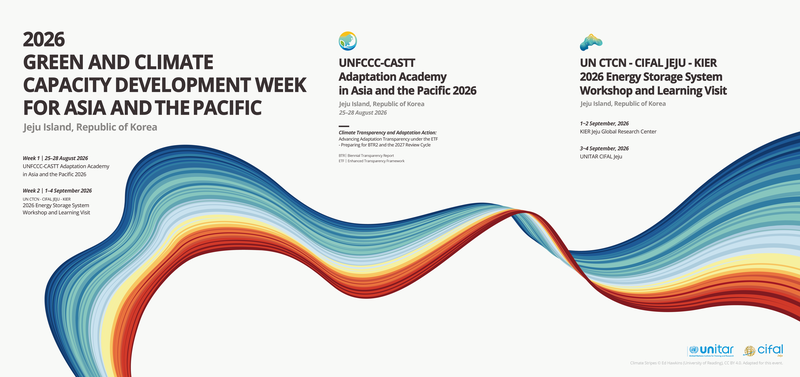
According to the UNITAR Jeju International Training Center on the 29th, the 2026 Asia and Pacific UNFCCC-CASTT Adaptation Academy was held from the 25th to the 28th at the UNITAR Jeju International Training Center in Seogwipo City.
The event was hosted by the Ministry of Climate, Energy and Environment and co-organized by the secretariat of the United Nations Framework Convention on Climate Change (UNFCCC), the Korea Environment Institute's National Climate Crisis Adaptation Center, the UNITAR Jeju International Training Center, and the Copenhagen Climate Centre of the United Nations Environment Programme. It was supported by the Ministry of Foreign Affairs and Jeju Special Self-Governing Province, and about 20 government officials, policy practitioners, and experts from developing countries in the Asia-Pacific took part.
The core of the training was how each country can demonstrate and report its climate policy achievements in line with the Paris Agreement's Enhanced Transparency Framework (ETF).
The ETF requires countries to disclose and undergo review of their greenhouse gas emissions, reduction performance, climate adaptation measures, and support status in accordance with international standards. The BTR is the framework's key report, submitted every two years to present each country's climate response results to the international community.
The deadline for submitting BTR2, the second report, is December 31. After submission, technical expert review and the multilateral consideration of progress will follow.
The curriculum was also designed around actual report writing and review responses.
On the first day, the program covered climate adaptation, the ETF system, and BTR adaptation reporting, along with AI- and data-based report writing methods. It also taught participants how to use generative AI tools such as ChatGPT and Claude as aids for structuring documents, drafting, summarizing, and translating.
The principle was clear. Rather than inserting AI-generated sentences directly into reports, participants were taught to verify the original data, legal and policy documents, and statistical figures before using them. The training also included a separate verification process to check evidence, numbers, wording, and risk factors step by step.
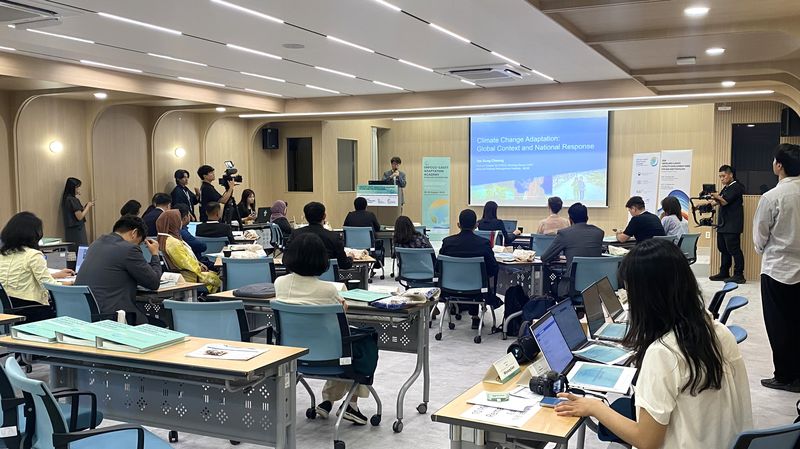
On the second day, participants shared BTR writing experience and focused on how to report loss and damage from climate disasters and what indicators and evidence should be used to present adaptation outcomes. They also discussed ways to connect different reporting systems, such as national adaptation plans and BTRs, and shared Korea's experience in preparing and reviewing BTRs.
On the third day, the program examined how national adaptation plans can serve as the basis for continuous adaptation reporting, and it included a special session and field learning on Jeju's climate crisis cases.
The final day was run as a practical assessment. Participants drafted the adaptation section of a BTR themselves and checked the clarity, consistency, and review readiness of their reports. They also took part in a mock exercise simulating technical expert review and the facilitative multilateral consideration of progress.
Since 2021, UNFCCC and related institutions have operated the CASTT Adaptation Academy and trained more than 200 experts from developing countries in the Asia-Pacific. This year's course was designed as an advanced program to reflect issues identified during the preparation and review of the first BTR in BTR2 and the 2027 reporting and review cycle.
Jeju's international climate training schedule will continue next week as well.
From September 1 to 4, the UN Climate Technology Centre and Network (CTCN), the UNITAR Jeju International Training Center, and the Korea Institute of Energy Research (KIER) will hold an international workshop and technical field trip on energy storage systems (ESS).
In Jeju, the program will focus on renewable energy and ESS technology, grid integration, policy and financial support, and joint research and development, centered on the KIER Jeju Global Research Center and the UNITAR Jeju International Training Center. Field learning sessions on the Jeju Energy Nuri Madang and battery energy storage systems (BESS) are also planned.
Following the first week's program on climate policy reporting capacity, the second week will broaden the scope to practical energy technology and research cooperation.
Attention is also on whether the UNITAR Jeju International Training Center can expand its role from hosting individual international events to becoming an Asia-Pacific capacity-building platform that links climate policy and technology training.
Shin Seong-cheol, Director of the UNITAR Jeju International Training Center, said, "I hope this becomes an opportunity for developing countries to build the practical capacity needed to respond to increasingly complex requirements for implementing international environmental agreements."
[email protected] Jung Yong-bok Reporter