KMI Conducts On-Site Survey of Jeju Offshore Wind Farms, Seeks Solutions for Fishing, Angling and Benefit Sharing
- Input
- 2026-08-29 12:01:16
- Updated
- 2026-08-29 12:01:16
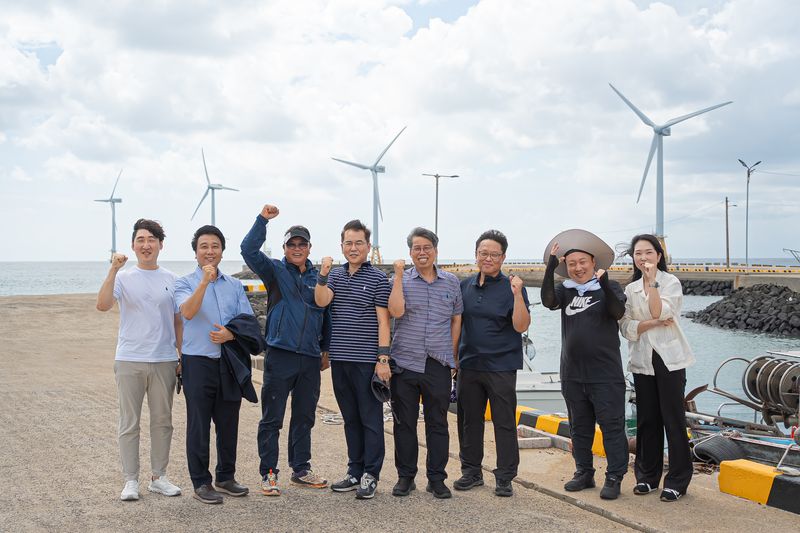
[Financial News, Jeju Province = Reporter Jung Yong-bok] Field research has begun to find ways to reduce conflicts between offshore wind power development and existing uses of the sea, such as fishing and angling, while returning some of the project’s benefits to fishing communities. As the government pushes to introduce a fishers-centered benefit-sharing model alongside site selection for offshore wind power, a state-run research institute went directly into the waters off Jeju’s wind farms to examine fishery resources, the marine environment and safety management conditions.
According to KMI on the 29th, President Jo Jeong-hee and researchers from the Fisheries Research Division boarded a fishing boat on the 27th and surveyed the waters around the Jeju Hallim Offshore Wind Power Plant and the Tamna offshore wind farm.
The researchers checked how fishers and anglers use the sea around the wind power facilities and examined changes in fishery resources, the marine environment and safety management issues.
One of the key issues in expanding offshore wind power is how to share the same marine space between fishers, who have long used it first, and new power generation projects. Once wind turbines are installed, fishing and navigation conditions can change, and access and safety issues may arise for anglers. How benefits are distributed to local residents in proportion to the burdens created by the project also affects whether the project is accepted.
The government is also treating this issue as a major task in offshore wind policy. The Ministry of Oceans and Fisheries (MOF) plans to establish a benefit-sharing model involving fishers and producer groups while supporting the designation of planned sites under the Offshore Wind Promotion Act this year. It is also separately advancing analysis of offshore wind site information and impact assessments.
That is why the Jeju field survey focused not on the facilities themselves, but on the people who use the sea.
Around the Hallim and Tamna offshore wind farms, the possibility that the turbine substructures, known as jackets, could function similarly to artificial reefs was also included in the research.
Artificial reefs are structures installed underwater to attract fish and provide habitats for marine life. There are observations that marine organisms may attach to offshore wind substructures and fish may gather around them, but the actual effects on fishery resources and changes in the marine environment require objective study. In this survey, KMI focused on verifying on-site conditions and the impact on fishery resources and the marine environment, rather than assuming an artificial reef effect.
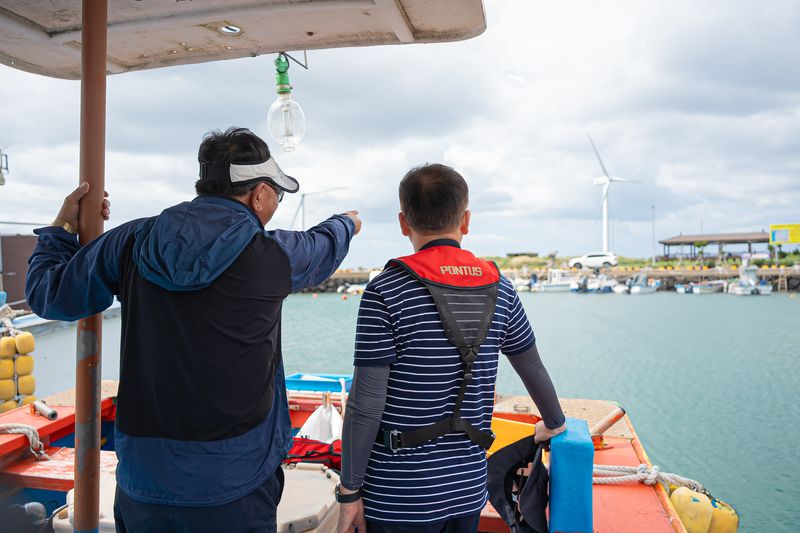
Safety issues linked to the increase in anglers were also reviewed. The waters around the Hallim and Tamna offshore wind farms are known as a popular spot for anglers. At a government briefing to the National Assembly in December last year, the need to investigate angling activity around offshore wind facilities and safety management measures was also raised.
KMI researchers checked fishing, angling and vessel use around the facilities and reviewed safety management measures that may be needed in the future.
After the field survey, the team met with residents of the Dumo fishing village community in Jeju City’s Hangyeong-myeon. The researchers heard concerns and opinions from local residents, including Ko Dae-bok, about the use of the waters around the wind facilities, and discussed ways to share the benefits generated by offshore wind projects with the local community.
Local benefit sharing will be a key factor in determining the pace of offshore wind expansion. Offshore wind is seen as a necessary power source for expanding the nation’s renewable energy supply, but areas where power facilities and transmission infrastructure are built have repeatedly seen conflicts over fishing rights, scenery, the marine environment and public acceptance.
Ways to return part of the power generation revenue to residents or fishers can take many forms, including dividends, resident investment and local funds, so designs suited to each region’s conditions and interests are needed.
Based on this Jeju survey and residents’ views, KMI plans to review policy tasks that would allow offshore wind power and fishing and angling to coexist in the same marine space. The institute aims to verify impacts on fishery resources and the marine environment with objective data, while also examining the scope of fishing and angling activity, safety management and local benefit-sharing measures.
The key question going forward is whether the field survey will lead to concrete institutional design. In particular, securing long-term data on changes in fishery resources around the facilities and on fishing activity, and establishing benefit-sharing standards that residents can actually feel, will be essential to reducing conflicts during offshore wind expansion.
KMI President Jo Jeong-hee said, "For the sustainable expansion of offshore wind power, it is important to closely examine how the surrounding waters are being used for fishing and angling, and to faithfully reflect the voices of local communities in policy." He added, "We will prepare effective policy measures that allow offshore wind power, the fisheries sector and local communities to coexist, and actively support the government’s policy-making."
[email protected] Jung Yong-bok Reporter