"Why must my daughter die?" The anguished cry of a bereaved family after a nurse's death from workplace bullying [Recorder from the Margins]
- Input
- 2026-08-30 06:00:00
- Updated
- 2026-08-30 06:00:00
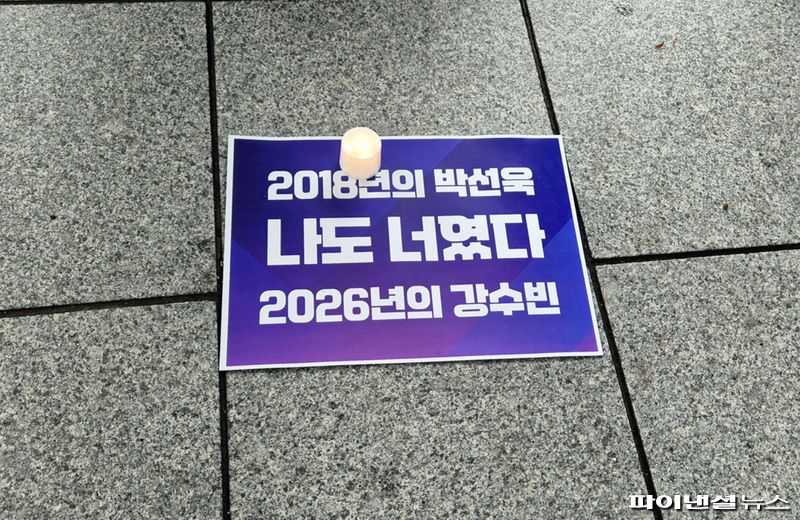
The names of nurses and health care workers who died while working in hospitals after being subjected to workplace bullying were once again read aloud in Gwanghwamun. "Taeum" refers to a hospital culture and staffing structure that cannot be explained simply as a personal conflict. A bereaved family member at the scene broke down in tears, pleading for the return of her daughter’s life. At the memorial ceremony for nurses who died from workplace bullying, we listened to the voices of bereaved families, nurses, and nursing students.
[Financial News] "How long do nurses have to keep dying?" "Why does my daughter's name have to appear as deceased?"
A bereaved family member of the late nurse Kang Subin, whom we met at the "I Was You 2026" memorial ceremony for nurses who died from workplace bullying held on the 22nd in front of the Kyobo Building in Gwanghwamun, Jongno-gu, Seoul, said this. The ceremony was a place to read aloud the names of nurses and health care workers who died while working in hospitals.
The bereaved family member looked at the names displayed at the venue and eventually burst into tears. "I still can't believe it," the family member said, urging, "Please, the government must solve this problem."
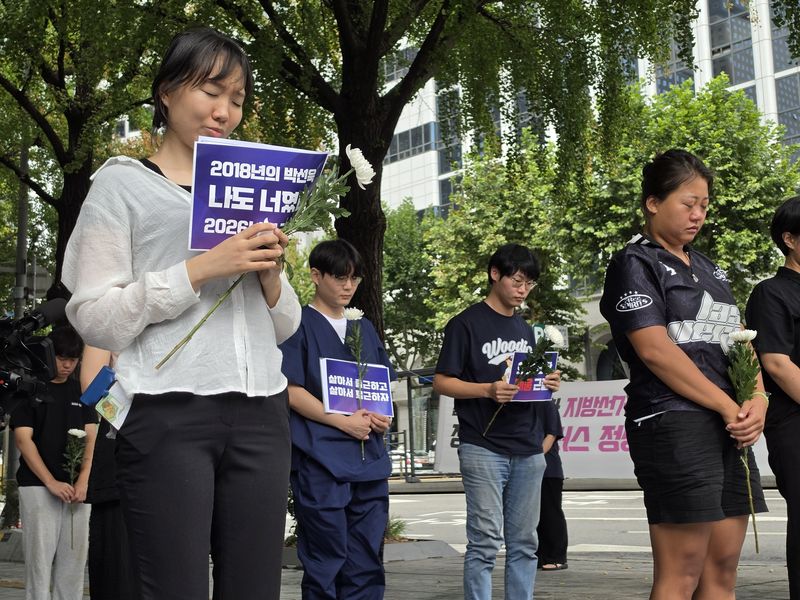
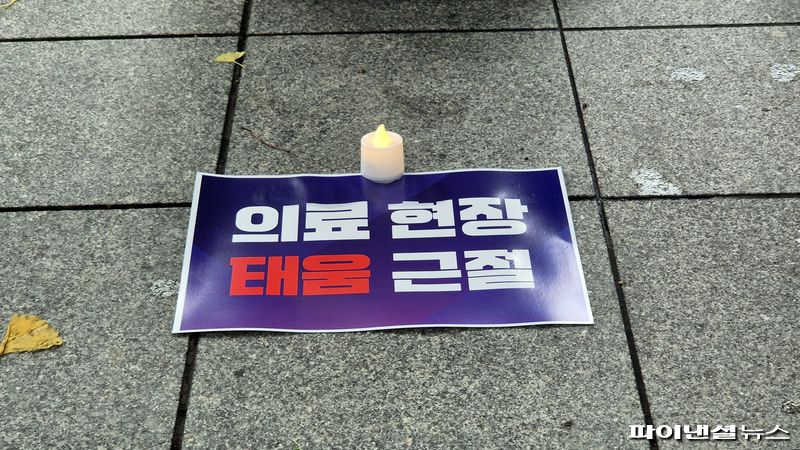
Nurses and nursing students attended the memorial ceremony that day. Participants laid white chrysanthemums and paid tribute to their deceased colleagues. Signs at the venue read, "Nurses are people too," "Let's go to work alive and come home alive," and "End workplace bullying in medical settings."
Participants called out the names of the late nurses Park Seon-uk, Seo Ji-yoon, Kang Subin, and the late radiologic technologist Lim Ga-hyeon one by one. Each time a name was read, silence fell over the venue.
The bereaved family member pointed to low levels of accountability and punishment as the reason workplace bullying keeps recurring. "It keeps happening because there is no strong punishment," the family member said angrily. "Even if you say you're going to change the structure or do something, the punishment is too weak, so they just keep doing it."
The bereaved family member again called for tough punishment. "Strong punishment, revoking licenses..." the family member said through tears. The point was that if responsibility is not clearly assigned even when abuse inside hospitals is confirmed, the same problems can repeat.
The bereaved family member also expressed concern that the victims' suffering fades from memory over time. "If this just gets buried, the same thing will keep happening," the family member said. "That is what hurts the most."
"Taeum" is a term used to describe workplace bullying in hospitals. In addition to verbal abuse, humiliation, and ostracism, excessive workloads and blocking questions are also cited as serious problems. Participants said taeum should not be treated merely as a personality issue between senior and junior staff or as a personal conflict.
When wards are understaffed, the remaining nurses are burdened with more work whenever a vacancy arises. Training for new nurses is also often handled by existing staff. As work and training burdens grow at the same time, conflict among nurses can intensify.
Participants pointed out that unless workload, staffing, and new nurse training systems are examined together, the focus may remain only on the behavior of a particular nurse. If bullying is treated as a problem between individuals, the situation can end with the victim leaving the workplace.
A nurse who worked at a medical center and spoke out about taeum described leaving the hospital after enduring verbal abuse from a senior nurse. The nurse said that if a case ends with the person who raised the issue leaving the workplace, the hospital organization may repeat the same problem.
Nurses also called for accountability from managers. They said it is necessary to check whether the victim and the perpetrator are separated when a bullying report is filed, whether the nurse who reported it suffers disadvantages in work or training, and whether secondary harm occurs during the investigation.
Nursing students said it is difficult to speak up even when they experience unfair treatment during clinical practice. They worry it could hurt their evaluation or future employment. They explained that even when assigned unrelated tasks or given unreasonable instructions, they tend to hold back from raising objections.
Amid these concerns, the government signed a memorandum of understanding on the 13th with six organizations, including the Ministry of Employment and Labor (MOEL), the Ministry of Health and Welfare (MOHW), the Korean Hospital Association, and the Korean Nurses Association. The parties agreed to operate a consultative body to reduce workplace bullying in the health care sector and improve hospital culture.
The government plans to conduct special inspections at hospitals for nurses with less than three years of experience. It will examine new nurse training methods, organizational culture, shift work, and staffing shortages, and will also check whether victims are properly protected after bullying is reported.
Hospitals found to have serious problems in the inspection results will be recommended for organizational culture improvement consulting. If a hospital refuses the consulting, the government is also considering linking the case to labor inspections. It also plans to strengthen counseling for nurses and support procedures for victims.
The health and welfare sector is one of the industries with the highest rates of workplace bullying experience and reporting. In a 2024 survey, the rate of workplace bullying experience in the health and welfare sector was 25 percent, the highest among all industries. In 2025, the reporting rate for workplace bullying cases was also the highest by industry at 16 percent.
The taeum problem has repeated itself for years. Even after the deaths of the late nurse Park Seon-uk in 2018 and the late nurse Seo Ji-yoon in 2019, nurses continued to raise concerns about staffing shortages, hierarchical workplace culture, and the lack of victim protection procedures. After the deaths of the late nurse Kang Subin and the late radiologic technologist Lim Ga-hyeon this year, the same demands were raised again.
After the death of the late nurse Seo Ji-yoon, the Seoul Metropolitan Government formed a fact-finding committee to investigate the hospital's staffing arrangements, work schedules, and personnel and labor systems. The investigation involved 867 nurses, and 296 survey responses were analyzed. Interviews were also conducted with 102 people, including bereaved families, colleagues, nursing department staff, labor union members, and Seoul Metropolitan Government officials.
The fact-finding committee recommended improvements to the practice of shifting staffing gaps onto existing nurses, as well as to the shortage of replacement workers and unreasonable shift assignments. It said that when bullying occurs, the focus should not be limited to mediating conflict between the parties, but should also include workload, staffing, and managerial responsibility.
Nurses who gathered in Gwanghwamun said the special inspection should not end with a report of findings. They called for confirmation that hospital staffing, new nurse training, and victim protection procedures after reporting are actually being followed in the field.
The bereaved family member said on the day, "Please don't let this remain just as a truly heartbreaking incident," and urged responsible action so that the same harm does not happen again.
We record the stories of real lives in print. Even if rough around the edges, we capture the words gathered on the scene as they are. From alleyways and markets to someone's workplace, the record of an ordinary day that we may have passed by comes to you, our readers. If you would like to follow [Recorder from the Margins] easily, please subscribe to the reporter page.