"I thought I was asking a human" Air conditioner breakdowns fixed in a flash... AI enters daily life [AI Sapiens - Questioning Intellectual Sovereignty 1]
- Input
- 2026-08-30 08:00:00
- Updated
- 2026-08-30 08:00:00

Photo = ChatGPT Generative AI has entered our daily lives, extending beyond search and summarization to writing, organizing materials, scheduling, and problem-solving. The special feature [AI Sapiens: Questioning Intellectual Sovereignty] examines in turn how the advancement of AI technology is changing human questioning, memory, and judgment methods. In Part 1, we traced the evolution from rule-based AI to generative and reasoning AI, and then to AI agents, assessing just how close AI has come to human problem-solving methods.
[Financial News] #. When Mr. A, an office worker in his 40s, found his home air conditioner not working over the weekend, he entered the message displayed on the AI screen along with the situation inside his house.
Photo = ChatGPT Generative AI has entered our daily lives, extending beyond search and summarization to writing, organizing materials, scheduling, and problem-solving. The special feature [AI Sapiens: Questioning Intellectual Sovereignty] examines in turn how the advancement of AI technology is changing human questioning, memory, and judgment methods. In Part 1, we traced the evolution from rule-based AI to generative and reasoning AI, and then to AI agents, assessing just how close AI has come to human problem-solving methods.The AI suggested a solution and instructed him to check the power status, remote control settings, and outdoor unit operation status in order. Each time Mr. A entered the results of his inspection, the AI changed the item to check next.Instead of having multiple search results open and checking them one by one, Mr. A continued the conversation with the AI. The method involved the AI categorizing possible causes based on a description of symptoms and then presenting the next question based on the verification results."In the past, I had to search for similar cases to pinpoint the cause myself, but this time, as I answered the questions, I could see the process of narrowing down the causes," said Mr. A. The reason AI appears human-like is not solely because it constructs sentences naturally.
It is because the process of interpreting the user's questions, asking for additional information, and modifying answers based on input conditions has become similar to human problem-solving methods. From AI that created words to AI that solves problems Early artificial intelligence operated according to rules pre-entered by humans. It was a method that produced a fixed answer when established conditions were met.
Photo = ChatGPT Generative AI has entered our daily lives, extending beyond search and summarization to writing, organizing materials, scheduling, and problem-solving. The special feature [AI Sapiens: Questioning Intellectual Sovereignty] examines in turn how the advancement of AI technology is changing human questioning, memory, and judgment methods. In Part 1, we traced the evolution from rule-based AI to generative and reasoning AI, and then to AI agents, assessing just how close AI has come to human problem-solving methods.
If unexpected situations arose, humans had to add or modify the rules. However, with the advent of machine learning, AI began to find patterns by learning from vast amounts of data rather than simply following rules entered by humans. Representative features include distinguishing objects in photos, converting speech to text, and recommending products the user is likely to like.
Photo = ChatGPT Generative AI has entered our daily lives, extending beyond search and summarization to writing, organizing materials, scheduling, and problem-solving. The special feature [AI Sapiens: Questioning Intellectual Sovereignty] examines in turn how the advancement of AI technology is changing human questioning, memory, and judgment methods. In Part 1, we traced the evolution from rule-based AI to generative and reasoning AI, and then to AI agents, assessing just how close AI has come to human problem-solving methods.Generative AI has added the ability to handle language to this. Even if the user does not complete the question, it estimates the meaning based on the surrounding context and generates the necessary content into a sentence. It has also become possible to summarize data or explain information by comparing various pieces of data.
The method of providing answers has also changed. Even for the same question, the scope and order of the explanation change depending on additional information entered by the user. This is why it appears as though the AI is creating new answers based on the conversation rather than simply retrieving stored responses.
Recently, inference models have emerged. Rather than providing an immediate answer, this method involves breaking down a problem into multiple parts, calculating each condition, and then combining the results. In the case of a math problem, conditions are separated, calculations are performed, and then the preceding and subsequent results are compared.
Humans also divide conditions first, compare possible causes, and then verify the results when solving complex problems. As AI processes a similar sequence of tasks within conversational responses, its resemblance to human thought processes has grown. AI Increases Calculations in Face with Difficult Problems [Boston=AP/Newsis] The OpenAI logo is visible on a mobile phone while the ChatGPT homepage is displayed on a computer screen.
March 17, 2023. /Photo=Newsis The changes in inference models are also confirmed in actual evaluation results. Although processing time and costs increase as more computational resources are used to generate answers, it achieved higher scores than existing models on problems requiring multi-step calculations.
Photo = ChatGPT Generative AI has entered our daily lives, extending beyond search and summarization to writing, organizing materials, scheduling, and problem-solving. The special feature [AI Sapiens: Questioning Intellectual Sovereignty] examines in turn how the advancement of AI technology is changing human questioning, memory, and judgment methods. In Part 1, we traced the evolution from rule-based AI to generative and reasoning AI, and then to AI agents, assessing just how close AI has come to human problem-solving methods.
4% in the International Mathematical Olympiad preliminary exam. 3%. The same report analyzed that the cost of using o1 is about six times higher than GPT-4o, and the time it takes to produce an answer is about 30 times longer.
Photo = ChatGPT Generative AI has entered our daily lives, extending beyond search and summarization to writing, organizing materials, scheduling, and problem-solving. The special feature [AI Sapiens: Questioning Intellectual Sovereignty] examines in turn how the advancement of AI technology is changing human questioning, memory, and judgment methods. In Part 1, we traced the evolution from rule-based AI to generative and reasoning AI, and then to AI agents, assessing just how close AI has come to human problem-solving methods.Photo = ChatGPT Generative AI has entered our daily lives, extending beyond search and summarization to writing, organizing materials, scheduling, and problem-solving. The special feature [AI Sapiens: Questioning Intellectual Sovereignty] examines in turn how the advancement of AI technology is changing human questioning, memory, and judgment methods. In Part 1, we traced the evolution from rule-based AI to generative and reasoning AI, and then to AI agents, assessing just how close AI has come to human problem-solving methods.
In 'FrontierMath,' which evaluates advanced mathematical reasoning abilities, the percentage of problems solved by AI was only 2%. 5%.
The score presented based on human standards in this evaluation was 97%. The results of these three evaluations demonstrate that AI does not handle all intellectual tasks at the same level.
It is difficult to evaluate the ability to answer questions similar to previously learned material and the ability to interpret the conditions of an unfamiliar problem and select a solution in the same way. However, it is also difficult to view reasoning AI merely as a simple search tool.
The model separates the conditions included in the question, modifies the answer according to the calculation process, and re-checks parts with potential errors. Observing this process, users may feel that the AI thinks like a human before coming up with an answer.
AI Taking on tasks beyond just answers The role of AI is expanding from generating answers to performing tasks. A representative example is AI agent technology, which identifies the user's purpose, breaks down necessary tasks into multiple steps, and carries out external operations such as searching, calculations, and document creation.
When requesting existing generative AI to "write a business trip email," it often stopped at creating a draft. AI agents, however, can operate by verifying the travel schedule, recipient, and necessary materials, organizing the content to be included in the email, and then requesting user approval.
Photo = ChatGPT Generative AI has entered our daily lives, extending beyond search and summarization to writing, organizing materials, scheduling, and problem-solving. The special feature [AI Sapiens: Questioning Intellectual Sovereignty] examines in turn how the advancement of AI technology is changing human questioning, memory, and judgment methods. In Part 1, we traced the evolution from rule-based AI to generative and reasoning AI, and then to AI agents, assessing just how close AI has come to human problem-solving methods.
In this process, identifying the goal, setting the task order, searching for information, and modifying results proceed in sequence. The function of answering user questions has expanded into a task aimed at achieving a specific objective.
Photo = ChatGPT Generative AI has entered our daily lives, extending beyond search and summarization to writing, organizing materials, scheduling, and problem-solving. The special feature [AI Sapiens: Questioning Intellectual Sovereignty] examines in turn how the advancement of AI technology is changing human questioning, memory, and judgment methods. In Part 1, we traced the evolution from rule-based AI to generative and reasoning AI, and then to AI agents, assessing just how close AI has come to human problem-solving methods.Photo = ChatGPT Generative AI has entered our daily lives, extending beyond search and summarization to writing, organizing materials, scheduling, and problem-solving. The special feature [AI Sapiens: Questioning Intellectual Sovereignty] examines in turn how the advancement of AI technology is changing human questioning, memory, and judgment methods. In Part 1, we traced the evolution from rule-based AI to generative and reasoning AI, and then to AI agents, assessing just how close AI has come to human problem-solving methods.
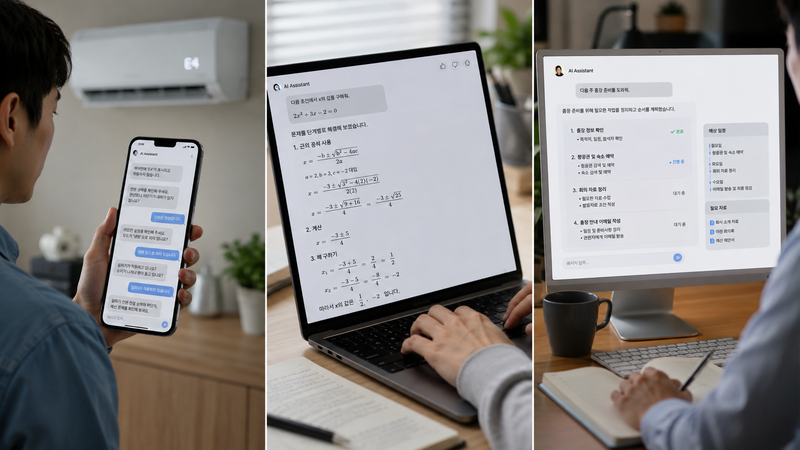
The Korea Information Society Development Institute (KISDI) report, "The Rise of AI Agents and Policy Challenges," explains that generative AI is evolving from "answering AI," which generates information, to "acting AI," equipped with problem-solving and execution capabilities. The report analyzes that AI agents are expanding into technology that performs decision-making, learning, and task coordination based on user demands.
It is difficult to explain how similar AI has become to humans based solely on a single test score. In their 2024 paper, "Levels of AGI to Measure Progress in the Path of AGI Development," researchers at Google DeepMind also proposed a framework for evaluating the advancement of artificial general intelligence by dividing it into performance, generality, and autonomy.
The ability to solve mathematical problems with high accuracy, generality—answering questions across various fields—and autonomy—planning and continuing tasks without user instructions—are distinct categories. This is why it is difficult to conclude that an AI that has achieved high performance in a specific field thinks in the same way as a human in all fields.
AI that asks and answers like a human The statement that AI is becoming like human thought does not mean it possesses consciousness or emotions identical to humans. Currently, AI calculates the relationships between language and information from large-scale training data and constructs the sequence of answers based on input conditions.
The change that users experience lies in the fact that this calculation process is presented in a conversational format. After reading a question, the AI asks for necessary information again, breaks down the answer into multiple steps, and modifies the explanation when new input is received.
Photo = ChatGPT Generative AI has entered our daily lives, extending beyond search and summarization to writing, organizing materials, scheduling, and problem-solving. The special feature [AI Sapiens: Questioning Intellectual Sovereignty] examines in turn how the advancement of AI technology is changing human questioning, memory, and judgment methods. In Part 1, we traced the evolution from rule-based AI to generative and reasoning AI, and then to AI agents, assessing just how close AI has come to human problem-solving methods.
As a sequence similar to a human problem-solving process is displayed on the screen, the way AI operates appears closer to human thinking than before. When Mr.
Photo = ChatGPT Generative AI has entered our daily lives, extending beyond search and summarization to writing, organizing materials, scheduling, and problem-solving. The special feature [AI Sapiens: Questioning Intellectual Sovereignty] examines in turn how the advancement of AI technology is changing human questioning, memory, and judgment methods. In Part 1, we traced the evolution from rule-based AI to generative and reasoning AI, and then to AI agents, assessing just how close AI has come to human problem-solving methods.Photo = ChatGPT Generative AI has entered our daily lives, extending beyond search and summarization to writing, organizing materials, scheduling, and problem-solving. The special feature [AI Sapiens: Questioning Intellectual Sovereignty] examines in turn how the advancement of AI technology is changing human questioning, memory, and judgment methods. In Part 1, we traced the evolution from rule-based AI to generative and reasoning AI, and then to AI agents, assessing just how close AI has come to human problem-solving methods.
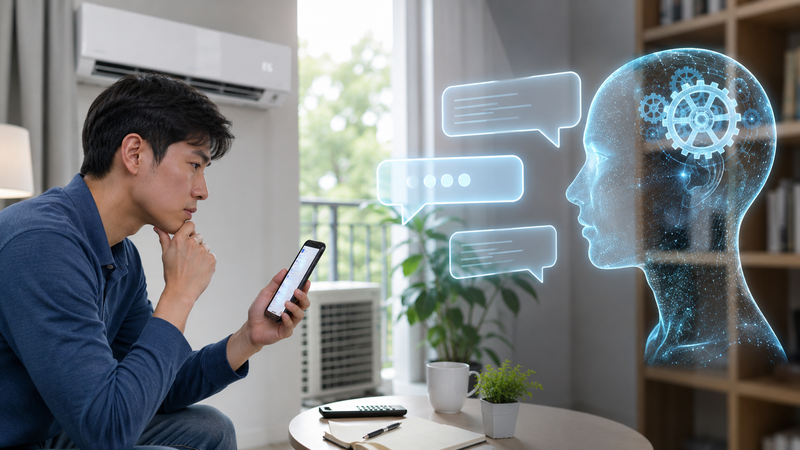
A was trying to solve an air conditioner problem, the AI asked about the text on the display, the power status, and whether the outdoor unit was operating in sequence. Although the AI did not physically inspect the air conditioner, it narrowed down possible causes and adjusted the next inspection items based on the information Mr.
A entered. The user provided the information necessary for the problem-solving process while simultaneously reading the AI's responses.
Experts explain that AI is evolving beyond the technology of simply constructing sentences to a stage where it acquires knowledge and communicates in a manner similar to humans. Lee Kyung-sun, a research fellow at the Digital Platform Economy Research Division of KISDI who analyzed changes in AI technology and the development of AI agents, described the characteristics of generative AI as "human-like knowledge acquisition and communication capabilities, as well as general reasoning abilities.
" Research Fellow Lee stated that generative AI performs "interpretation of relationships between data and logical inference" to achieve the goals presented by humans.
[email protected] Han Seung-gon Reporter